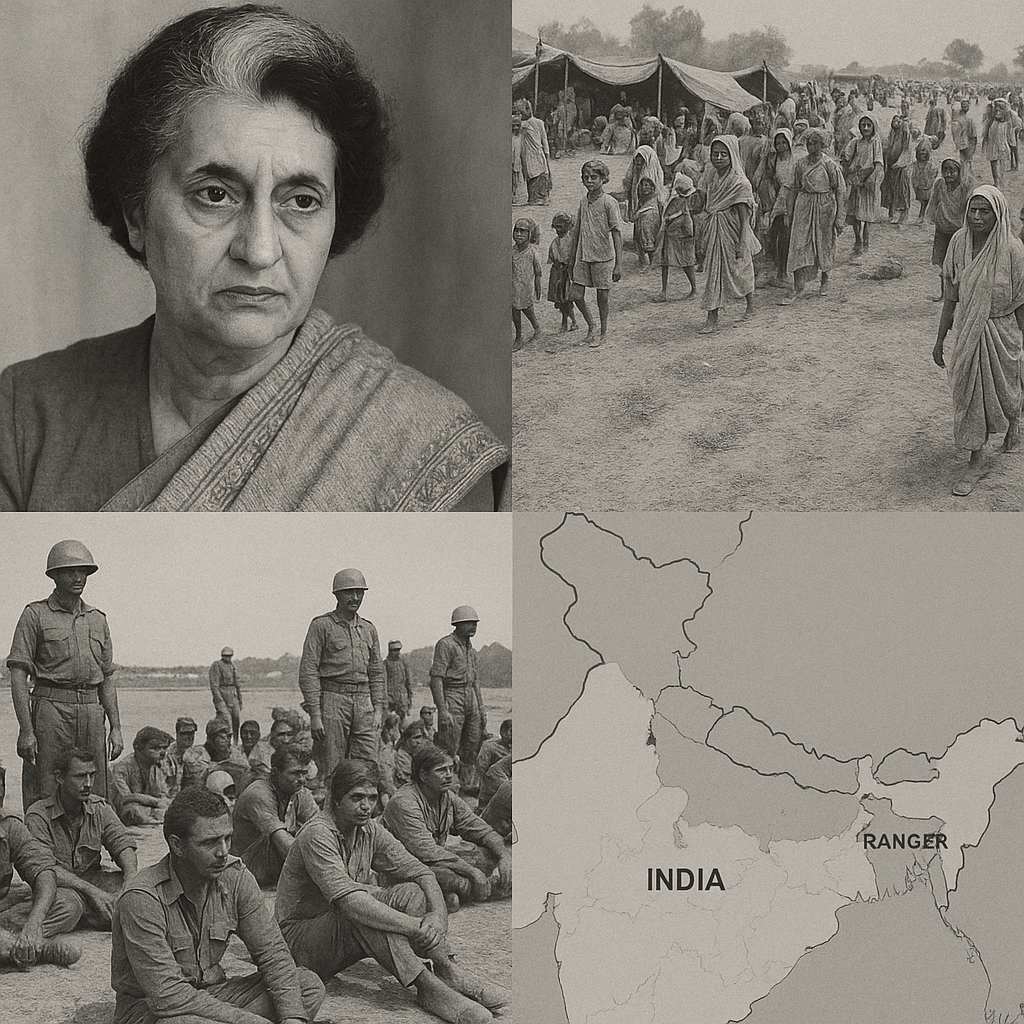
Today, as India reflects on its historical milestones, the 1971 India-Pakistan War remains a defining moment in the nation’s geopolitical journey. Led by Smt. Indira Gandhi, India’s decisive intervention resulted in the creation of Bangladesh, a humanitarian triumph that reshaped South Asia. However, debates persist over whether India could have secured greater strategic gains, such as annexing the Rangpur area to widen the Siliguri Corridor—transforming the “Chicken’s Neck” into a “Chicken’s Chest”—and ensuring the return of its soldiers still missing in Pakistan. This article examines the war’s outcomes, evaluates the decision to forego territorial annexation, and explores the unresolved issue of Indian POWs, assessing the long-term implications for India.
The 1971 War and Bangladesh Liberation
In 1971, East Pakistan (now Bangladesh) faced brutal repression after the Awami League’s electoral victory was denied by West Pakistan’s military regime. The ensuing crackdown, which killed an estimated 300,000 to 3 million people, triggered a humanitarian crisis, with 10 million refugees fleeing into India, primarily West Bengal, Assam, and Tripura. Smt. Indira Gandhi, recognizing both the humanitarian imperative and strategic opportunity, supported the Mukti Bahini (Bangladesh liberation forces) with military training, arms, and diplomatic backing. Following months of preparation, India intervened militarily in December 1971, leading to a 13-day war that ended with Pakistan’s surrender on December 16, 1971. The war resulted in the creation of Bangladesh and the capture of 93,000 Pakistani soldiers as prisoners of war (POWs)—one of the largest military surrenders in modern history.
Humanitarian and Strategic Triumph
- Refugee Crisis Resolution: The war alleviated the burden of 10 million refugees on India, with over 90% returning to Bangladesh by 1973, reducing economic and social strain.
- Weakening Pakistan: The division of Pakistan into two nations diminished its military threat, eliminating its two-front strategy against India.
- Global Recognition: India’s intervention earned international praise for halting a genocide, enhancing its soft power. The Indo-Soviet Treaty of 1971 ensured Soviet support, countering US and Chinese opposition.
- Regional Influence: The 1972 India-Bangladesh Treaty of Friendship initially solidified Bangladesh as a friendly neighbor, giving India a strategic buffer against Pakistan.
The Chicken’s Neck Dilemma: Should India Have Taken Rangpur?
The Siliguri Corridor, a narrow strip (20–40 km wide) connecting India’s mainland to its northeastern states, is a strategic vulnerability known as the “Chicken’s Neck.” Bordered by Nepal, Bhutan, and Bangladesh, it is susceptible to being severed in a conflict, particularly by China via the Chumbi Valley, 130 km away. Some strategists argue that India, at the peak of its post-1971 influence, could have annexed the Rangpur area in northern Bangladesh to widen this corridor into a “Chicken’s Chest,” enhancing security and connectivity.
Potential Benefits of Annexation
- Strategic Depth: Widening the corridor would have reduced the risk of the Northeast being isolated in a conflict. In 2025, with China’s military buildup in the Chumbi Valley and border tensions (e.g., post-2020 Galwan clash), this vulnerability remains a concern. A broader corridor would have improved military logistics, crucial for addressing insurgencies like the ongoing Naga peace talks.
- Economic Integration: Enhanced connectivity would have boosted trade and infrastructure in the Northeast, a region lagging economically. The 2025 Economic Survey notes the Northeast’s GDP growth at 5.2%, below the national average of 6.8%, partly due to connectivity bottlenecks.
- Geopolitical Leverage: With 93,000 Pakistani POWs in custody and Bangladesh’s gratitude under Sheikh Mujibur Rahman, India could have negotiated territorial adjustments as a mutual security arrangement, offering economic or diplomatic concessions in return.
Challenges and Risks
- Diplomatic Fallout: Annexing Rangpur would have contradicted India’s humanitarian narrative, risking its global image as a defender of self-determination. It would have violated the 1972 India-Bangladesh Treaty of Friendship, potentially turning Bangladesh into a resentful neighbor.
- International Backlash: The US and China, already hostile during the Cold War, could have rallied global opposition, isolating India. The USSR, India’s ally, might have opposed such a move as a violation of sovereignty norms.
- Regional Instability: Annexation could have destabilized Bangladesh’s fragile post-independence government, fueling anti-India sentiment. In India’s Northeast, where separatist movements like the Mizo National Front (1966–1986) were active, it might have escalated ethnic tensions.
- Long-Term Costs: By 2025, India-Bangladesh relations are strained over water sharing, migration, and Bangladesh’s ties with China (e.g., the $1.2 billion Padma Bridge project). Annexation in 1971 would likely have made Bangladesh a hostile neighbor, aligning it with China or Pakistan, undermining India’s regional influence.
Verdict on Rangpur
Indira Gandhi’s decision to forego annexing Rangpur was strategically prudent. While widening the Chicken’s Neck offered clear benefits, the diplomatic, ethical, and practical costs—international condemnation, regional instability, and long-term hostility—outweighed the gains. A hostile Bangladesh could have provided China with a foothold closer to the Siliguri Corridor, negating any strategic advantage. However, India might have explored diplomatic negotiations for a mutual security arrangement, such as joint control or transit rights, to address the corridor’s vulnerability without territorial annexation.
The Unresolved POW Issue: A Lingering Grievance
Despite India’s release of 93,000 Pakistani POWs by 1974 under the Shimla Agreement, the fate of Indian soldiers believed to be held in Pakistan remains unresolved. Known as the “Missing 54″—30 Army and 24 Air Force personnel—these soldiers were captured primarily on the Western Front. India claims a total of 83 personnel are missing, with some families believing they are still alive in Pakistani jails, facing harsh conditions. Pakistan has consistently denied holding them, with its latest statement in 2025 reiterating this position, though earlier contradictions fuel India’s suspicions.
- Missed Leverage: Public sentiment on X in 2025 reflects frustration that India did not use the 93,000 Pakistani POWs as leverage to secure the return of its soldiers or other concessions, such as addressing the Chicken’s Neck vulnerability. Some argue this was a diplomatic oversight, prioritizing goodwill over strategic gains.
- Emotional Toll: Families of the Missing 54 have waited over five decades for closure. Advocacy groups, as noted in recent articles by CAPS India, highlight the emotional toll, with daughters of these soldiers continuing their fight for justice.
- Diplomatic Stalemate: India’s repeated demands, including the latest exchange of lists in July 2024, have yielded no progress. The recent Operation Sindoor (May 2025) and ongoing tensions with Pakistan further complicate resolution, with Pakistan’s allies like China and Turkey reducing international pressure on this issue.
Long-Term Implications for India
Strategic Lessons
The 1971 war was a tactical triumph but highlighted missed strategic opportunities. While India weakened Pakistan and gained regional influence, the failure to secure its POWs or address vulnerabilities like the Chicken’s Neck underscores the need for a balanced approach in geopolitics. The Shimla Agreement prioritized short-term stability over long-term gains, a decision debated in strategic circles in 2025.
India-Bangladesh Relations
By 2025, India-Bangladesh relations are strained, with Bangladesh’s growing ties with China and unresolved issues like migration (e.g., the 2019 NRC in Assam identifying 1.9 million potential illegal immigrants) fueling tensions. Annexing Rangpur would likely have worsened this dynamic, potentially creating a hostile neighbor aligned with India’s adversaries.
Geopolitical Vulnerabilities
The Siliguri Corridor remains a strategic concern, with China’s presence in the Chumbi Valley and Bangladesh posing risks. The 2025 Economic Survey emphasizes the need for infrastructure development in the Northeast, suggesting that India must address this vulnerability through diplomatic and economic means rather than territorial adjustments.
Conclusion
The 1971 India-Pakistan War, under Indira Gandhi’s leadership, was a defining moment that showcased India’s military prowess and humanitarian resolve, leading to the creation of Bangladesh. However, strategic decisions made in its aftermath have left lasting challenges. Not annexing Rangpur to widen the Siliguri Corridor was likely the right choice, avoiding diplomatic fallout and regional instability, though India could have pursued non-territorial solutions to address this vulnerability. The failure to secure the return of its POWs, however, remains a significant oversight, with the “Missing 54” symbolizing a lingering grievance as of today. The war’s legacy underscores the complexities of balancing humanitarian ideals with strategic interests, a lesson India must heed as it navigates contemporary geopolitical challenges with Pakistan, China, and Bangladesh.
 Unmukt
Leave a comment