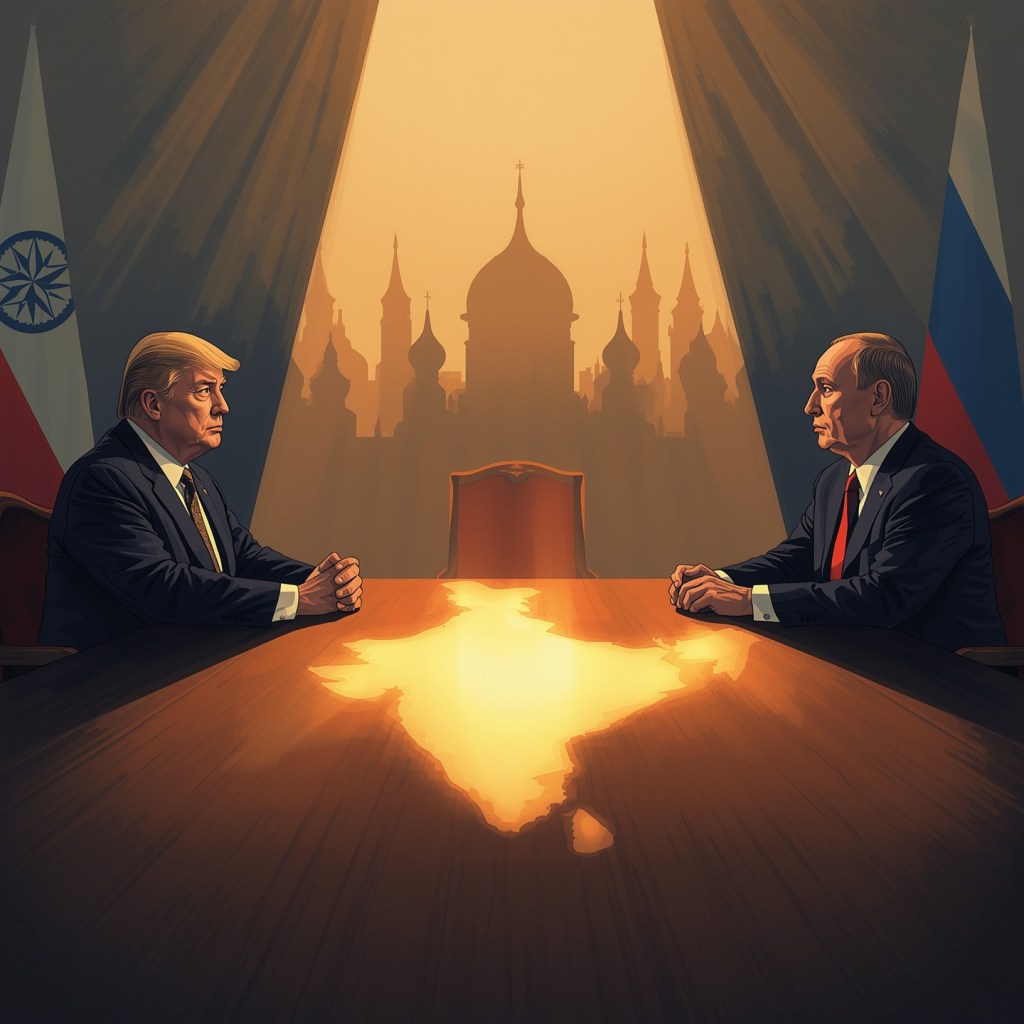
The recent meeting between former U.S. President Donald Trump and Russian President Vladimir Putin drew the world’s attention, not because it resolved the Ukraine conflict, but because of the larger signals it sent to the global community — including India.
A Meeting Without a Breakthrough
Despite the hype, the Trump–Putin encounter ended without any ceasefire or binding agreement. Both leaders described the discussion as “positive,” acknowledging that fundamental concerns were placed on the table. Putin reiterated Russia’s long-standing demands: recognition of Crimea, autonomy for Russian-speaking regions of Ukraine, and a guarantee that NATO will not expand into Ukraine. Trump, on his part, promised to consult NATO allies and Ukraine’s leadership before moving forward.
While Western commentators stopped short of calling it Trump’s defeat, many conceded that Putin emerged relatively stronger. Trump’s earlier claim that he could end the war “in one day” now appears hollow after months of stalemate.
India’s Name in the Room
Interestingly, even though India was not directly present at the talks, it became a focal point. Trump had earlier imposed a 25% penalty tariff on Indian goods, arguing that this economic pressure would push Moscow to the negotiation table. Yet, the measure has done little to alter Russia’s stance.
For India, however, the linkage is important. If the penalty tariff is lifted, Indian exporters believe they can absorb the standard trade duties and remain competitive in the U.S. market. American importers of Indian goods have expressed similar confidence. Thus, India’s economic resilience is indirectly shaping the diplomatic calculus.
A Validation of India’s Position
Prime Minister Narendra Modi has consistently emphasized that dialogue is the only sustainable path to peace. The Trump–Putin interaction, though inconclusive, demonstrates that even hardened adversaries ultimately return to the negotiating table. This underscores the credibility of India’s long-standing call for diplomacy over confrontation.
Moreover, India’s role is not limited to economics. Zelensky has already reached out to Modi, expressing concerns that Ukraine’s fate might be decided without Kyiv’s participation — echoing fears of being sidelined, much like smaller nations during the Yalta Conference of 1945. With an invitation to meet Modi during the upcoming UN General Assembly session, India is seen as a possible bridge between conflicting powers.
A Shifting Strategic Landscape
Even as trade disputes simmer, defense ties between India and the U.S. are deepening. The ongoing joint military exercises in Alaska highlight India’s pragmatic balancing of relationships with both Washington and Moscow. At the same time, Trump’s tariff policy is unpopular at home, with falling approval ratings and internal dissent within his administration.
This juxtaposition of economic pressure, military cooperation, and diplomatic maneuvering illustrates the complexity of today’s multipolar order — and India’s increasingly central place within it.
Conclusion: India’s Moment of Responsibility
The Trump–Putin talks may not have yielded a ceasefire, but they remind the world that the global order cannot bypass India. Whether through economic resilience, diplomatic credibility, or strategic partnerships, India today occupies a pivotal role in shaping outcomes that extend far beyond South Asia.
As the UN General Assembly approaches, the question is no longer whether India will be part of the conversation — it is how India chooses to shape it.
 Unmukt
Leave a comment