Unmukt

Blog

  • Darwin and Indian Family Businesses: A Case Study in Survival of the Fittest

    Darwin’s theory of “survival of the fittest” emphasizes adaptability and resilience in changing environments, originally framed in the context of natural selection. When extended to the realm of business—particularly Indian family businesses—this theory finds a compelling real-world parallel. These enterprises, some of which have thrived for over a century, exemplify evolutionary fitness not through brute force, but through innovation, cultural rootedness, and strategic foresight.

    As of today, Indian family businesses remain a vital engine of the economy, continuing to grow in the face of global competition, technological disruption, and internal challenges. Let’s explore how they mirror Darwinian survival principles and why their longevity defies conventional business logic.

    How Indian Family Businesses Embody “Survival of the Fittest

    1. Adaptability to Changing Environments

    India’s oldest family businesses have evolved across colonial rule, independence, liberalization, and globalization. The Tata Group, founded in 1868, began as a trading firm and expanded into steel, automobiles, and IT. Its transformation from industrial-era manufacturing to digital-era innovation (e.g., TCS) is a textbook example of Darwinian adaptation.

    In contrast, many traditional textile firms that failed to modernize during British rule were eventually wiped out—showing that inability to evolve leads to extinction, in nature and in business.

    2. Resilience Through Cultural and Social Ties

    Family businesses in India are often embedded in joint family systems, which extend to business relationships. Trust, loyalty, and informal governance allow them to endure through crises. The Murugappa Group, established in 1900, diversified into agriculture, engineering, and financial services, maintaining internal cohesion while responding to external change.

    These cultural moorings act as stabilizing mechanisms, enabling long-term survival even during political or economic turbulence.

    3. Innovation and Modernization

    Survival in modern markets demands innovation. Reliance Industries, which began as a textile trading firm in the 1960s, disrupted India’s telecom industry in 2016 with Jio. By 2025, Jio leads India’s 5G revolution and digital ecosystem, a testament to how family businesses must continually reinvent themselves to stay fit in Darwinian terms.

    4. Niche Market Mastery

    Smaller family-run firms often dominate niche sectors—jewelry, spices, textiles—where heritage and expertise provide a durable edge. The Gitanjali Group globalized traditional Indian jewelry through modern branding and retail, showing how specialization is a form of adaptive fitness.

    Why They Thrive Despite Intense Competition

    1. Long-Term Vision Over Short-Term Gains

    Unlike other businesses, which chase quarterly profits, family firms often prioritize intergenerational wealth and legacy. The Aditya Birla Group, dating back to 1857, continues to invest in sustainable industries like cement, metals, and renewable energy—opting for long-term survival over short-term spikes.

    2. Trust and Reputation as Capital

    Brands like Britannia (part of the Wadia Group, founded in 1736) thrive on legacy, not just marketing. Indian consumers often trust family-run brands more due to perceived authenticity and continuity, which creates a moat against newer entrants.

    3. Policy Tailwinds

    Post-1991 liberalization opened global markets. Initiatives like Make in India and MSME incentives have empowered family businesses, especially in cities like Surat, where textile exports are dominated by generational firms. These businesses are not just surviving—they are scaling.

    4. Cultural Alignment and Succession Planning

    In India, businesses are often an extension of the family’s identity. Succession, when managed well, ensures continuity. The Godrej Group (est. 1897) has seen multiple generational transitions while investing in green products and sustainability—ensuring continued relevance.

    Challenges and Darwinian Pressures

    Despite their advantages, Indian family businesses are not immune to natural selection:

    Internal Conflicts: Feuds within the Singhania family (Raymond Group) have weakened the brand and distracted from business strategy.

    Global Disruption: Multinational tech and consumer giants pose existential threats to slower-moving firms.

    Digital Lag: Traditional mindsets sometimes resist digital transformation, risking obsolescence in a data-driven economy.

    Conclusion:

    Evolution, Not Inheritance, Ensures Survival

    Indian family businesses are not relics of the past—they are living organisms in an economic ecosystem. Their longevity proves that fitness is not about being the strongest or richest, but about being the most adaptive.

    By balancing tradition with transformation, culture with competitiveness, they remain relevant in 2025 and beyond. Darwin would likely agree: in both nature and business, those who evolve with their environment endure the test of time.
  • The Sensitivity of a Good Government: A Democratic Appraisal

    The success of any democracy hinges not just on the power it wields but on how sensitively that power is exercised. A truly good government is not only strong against external threats but also just, inclusive, responsive, and tolerant of dissent within.

    Lets evaluates government sensitivity from two perspectives: the timeless principles of Chanakya, the ancient Indian political strategist, and the expectations of a modern democratic society. This article reflect on whether India’s current government aligns with these benchmarks, especially in light of recent debates.

    1. Sensitivity to National Security

    A government’s foremost duty is to protect its citizens and territorial integrity. In this regard, the current Indian government has shown decisive action—be it in the form of surgical strikes post-Uri, the Balakot airstrike, or its firm stand during the Doklam and Galwan standoffs with China.

    • Chanakya believed in preemptive strength and strategic deterrence. The government’s proactive stance reflects this principle, treating security not as reaction but as preparation.

     Verdict: The government has shown high sensitivity and effectiveness in national security.

    2. Responsiveness to Dissent and Criticism

    Chanakya advised rulers to avoid arrogance and listen to advisors. In a modern democracy, this wisdom translates to respecting dissent, ensuring press freedom, and protecting institutional checks.

    While some actions (e.g., raids on certain media houses, NGOs, and arrests under stringent laws) have triggered criticism, it is also true that state action is justified when foreign-funded actors violate national interest, as seen in the NewsClick case with reported Chinese links.

    • The key question is: Are patriotic critics also facing suppression, or only those with dubious agendas? Sensitivity lies in distinguishing the two.

    Verdict: National security must be upheld, but sensitivity to fair criticism and transparency in action is vital to maintain democratic credibility.

    3. Inclusiveness Toward All Communities

    A sensitive government fosters harmony. Critics of the Citizenship Amendment Act (CAA) claimed it discriminated based on religion. The government clarified that CAA targets only persecuted minorities in Pakistan, Afghanistan, and Bangladesh, and does not affect Indian Muslims.

    However, protests and violent reactions created confusion and unrest.

    • Chanakya emphasized just rule over all subjects, ensuring that no group feels alienated.

    Verdict: The intention of the law may be just, but the government’s communication and engagement could have been more inclusive to prevent polarisation.

    4. Institutional Independence

    A Chanakyan state requires strong and independent institutions. Modern critics raise concerns over the independence of the judiciary, Election Commission, and investigative agencies.

    Yet, it’s also true that:

    • Judges in India are appointed through a collegium system, not by the government.
    • The new law for appointing the Election Commission includes representation from opposition, which didn’t exist before.

    Still, public trust depends on the perception of independence—not just the procedure.

    Verdict: The government must strengthen transparency and public confidence in autonomous institutions.

    5. Transparency and Accountability

    A sensitive government must allow scrutiny. RTI amendments, electoral bond secrecy, and reduced media questioning have led to concerns of reduced transparency.

    The electoral bonds system aimed to curb black money in politics, but without public disclosure, it became opaque to voters.

    • Chanakya warned against rulers becoming unaccountable and detached from their subjects.

    Verdict: Intent may be reform-driven, but greater openness and citizen access to political funding data are essential hallmarks of sensitivity.

    Conclusion: Is the Current Government Sensitive?

    If measured against national interest and strength, the government has been decisive and strategic. From defense modernization to diplomacy, digital outreach to welfare delivery, the state has shown competence.

    However, sensitivity also demands:

    • Respect for dissent that is within the law
    • More transparent governance
    • Active efforts to keep every citizen—irrespective of background—feeling heard

    In Chanakya’s terms, a king (or elected ruler) must uphold Dharma (just conduct), listen to truth even when unpleasant, and act with foresight.

    A sensitive government is not one that avoids using power—but one that uses it judiciously, proportionally, and accountably.

  • क्या वर्तमान सरकार चाणक्य की नीति पर चल रही है? – एक विश्लेषण

    भारत की शासन-व्यवस्था के मूल्यांकन में यदि किसी प्राचीन विचारक का दृष्टिकोण सबसे अधिक प्रासंगिक माना जाता है, तो वह हैं आचार्य चाणक्य (कौटिल्य)। उन्होंने ‘अर्थशास्त्र’ में एक आदर्श राजा व शासन के गुण बताए थे – न्यायप्रियता, जनकल्याण, पारदर्शिता, सुरक्षा, परामर्श से निर्णय और आत्म-नियंत्रण। इस आलेख में हम देखेंगे कि क्या वर्तमान भारतीय सरकार इन सिद्धांतों पर खरी उतरती है और क्या वह एक संवेदनशील सरकार के मानकों को पूरा करती है।

    1. राष्ट्र की सुरक्षा और आक्रामकता से रक्षा: चाणक्य का मूल सिद्धांत

    चाणक्य के अनुसार, शत्रुओं के प्रति कठोरता और जनता की सुरक्षा में कोई समझौता नहीं होना चाहिए। वर्तमान सरकार ने आतंकी हमलों (पुलवामा, उरी) के जवाब में सर्जिकल और एयर स्ट्राइक कर स्पष्ट संकेत दिया कि वह सुरक्षा के मुद्दे पर चुप नहीं बैठेगी। चीन के विरुद्ध एलएसी पर भारत की स्थिति और आत्मनिर्भर रक्षा नीति (Make in India in Defence) इस दर्शन के अनुरूप है।

    निष्कर्ष: सरकार राष्ट्रीय सुरक्षा के संदर्भ में चाणक्य के विचारों के काफी निकट है।

    2. परामर्श और आलोचना के प्रति संवेदनशीलता

    चाणक्य कहते हैं – एक राजा को अपने मंत्रियों की बात सुननी चाहिए और अहंकार से बचना चाहिए। आलोचना से सीखकर ही कोई शासन मजबूत बनता है।

    हालांकि, कुछ आलोचनाएं यह दर्शाती हैं कि सरकार आलोचना के प्रति कम सहिष्णु है – जैसे कुछ मीडिया हाउसों, एनजीओ या विपक्षी नेताओं पर कार्यवाही। लेकिन सवाल यह है कि क्या यह कार्यवाहियाँ उचित थीं?

    उदाहरण: NewsClick पर चीनी फंडिंग के आरोपों के बाद की गई कार्रवाई, यदि राष्ट्रविरोधी कृत्यों के खिलाफ है, तो यह राष्ट्रीय हित में है। लेकिन आलोचना इस बात पर थी कि कार्रवाई कैसे की गई – क्या पारदर्शिता थी, और क्या मीडिया की स्वतंत्रता पर इसका असर पड़ा?

    निष्कर्ष: आलोचना का दमन नहीं, बल्कि विधि सम्मत पारदर्शिता बनाना एक संवेदनशील शासन का गुण है। इसमें सुधार की आवश्यकता है, लेकिन नीयत पर सीधा प्रश्न उचित नहीं।

    3. सामाजिक समावेशिता और न्याय

    चाणक्य ने सभी समुदायों के प्रति न्याय की बात कही थी। CAA जैसे कानूनों को लेकर विपक्ष ने अल्पसंख्यकों में असुरक्षा का मुद्दा उठाया, हालांकि यह कानून भारत में पहले से रह रहे अल्पसंख्यकों के विरुद्ध नहीं था, बल्कि पाकिस्तान, अफगानिस्तान, बांग्लादेश से उत्पीड़न के कारण आए हिंदू, सिख, ईसाई, पारसी, जैन, बौद्ध शरणार्थियों को नागरिकता देने का कानून था।

    निष्कर्ष: सामाजिक ध्रुवीकरण की आशंका राजनीतिक विमर्श का हिस्सा रही, परन्तु यदि नीतियों का उद्देश्य स्पष्ट और राष्ट्रहित में है, तो संवेदनशीलता का सही आकलन इस बात पर होना चाहिए कि वह नीति समाज को सुरक्षित और न्यायोचित दिशा में ले जाती है या नहीं।

    4. संवैधानिक संस्थाओं की स्वतंत्रता

    चाणक्य का मत था कि न्यायपालिका और संस्थाएं राजा को जवाबदेह रखें। भारत में न्यायपालिका की नियुक्ति प्रक्रिया (कोलेजियम सिस्टम) सरकार से स्वतंत्र है।

    हालाँकि कुछ आलोचकों ने चुनाव आयोग या जाँच एजेंसियों की निष्पक्षता पर सवाल उठाए, लेकिन यह भी सच है कि पहली बार चुनाव आयोग की नियुक्ति की प्रक्रिया को संसद के माध्यम से विधिक आधार मिला है – जिसमें विपक्षी सदस्य भी सम्मिलित होते हैं।

    निष्कर्ष: आलोचना के बावजूद, संस्थागत प्रक्रिया में सुधार हुए हैं। वास्तविक स्वतंत्रता का मूल्यांकन समय के साथ हो सकता है।

    5. पारदर्शिता और जवाबदेही

    चाणक्य ने स्पष्ट लिखा है कि जनता के धन का दुरुपयोग या अपारदर्शिता शासन के पतन का कारण बनती है। चुनावी बांड प्रणाली और RTI में संशोधन को लेकर कुछ चिंताएं रही हैं – जैसे किस पार्टी को किससे फंडिंग मिली, यह जानकारी क्यों नहीं मिलती।

    निष्कर्ष: जवाबदेही और पारदर्शिता की कसौटी पर सरकार को और खुलापन दिखाना चाहिए ताकि लोकतांत्रिक विश्वास बना रहे।

    निष्कर्ष: क्या वर्तमान सरकार चाणक्य के आदर्शों पर चल रही है?

    यदि हम चाणक्य के सिद्धांतों की कसौटी पर परखें, तो भारत की वर्तमान सरकार कई मामलों में उनके दर्शन के अनुरूप कार्य कर रही है:

    राष्ट्रीय सुरक्षा
    आत्मनिर्भरता
    जनहित में योजनाएं (जनधन, आयुष्मान, डिजिटल इंडिया)
    सीमाओं पर आक्रामक नीति

    जहाँ चुनौतियाँ हैं:
    पारदर्शिता में संतुलन
    आलोचना के प्रति प्रतिक्रिया की विधि
    संवैधानिक संस्थाओं की सार्वजनिक छवि

    विचार:
    एक संवेदनशील और चाणक्यनिष्ठ सरकार केवल नीतियों से नहीं, बल्कि उनके कार्यान्वयन में दिखने वाली न्यायप्रियता, सहिष्णुता और पारदर्शिता से बनती है। वर्तमान सरकार ने अनेक बिंदुओं पर चाणक्य की नीति को साकार किया है, पर कुछ पहलुओं पर और संवेदनशील दृष्टिकोण की आवश्यकता बनी हुई है।

  • Is the Current Indian Government Aligned with Chanakya’s Philosophy and the Sensitivity of Good Governance?

    In the tapestry of Indian political thought, few figures loom as large as Chanakya (Kautilya), the ancient strategist and author of the Arthashastra. His philosophy of statecraft balances ruthlessness with responsibility, nationalism with ethics, and power with restraint. In today’s context, examining whether the current Indian government embodies Chanakya’s principles offers a compelling lens into the nature of governance and democratic sensitivity.

    Chanakya’s Vision of Ideal Governance

    Chanakya envisioned a ruler who:

    • Prioritized national security above all.
    • Encouraged economic self-sufficiency.
    • Practiced diplomacy with strength.
    • Valued institutional autonomy.
    • Exercised compassion and justice toward all citizens.
    • Listened to advisors and allowed dissent to prevent arrogance.

    Governance, according to Chanakya, was not merely about ruling effectively but ruling wisely and justly.

    Critical Analysis of Current Government

    1. National Security and Strategic Assertiveness

    Chanakya emphasized defending the kingdom through preparedness and strong alliances. The present government has shown:

    • Military assertiveness (e.g., Balakot strikes, Galwan response).
    • Strategic alliances like the Quad, reflecting a proactive Indo-Pacific strategy.
    • Intelligence modernization and internal security measures.

    These initiatives echo Chanakya’s realpolitik, where strength ensures sovereignty.

    2. Economic Self-Reliance

    Chanakya advised kings to develop internal economic strength to avoid foreign dependency. Today, India’s:

    • Atmanirbhar Bharat campaign.
    • Emphasis on Make in India.
    • Tech-driven reforms and startup ecosystem.
    • Focus on infrastructure and digital public goods.

    …all resonate with his call for economic autonomy.

    3. Handling of External Threats and Internal Subversion

    Chanakya proposed strict action against internal threats and foreign-backed conspiracies. The government’s action against organizations allegedly funded by adversarial nations (e.g., NewsClick) and anti-terror operations aligns with this Chanakyan principle.

    Concern should be given:

    1. Tolerance for Dissent and Democratic Institutions

    Chanakya warned against rulers ignoring criticism or becoming arrogant. Some critics argue:

    • Media freedoms and civil society space have narrowed.
    • Investigative agencies may appear to disproportionately target dissenting voices.
    • Public dissent is sometimes labeled as anti-national.

    Even if well-intentioned, this creates fear among democratic institutions, potentially stifling legitimate discourse.

    2. Institutional Autonomy and Accountability

    While India’s judiciary and Election Commission are constitutionally independent, concerns arise:

    • Over perceived executive influence.
    • Over use of investigative agencies during political cycles.

    Chanakya upheld justice as the cornerstone of governance. Visible autonomy ensures public trust.

    3. Equity and Inclusiveness

    Chanakya advocated for just treatment of all communities. While government schemes like Ujjwala, Ayushman Bharat, and Jan Dhan Yojana are inclusive by design, perceptions of alienation persist:

    • Around policies like the Citizenship Amendment Act (CAA).
    • During certain state-level crackdowns.

    These perceptions, even if not rooted in reality, call for sensitive outreach and clear communication to maintain national cohesion.

    4. Transparency and Electoral Reforms

    Transparency is a pillar of trust. Critics highlight:

    • Electoral bond opacity.
    • Amendments to RTI that reduce oversight.
    • Limited media questioning in formal press settings.

    Chanakya believed in clear communication and visible justice. Modern democracy demands visible transparency to uphold this ideal.

    Final Assessment: Chanakyan Governance in a Democratic Era

    The current Indian government reflects many core Chanakyan ideals:

    • Strategic foresight.
    • Economic revival.
    • National pride and internal discipline.

    But Chanakya also stressed humility, responsiveness to criticism, and visible justice. A sensitive government not only punishes the guilty but also protects the innocent from undue fear.

    In essence:

    Strong governance grounded in Chanakya’s vision is effective when paired with democratic empathy.

    India today needs both: strategic muscle and moral grace.

    Conclusion

    The current government mirrors Chanakya’s pragmatism and vision in many areas. Yet, to fully embody the spirit of sensitive and just governance, it must ensure:

    • Institutions remain visibly autonomous.
    • Criticism is heard, not crushed.
    • Justice is both done and seen to be done.

    Chanakya’s legacy lies in building a powerful yet benevolent state. A government that embodies this will not only command authority but also earn enduring respect.

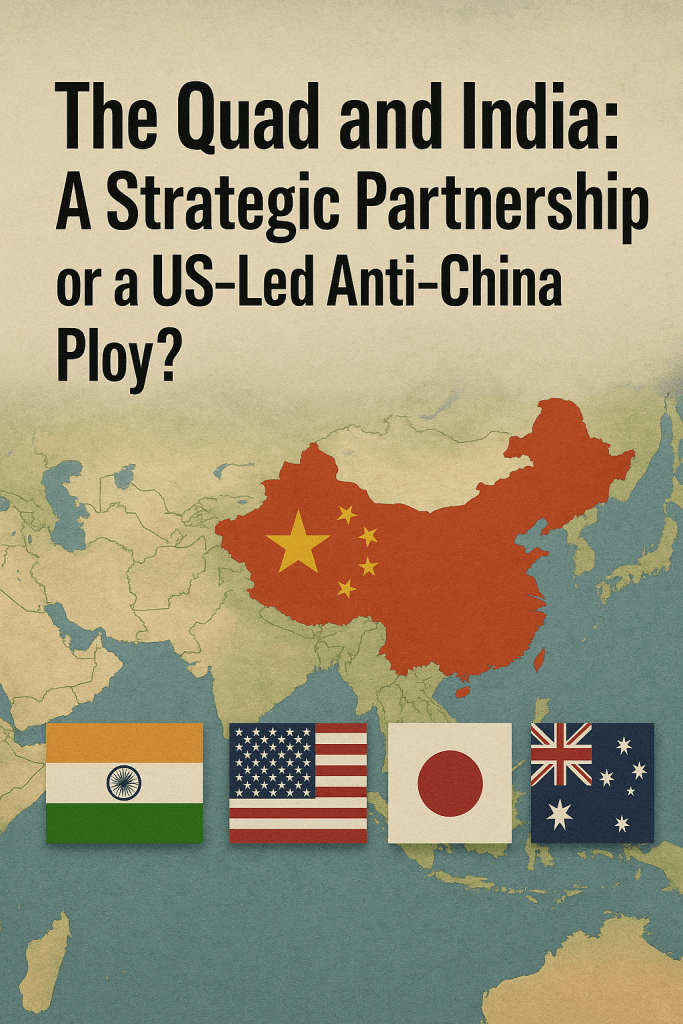
  • India and the Quad: Strategic Synergy or a US Gambit to Counter China?

    In the turbulent waters of the Indo-Pacific, the Quadrilateral Security Dialogue (Quad)—uniting India, United States, Japan, and Australia—stands as a beacon of strategic alignment. Revived in 2017 to promote a “free, open, and prosperous Indo-Pacific,” the Quad’s unspoken mission is to counter China’s maritime ambitions and regional dominance. For India, a rising power grappling with China’s border provocations and Pakistan’s terrorism, the Quad promises enhanced security, economic growth, and global influence. Yet, skepticism persists: Is India a linchpin in a transformative partnership, or merely a pawn in a US-led strategy to contain China? As the recent India-Pakistan escalation (May 2025) underscores the Quad’s limitations, this article explores its true value for India, India’s indispensability to the group, and whether New Delhi could achieve its ambitions alone.

    The Quad’s Strategic Lifeline for India

    India’s integration into the Quad, cemented after China’s assertive moves (e.g., 2017 Doklam standoff, 2020 Galwan clash), aligns with its goal of countering Beijing’s influence while advancing broader interests. Far from being a passive partner, India leverages the Quad to amplify its strategic, economic, and diplomatic clout.

    1.  Fortifying Against China
    The Quad bolsters India’s capacity to counter China’s “String of Pearls” network—ports like Gwadar (Pakistan) and Hambantota (Sri Lanka)—and its naval expansion in the Indian Ocean Region (IOR). The Malabar naval exercises, involving all Quad members, enhance India’s interoperability with world-class navies, securing sea lanes critical for 90% of its trade by volume. Bilateral agreements, such as COMCASA and BECA with the US, provide advanced technologies (e.g., P-8I aircraft, geospatial intelligence), strengthening India’s maritime and border defenses. The Quad’s strategic pressure on China indirectly limits Beijing’s support for Pakistan, as seen in its restrained response during the India-Pakistan escalation, where reported missile supplies to Pakistan were not escalated further.

    2.  Economic and Technological Leap
    The Quad’s Blue Dot Network offers sustainable infrastructure alternatives to China’s Belt and Road Initiative (BRI), aligning with India’s Act East policy to deepen ties with ASEAN. Initiatives in supply chain resilience—focusing on semiconductors and critical minerals—reduce India’s reliance on Chinese imports, fueling Make in India. Investments from Quad partners, such as Japan’s $35 billion in India’s Northeast and Australia’s critical minerals cooperation, drive economic growth, cementing India’s status as the world’s 4th largest economy (2025). Collaboration in emerging technologies (AI, 5G, cybersecurity, space) positions India to compete with China’s technological edge, critical for both economic and defense advancements.

    3.  Diplomatic Ascendancy
    The Quad elevates India as a leading Indo-Pacific power, amplifying its voice in global forums like the UN and G20. During the Pahalgam terror attack (April 2025) and India’s retaliatory Operation Sindoor, Quad members condemned terrorism without criticizing India’s strikes, unlike China and Turkey, reflecting India’s diplomatic clout. The Quad’s non-binding structure preserves India’s strategic autonomy, allowing unilateral actions (e.g., against Pakistan) while benefiting from collective support. By countering the China-Pakistan Economic Corridor (CPEC) and China’s regional influence, the Quad enhances India’s leverage in South Asia and beyond.

    4.  Leadership in Non-Traditional Security
    The Quad’s focus on climate change (renewable energy), health security (vaccine diplomacy), and humanitarian assistance and disaster relief (HADR) enhances India’s soft power. Building on the 2004 Tsunami Core Group, the Quad strengthens India’s role as a regional first responder. Its Women, Peace, and Security agenda aligns with India’s gender-inclusive peacekeeping efforts, bolstering its global image as a responsible power.

    The India-Pakistan Escalation: Testing the Quad’s Limits

    The Pahalgam terror attack (April 22, 2025) and India’s Operation Sindoor (May 7, 2025), targeting terror camps in Pakistan and PoK, highlighted the Quad’s constrained role in bilateral disputes. India’s precision strikes, executed with indigenous systems (Akash, S-400) and bilateral intelligence (e.g., US-derived), showcased its self-reliance. Quad members condemned the attack but urged restraint, offering no direct support, prompting X users to label the Quad “ineffective” or a “US ploy” that fails India in South Asian crises.

    Yet, the Quad’s indirect contributions were significant. Its diplomatic weight ensured global focus on condemning terrorism, not India’s response, with Quad partners avoiding the critical tone of China and Turkey. The group’s strategic pressure on China likely limited Beijing’s escalation of support for Pakistan (e.g., beyond reported missile supplies), preserving regional stability. While the Quad’s China-centric, maritime focus doesn’t address Pakistan directly, its role in countering the China-Pakistan axis supports India’s broader security calculus.

    Can India Stand Alone?

    India’s skeptics argue it doesn’t need the Quad. With the world’s 4th largest defense budget (~$80 billion), a modernizing navy (INS Vikrant, nuclear submarines), and nuclear capabilities, India executed Operation Sindoor independently. Its economy drives self-reliance (Atmanirbhar Bharat), attracting investments from non-Quad nations (e.g., UAE, Singapore). Diplomatically, India’s non-alignment and ties with Russia, ASEAN, and the Global South ensure global influence, as seen in widespread condemnation of the Pahalgam attack. India counters China unilaterally—banning apps, restricting investments, and fortifying the LAC—while leading in climate (International Solar Alliance) and HADR.

    However, going solo has limits. China’s $300 billion defense budget, largest navy, and economic dominance outmatch India’s resources. Developing advanced tech (e.g., 5G, AI) and infrastructure independently is cost-intensive, and facing China’s global influence (e.g., UNSC vetoes) alone risks isolation. The Quad’s collective strength—US superpower status, Japan’s tech leadership, Australia’s Pacific reach—reduces India’s burden, accelerates progress, and counters the China-Pakistan axis more effectively. Without the Quad, India could face a bolder Beijing, potentially escalating support for Pakistan, as hinted in May 2025.

    Is India Being Used Against China?

    The notion that the Quad is a US-orchestrated effort to leverage India against China resonates in public discourse. X users describe India as a “frontline state” in a US-led “anti-China axis,” noting that the US, Japan, and Australia rely on India’s IOR dominance and rivalry with China (e.g., LAC tensions) to counter Beijing’s BRI and naval expansion. India’s strategic location and military weight make it a natural partner, but critics argue it bears disproportionate risks—provoking China’s ire while Quad partners gain strategic benefits with less exposure.

    This view oversimplifies India’s role. New Delhi actively shapes the Quad, emphasizing non-traditional security (climate, health) to avoid a militarized anti-China stance. India’s non-aligned stance and ASEAN ties ensure the Quad isn’t a Western bloc, broadening its appeal. The tangible benefits—tech transfers, investments, diplomatic leverage—align with India’s goals, proving mutual dependence. The Quad’s neutrality in the India-Pakistan escalation fueled frustration, with X posts questioning its reciprocity, but India’s strategic autonomy ensures it’s no mere tool, extracting value while maintaining independence.

    A Quad Without India: Viable or Hollow?

    Could the Quad survive without India? Technically, yes—it existed briefly in 2007 with limited Indian commitment but collapsed under Chinese pressure. Today, India’s IOR presence, naval power, and democratic weight are irreplaceable. Without India:

    •  IOR Influence Wanes: China’s BRI ports and Djibouti base face less opposition, as Japan and Australia focus on the Pacific.

    •  Maritime Strength Fades: Malabar exercises lose relevance, and sea lane security falters.

    •  Diplomatic Credibility Suffers: The Quad risks becoming a US-led alliance, alienating ASEAN and the Global South.

    •  Economic and Tech Gaps: India’s market and IT sector drive supply chain and tech initiatives; its absence slows progress.

    A US-Japan-Australia triad could pivot to AUKUS or Pacific alliances, but these lack India’s regional heft. X users emphasize India’s indispensable role, though some see a Pacific-focused alternative. Without India, the Quad would be a diminished, Pacific-centric shell, unable to counter China’s Indo-Pacific ambitions effectively.

    Conclusion: A Strategic Symbiosis

    The Quad is a strategic lifeline for India, amplifying its ability to counter China, secure maritime routes, modernize its economy, and lead globally, while preserving autonomy. Its limitations in bilateral conflicts like the India-Pakistan escalation underscore India’s need for self-reliance, but its indirect benefits—diplomatic cover, pressure on China—prove its worth. India’s robust capabilities enable independent action, but the Quad’s collective strength addresses challenges (China’s superiority, resource constraints) that New Delhi cannot fully overcome alone.

    Is the Quad a US gambit to use India against China? Partially, but India’s agency transforms it into a symbiotic partnership. By shaping the Quad’s inclusive agenda, India maximizes benefits while mitigating risks. The Quad’s viability hinges on India’s participation; without it, the group loses strategic and diplomatic weight. For India, the Quad is a pragmatic multiplier, not a necessity, enabling it to navigate a complex geopolitical landscape with unmatched finesse.

  • ऑपरेशन सिन्दूर: भारत की स्वदेशी रक्षा क्षमताओं का प्रदर्शन और वैश्विक प्रभाव

    7 मई 2025 को भारतीय सशस्त्र बलों ने ऑपरेशन सिन्दूर शुरू किया, जो एक त्रि-सेवा सटीक हमला था, जिसमें पाकिस्तान और पीओके में जैश-ए-मोहम्मद (JeM) और लश्कर-ए-ताइबा (LeT) जैसे समूहों से जुड़े नौ आतंकी शिविरों को निशाना बनाया गया। यह ऑपरेशन रात 1:05 बजे से 1:30 बजे तक चला और इसके बाद 8-9 मई को हुए परिणामों ने भारत की स्वदेशी रक्षा प्रणालियों को प्रदर्शित किया, जो आत्मनिर्भरता की बढ़ती क्षमता का संकेत है। यह लेख स्वदेशी प्रौद्योगिकियों के उपयोग और भारत की वैश्विक रक्षा बाजार में स्थिति पर उनके प्रभावों की जांच करता है।

    ऑपरेशन सिन्दूर में स्वदेशी प्रणालियों का उपयोग

    ऑपरेशन सिन्दूर ने बहावलपुर और मुजफ्फराबाद जैसे स्थानों पर 80-100 आतंकियों को मार गिराया, जिसमें स्वदेशी प्रणालियों का उपयोग कर न्यूनतम संपार्श्विक क्षति सुनिश्चित की गई:

    • स्काईस्ट्राइकर लॉइटरिंग म्यूनिशन्स: बेंगलुरु में अल्फा डिज़ाइन और इज़राइल की एलबिट सिस्टम्स के सहयोग से निर्मित, इन ड्रोनों ने अहमदपुर ईस्ट और मुरिदके में सटीक हमले किए। 100 किमी की रेंज और लाइव वीडियो फीड के साथ, इनने भारत की मानवरहित प्रणालियों की क्षमता दिखाई।
    • डीआरडीओ लॉइटरिंग म्यूनिशन सिस्टम (एलएमएस): डीआरडीओ के कम लागत वाले स्वार्म ड्रोनों ने आतंकी ठिकानों को निशाना बनाया, जो सटीक हमलों के लिए किफायती समाधान प्रदान करते हैं, और स्वायत्त हथियार प्रौद्योगिकी में प्रगति को दर्शाते हैं।
    • आईएनएस विक्रांत: कोचीन शिपयार्ड लिमिटेड द्वारा निर्मित भारत का पहला स्वदेशी विमानवाहक पोत, जिसने नौसेना-वायुसेना समन्वय का समर्थन किया। मुंबई से 600 नॉटिकल मील की दूरी पर तैनात, इसने संभवतः समुद्री निगरानी प्रदान की।
    • उन्नत इलेक्ट्रॉनिक वारफेयर (ईडब्ल्यू) सिस्टम: डीआरडीओ के संभवतः संयुक्ता जैसे स्वदेशी ईडब्ल्यू सिस्टम ने दुश्मन संचार और रडार को जाम किया, हमले की गुप्तता सुनिश्चित की।

    परिणाम: स्वदेशी रक्षा प्रणालियों का उपयोग (8-9 मई, 2025)

    पाकिस्तान के जवाबी ड्रोन और मिसाइल हमलों ने जम्मू, उधमपुर और राजस्थान में भारतीय ठिकानों को निशाना बनाया, जिसके जवाब में स्वदेशी प्रणालियों ने प्रभावी प्रदर्शन किया:

    • एकीकृत काउंटर यूएएस ग्रिड: रडार और ड्रोन-रोधी तकनीकों से युक्त इस स्वदेशी प्रणाली ने 8 मई को जम्मू-कश्मीर में 35 मिनट के ड्रोन हमलों (रात 8:45 से 9:20 बजे) को विफल किया, जिसके मलबे ने इसकी सफलता सिद्ध की।
    • आकाश वायु रक्षा प्रणाली: डीआरडीओ की आकाश प्रणाली, 25-50 किमी की रेंज के साथ, ने सैन्य ठिकानों की रक्षा की, जिसमें हवाई खतरों को 100% रोकने की सफलता मिली।
    • सीड/डेड ऑपरेशन्स: 8 मई को लाहौर में स्वदेशी ईडब्ल्यू सिस्टम ने पाकिस्तान की HQ-9 और HQ-16 रक्षा प्रणालियों को निष्क्रिय कर उनकी कमजोरियों को उजागर किया।
    • बीएसएफ ऑपरेशन्स: 8 मई को सांबा में बीएसएफ ने डीआरडीओ के नेत्र वी ड्रोनों और इंसास राइफलों का उपयोग कर घुसपैठ को रोका।
    • चांदीपुर सुरक्षा समीक्षा: 9 मई को डीआरडीओ ने चांदीपुर, ओडिशा में आकाश और पिनाका जैसी स्वदेशी प्रणालियों की सुरक्षा समीक्षा की।

    प्रभावशीलता और वैश्विक प्रभाव

    स्वदेशी प्रणालियों ने प्रभावी प्रदर्शन किया, लेकिन राफेल जेट और S-400 जैसे आयातित सिस्टम पर निर्भरता ने आत्मनिर्भरता में कमी को उजागर किया। भारत के रक्षा निर्यात 2023-24 में $2.5 बिलियन तक पहुंचे, जिसमें ब्रह्मोस और पिनाका शामिल हैं, लेकिन यह अमेरिका और चीन से पीछे है। ऑपरेशन सिन्दूर ने भारत को किफायती रक्षा समाधानों के नवप्रवर्तक के रूप में स्थापित किया, जिससे 2025 तक $4.2 बिलियन निर्यात का लक्ष्य संभव प्रतीत होता है। तकनीकी गहराई में सुधार के साथ, भारत वैश्विक बाजार में अपनी स्थिति मजबूत कर सकता है।

  • मोदी का वैश्विक संदेश: पाकिस्तान की ‘आतंक की यूनिवर्सिटी’ का अर्थ और वैश्विक निहितार्थ

    12 मई 2025 को, प्रधानमंत्री नरेंद्र मोदी ने राष्ट्र के नाम अपने संबोधन में पाकिस्तान के बहावलपुर और मुरीदके में स्थित आतंकी ठिकानों को “वैश्विक आतंकवाद की यूनिवर्सिटी” करार दिया। उन्होंने इन ठिकानों को 9/11 हमले, लंदन ट्यूब बम विस्फोट और भारत में हुए कई आतंकी हमलों से जोड़ा, विशेष रूप से पश्चिमी देशों को यह संदेश देते हुए कि पाकिस्तान की आतंकी बुनियाद पूरी दुनिया के लिए खतरा है। यह बयान ‘ऑपरेशन सिंदूर’ की सफलता के बाद आया, जिसने 7 मई 2025 को पाकिस्तान और पाकिस्तान अधिकृत कश्मीर (PoK) में नौ आतंकी ठिकानों को नष्ट कर 100 से अधिक आतंकियों को मार गिराया। इस लेख में हम इस बयान के अर्थ और इसके वैश्विक निहितार्थों का विश्लेषण करेंगे, यह समझते हुए कि यह वैश्विक आतंकवाद विरोधी नीतियों और अंतरराष्ट्रीय कूटनीति को कैसे प्रभावित करता है।

    बयान का अर्थ: ‘आतंक की यूनिवर्सिटी’ का तात्पर्य

    1.  पाकिस्तान को वैश्विक आतंक का केंद्र बताना:

    •  ऐतिहासिक संदर्भ: मोदी ने बहावलपुर और मुरीदके को “आतंक की यूनिवर्सिटी” कहकर इन स्थानों को वैश्विक आतंकवादी गतिविधियों के प्रशिक्षण और नियोजन केंद्र के रूप में चिह्नित किया। ये क्षेत्र लश्कर-ए-तैयबा (LeT) और जैश-ए-मोहम्मद (JeM) जैसे संगठनों के गढ़ रहे हैं, जिनके तार 2001 के 9/11 हमलों, 2005 के लंदन ट्यूब बम विस्फोटों और भारत में 2008 के मुंबई हमले जैसे बड़े हमलों से जुड़े हैं। यह बयान इन ठिकानों को केवल क्षेत्रीय नहीं, बल्कि वैश्विक खतरे का स्रोत बताता है।

    •  पश्चिमी खुफिया जानकारी का उपयोग: मोदी का बयान पश्चिमी खुफिया एजेंसियों, जैसे CIA, की उन रिपोर्टों पर आधारित है, जो लंबे समय से पाकिस्तान के आतंकी ढांचे को दस्तावेज करती रही हैं। 9/11 हमलों में अल-कायदा के कुछ आतंकियों को पाकिस्तान में प्रशिक्षण मिला था, और लंदन बम विस्फोट करने वालों का LeT के वैचारिक नेटवर्क से संबंध था। यह बयान पश्चिम को उनके ही निष्कर्षों की याद दिलाता है।

    2.  आतंक और उसके सरपरस्तों को एकसमान ठहराना:

    •  राज्य प्रायोजित आतंकवाद पर हमला: मोदी ने अपने संबोधन में कहा कि भारत अब आतंकियों और उनके सरपरस्तों को अलग नहीं मानेगा। यह बयान पाकिस्तान की सैन्य और खुफिया एजेंसियों पर सीधा निशाना है, जिन पर LeT और JeM जैसे समूहों को समर्थन देने का आरोप है। ऑपरेशन सिंदूर के दौरान मारे गए आतंकियों को विदाई देने के लिए पाकिस्तानी सेना के अधिकारियों का उमड़ना इस राज्य प्रायोजित आतंकवाद का सबूत है।

    •  नैतिक और रणनीतिक अपील: “आतंक की यूनिवर्सिटी” का रूपक मानवता के खिलाफ अपराध के रूप में आतंकवाद को प्रस्तुत करता है, जो वैश्विक समुदाय से एकजुटता की मांग करता है। यह भारत को एक नैतिक और रणनीतिक नेता के रूप में स्थापित करता है, जो आतंकवाद के खिलाफ निर्णायक कार्रवाई करने को तैयार है।

    3.  परमाणु ब्लैकमेल का खंडन:

    •  पाकिस्तान की रणनीति पर प्रहार: पाकिस्तान ने लंबे समय से अपने परमाणु शस्त्रागार (लगभग 170 वॉरहेड्स) का उपयोग आतंकवाद के खिलाफ कार्रवाई को रोकने के लिए किया है। मोदी का बयान, जिसमें उन्होंने “परमाणु ब्लैकमेल” को खारिज किया, यह संदेश देता है कि भारत ऐसी धमकियों से डरेगा नहीं। ऑपरेशन सिंदूर, जो परमाणु जोखिम के बावजूद आतंकी ठिकानों पर सटीक हमले कर सफल रहा, इस दृढ़ता का प्रमाण है।

    •  वैश्विक संदेश: यह बयान उन देशों को चेतावनी देता है जो परमाणु शक्ति का दुरुपयोग आतंकवाद को ढाल देने के लिए करते हैं, और साथ ही पश्चिम से मांग करता है कि वे ऐसी रणनीतियों को बर्दाश्त न करें।

    वैश्विक निहितार्थ: विश्व के लिए इसका क्या अर्थ है

    मोदी का बयान और ऑपरेशन सिंदूर वैश्विक आतंकवाद विरोधी नीतियों, कूटनीति और सामरिक गठबंधनों को प्रभावित करने की क्षमता रखते हैं। इसके प्रमुख निहितार्थ निम्नलिखित हैं:

    1.  पश्चिमी जवाबदेही और नीतिगत बदलाव:

    •  साझा खतरे की याद: 9/11 और लंदन बम विस्फोटों का उल्लेख पश्चिमी देशों को उनके अपने अनुभवों से जोड़ता है, उन्हें पाकिस्तान के आतंकी ढांचे के खिलाफ कार्रवाई करने के लिए मजबूर करता है। अमेरिका और ब्रिटेन, जो आतंकवाद के खिलाफ वैश्विक युद्ध का नेतृत्व करने का दावा करते हैं, अब अपनी नीतियों को भारत की जीरो टॉलरेंस नीति के साथ संरेखित करने के दबाव में हैं।

    •  दोहरे मापदंडों का अंत: पश्चिम ने भू-राजनीतिक हितों (जैसे अफगानिस्तान में पाकिस्तान की भूमिका या चीन के खिलाफ संतुलन) के कारण पाकिस्तान को रियायतें दी हैं। उदाहरण के लिए, 2001 से अमेरिका ने पाकिस्तान को अरबों डॉलर की सैन्य सहायता दी, जबकि LeT और JeM जैसे समूह वहां सक्रिय रहे। मोदी का बयान इन दोहरे मापदंडों को चुनौती देता है, और X पर चर्चा इसे “कूटनीतिक मास्टरस्ट्रोक” करार देती है।

    •  प्रतिबंधों की मांग: बयान अप्रत्यक्ष रूप से पश्चिम से मांग करता है कि वे पाकिस्तान पर सख्त प्रतिबंध लगाएं या इसे आतंकी राज्य घोषित करें, जैसा कि राज्यसभा सांसद कपिल सिब्बल ने सुझाया था। यह 2019 में JeM प्रमुख मसूद अजहर को UNSC द्वारा आतंकी घोषित करने जैसी कार्रवाइयों को और बढ़ाने का आह्वान है।

    2.  वैश्विक आतंकवाद विरोधी नेतृत्व में भारत की भूमिका:

    •  निर्णायक कार्रवाई का प्रदर्शन: ऑपरेशन सिंदूर, जो स्वदेशी ड्रोन्स और मिसाइलों पर आधारित था, ने भारत की सैन्य और तकनीकी क्षमता को दुनिया के सामने रखा। जहां अमेरिका और ब्रिटेन ने तनाव कम करने की अपील की, वहीं भारत ने आतंकी ठिकानों को नष्ट कर अपनी दृढ़ता दिखाई। रूस, इजरायल और फ्रांस जैसे देशों के नेताओं की प्रशंसा ने भारत की स्थिति को मजबूत किया।

    •  नया सामान्य (न्यू नॉर्मल): मोदी ने आतंकवाद के खिलाफ “नया सामान्य” स्थापित किया, जिसमें आतंकी हमलों का मुंहतोड़ जवाब देना, परमाणु ब्लैकमेल को खारिज करना, और आतंकियों व उनके सरपरस्तों को एकसमान ठहराना शामिल है। यह नीति पश्चिमी देशों को प्रेरित कर सकती है कि वे भी आतंकवाद के खिलाफ अधिक आक्रामक रुख अपनाएं।

    •  आत्मनिर्भरता का संदेश: ऑपरेशन में स्वदेशी हथियारों की सफलता ने भारत की आत्मनिर्भरता को प्रदर्शित किया, जो अन्य देशों को अपनी रक्षा क्षमताओं को विकसित करने की प्रेरणा दे सकता है। यह वैश्विक हथियार बाजार, खासकर पश्चिमी आपूर्तिकर्ताओं, पर निर्भरता को कम करने की दिशा में एक कदम है।

    3.  पाकिस्तान पर बढ़ता दबाव:

    •  आतंकी ढांचे का खात्मा: मोदी ने चेतावनी दी कि आतंकवाद को बढ़ावा देना पाकिस्तान को नष्ट कर देगा। भारत की कूटनीतिक कार्रवाइयां, जैसे सिंधु जल संधि को निलंबित करना और पाकिस्तानी राजनयिकों को निष्कासित करना, वैश्विक समुदाय से मांग करती हैं कि वे पाकिस्तान को आतंकी समर्थन बंद करने के लिए मजबूर करें।

    •  परमाणु रणनीति पर प्रभाव: भारत की कार्रवाइयों ने दिखाया कि परमाणु धमकियां आतंकवाद के खिलाफ कार्रवाई को नहीं रोक सकतीं। यह अन्य परमाणु-सशस्त्र देशों के लिए एक मिसाल कायम करता है, और पश्चिम को चेतावनी देता है कि परमाणु जोखिम के डर से आतंकवाद को बर्दाश्त नहीं किया जाना चाहिए।

    •  अलगाव का खतरा: ऑपरेशन सिंदूर के बाद पाकिस्तान की असफल जवाबी कार्रवाइयों और 10 मई को तनाव कम करने की गुहार ने इसे कूटनीतिक रूप से अलग-थलग कर दिया। मोदी का बयान इस अलगाव को और गहरा करता है, जिससे पश्चिमी देशों के लिए पाकिस्तान के साथ रणनीतिक साझेदारी बनाए रखना मुश्किल हो सकता है।

    4.  भू-राजनीतिक पुनर्संतुलन:

    •  पश्चिम के साथ संबंध: बयान अमेरिका और यूरोपीय देशों को भारत के साथ अपनी रणनीतिक साझेदारी को मजबूत करने के लिए प्रेरित करता है, खासकर तब जब भारत ने आतंकवाद विरोधी लड़ाई में नेतृत्व दिखाया है। डोनाल्ड ट्रम्प और इमैनुएल मैक्रों जैसे नेताओं के समर्थन ने इसकी शुरुआत को दर्शाया।

    •  रूस और इजरायल के साथ गठजोड़: रूस और इजरायल का मजबूत समर्थन भारत को एक बहुध्रुवीय विश्व में मजबूत स्थिति देता है, जो पश्चिमी हिचकिचाहट के खिलाफ एक संतुलन बनाता है।

    •  दक्षिण एशिया में तनाव: बयान और ऑपरेशन दक्षिण एशिया में तनाव बढ़ा सकते हैं, जिसके लिए पश्चिमी देशों को सावधानीपूर्वक कूटनीति अपनानी होगी ताकि गलत अनुमान से बचा जा सके।

    संभावित चुनौतियां और आलोचनात्मक दृष्टिकोण

    हालांकि मोदी का बयान कूटनीतिक रूप से शक्तिशाली है, इसके प्रभाव की सफलता पश्चिमी नीतियों पर निर्भर है। पाकिस्तान के साथ उनके भू-राजनीतिक हित, जैसे चीन के खिलाफ संतुलन, कार्रवाई में बाधा बन सकते हैं। बयान क्षेत्रीय गतिशीलता को सरल बना सकता है, जिससे पाकिस्तान में सुधारवादी तत्वों का अलगाव हो सकता है। इसके अलावा, आतंकवाद को पूरी तरह पाकिस्तान से जोड़ना वैश्विक आतंकवाद की जटिलता को कम आंक सकता है, जिसमें अन्य क्षेत्रों और गैर-राज्य अभिकर्ताओं की भी भूमिका है।

    निष्कर्ष

    मोदी का “वैश्विक आतंकवाद की यूनिवर्सिटी” वाला बयान पश्चिमी देशों के लिए एक जागृति कॉल है, जो उन्हें पाकिस्तान के आतंकी ढांचे के खिलाफ ठोस कार्रवाई करने और भारत की जीरो टॉलरेंस नीति का समर्थन करने को कहता है। यह ऑपरेशन सिंदूर की स्वदेशी सफलता के साथ मिलकर भारत को आतंकवाद विरोधी लड़ाई में एक वैश्विक नेता के रूप में स्थापित करता है। बयान पश्चिमी जवाबदेही, परमाणु रणनीतियों में बदलाव, और पाकिस्तान पर दबाव बढ़ाने की मांग करता है, साथ ही आत्मनिर्भरता को बढ़ावा देता है। हालांकि, इसके प्रभाव को अधिकतम करने के लिए निरंतर कूटनीतिक दबाव और वैश्विक सहयोग की आवश्यकता है। अधिक जानकारी के लिए, प्रेस इंफॉर्मेशन ब्यूरो (www.pib.gov.in) जैसे आधिकारिक स्रोत उपयोगी हो सकते हैं।

    भारत माता की जय

  • भारत की नई ताकत, नया सामान्य और वैश्विक अपेक्षाएं: ऑपरेशन सिंदूर के बाद पीएम मोदी का राष्ट्र के नाम संदेश

    12 मई 2025 को, प्रधानमंत्री नरेंद्र मोदी ने राष्ट्र के नाम एक ऐतिहासिक संबोधन दिया, जिसमें उन्होंने भारत की सैन्य शक्ति, आतंकवाद के खिलाफ दृढ़ संकल्प और वैश्विक मंच पर देश की नई नीतियों को रेखांकित किया। यह संबोधन 22 अप्रैल 2025 को पहलगाम में हुए आतंकी हमले के जवाब में शुरू किए गए ‘ऑपरेशन सिंदूर’ की सफलता और इसके व्यापक प्रभावों पर केंद्रित था। इस लेख में हम भारत की उपलब्धियों, नए सामान्य (न्यू नॉर्मल) की स्थापना, और पाकिस्तान तथा विश्व समुदाय से भारत की अपेक्षाओं को विस्तार से देखेंगे।

    भारत की उपलब्धियां: ऑपरेशन सिंदूर का पराक्रम

    ‘ऑपरेशन सिंदूर’ केवल एक सैन्य कार्रवाई नहीं, बल्कि भारत की एकजुटता, संकल्प और भावनाओं का प्रतीक है। पीएम मोदी ने अपने संबोधन में भारतीय सेनाओं, खुफिया एजेंसियों और वैज्ञानिकों की प्रशंसा की, जिन्होंने इस ऑपरेशन को अभूतपूर्व सफलता दिलाई। 6 मई की रात और 7 मई की सुबह को भारतीय सेनाओं ने पाकिस्तान में आतंकवादी ठिकानों, जैसे बहावलपुर और मुरीदके, पर सटीक हमले किए। ये ठिकाने वैश्विक आतंकवाद के केंद्र रहे हैं, जिनके तार 9/11, लंदन ट्यूब बम विस्फोट और भारत में हुए कई आतंकी हमलों से जुड़े थे।

    भारत ने इन हमलों में 100 से अधिक खूंखार आतंकवादियों को मार गिराया और आतंक के प्रमुख सरगनाओं को, जो दशकों से पाकिस्तान में खुलेआम साजिशें रच रहे थे, खत्म कर दिया। पीएम ने इसे “न्याय की अखंड प्रतिज्ञा” करार देते हुए कहा कि यह कार्रवाई देश की माताओं, बहनों और बेटियों को समर्पित है, जिनके माथे का सिंदूर आतंकियों ने उजाड़ने की कोशिश की थी।

    पाकिस्तान की जवाबी कार्रवाई, जिसमें उसने भारत के स्कूलों, मंदिरों, गुरुद्वारों और सैन्य ठिकानों को निशाना बनाया, नाकाम रही। भारत के उन्नत एयर डिफेंस सिस्टम ने पाकिस्तानी ड्रोन्स और मिसाइलों को आसमान में ही नष्ट कर दिया। भारतीय ड्रोन्स और मिसाइलों ने पाकिस्तानी वायुसेना के अड्डों को तबाह कर दिया, जिससे पाकिस्तान को पहले तीन दिनों में ही भारी नुकसान झेलना पड़ा।

    इसके परिणामस्वरूप, 10 मई को पाकिस्तानी सेना ने भारत के डीजीएमओ से संपर्क कर तनाव कम करने की गुहार लगाई। भारत ने अपनी कार्रवाई को अस्थायी रूप से स्थगित किया, लेकिन चेतावनी दी कि पाकिस्तान के हर कदम को कड़ी निगरानी में रखा जाएगा। इस ऑपरेशन में ‘मेड इन इंडिया’ हथियारों की प्रभावशीलता ने भी दुनिया को भारत की तकनीकी क्षमता का परिचय दिया।

    नया सामान्य: आतंकवाद के खिलाफ भारत की नीति

    पीएम मोदी ने ‘ऑपरेशन सिंदूर’ को आतंकवाद के खिलाफ भारत की नई नीति और “न्यू नॉर्मल” का प्रतीक बताया। इस नीति के तीन प्रमुख आधार हैं:

    1.  मुंहतोड़ जवाब: भारत अब आतंकी हमलों का जवाब अपनी शर्तों पर, अपने तरीके से देगा। आतंक की जड़ों को जहां से भी उत्पत्ति होगी, वहां तक पहुंचकर कठोर कार्रवाई की जाएगी।

    2.  न्यूक्लियर ब्लैकमेल का अंत: भारत किसी भी न्यूक्लियर ब्लैकमेल को बर्दाश्त नहीं करेगा। आतंकी ठिकानों पर सटीक और निर्णायक हमले किए जाएंगे, चाहे वे किसी भी आड़ में क्यों न छिपे हों।

    3.  आतंक और उसके सरपरस्त एक ही: भारत अब आतंकियों और उनकी सरपरस्त सरकारों को अलग नहीं देखेगा। पाकिस्तान में मारे गए आतंकियों को विदाई देने के लिए वहां की सेना के अधिकारियों का उमड़ना स्टेट-स्पॉन्सर्ड आतंकवाद का स्पष्ट सबूत है।

    यह नया सामान्य आतंकवाद के खिलाफ जीरो टॉलरेंस की नीति को रेखांकित करता है, जो एक बेहतर और सुरक्षित दुनिया की गारंटी है। पीएम ने स्पष्ट किया कि भारत अपनी इस नीति को लगातार लागू करेगा ताकि इसके नागरिक किसी भी खतरे से सुरक्षित रहें।

    पाकिस्तान से भारत की अपेक्षाएं

    पीएम मोदी ने पाकिस्तान को कड़ा संदेश देते हुए कहा कि आतंकवाद को बढ़ावा देना अंततः पाकिस्तान को ही नष्ट कर देगा। शांति का एकमात्र रास्ता आतंकी ढांचे का पूर्ण सफाया है। भारत की नीति स्पष्ट है:

    •  आतंक और बातचीत साथ नहीं: आतंकवाद और बातचीत, आतंकवाद और व्यापार, या पानी और खून एक साथ नहीं चल सकते।

    •  बातचीत के मुद्दे: यदि पाकिस्तान से कोई बात होगी, तो वह केवल आतंकवाद और पाकिस्तान अधिकृत कश्मीर (PoK) पर होगी।

    पाकिस्तान को अपनी नीतियों में आमूलचूल परिवर्तन लाना होगा, अन्यथा भारत अपनी कार्रवाइयों को और सख्त करेगा।

    विश्व समुदाय से भारत की अपेक्षा

    पीएम ने विश्व समुदाय से आतंकवाद के खिलाफ एकजुट होने का आह्वान किया। उन्होंने कहा कि आतंकवाद के खिलाफ जीरो टॉलरेंस ही वैश्विक शांति की गारंटी है। भारत की कार्रवाइयों ने यह दिखाया है कि वह न केवल अपनी सुरक्षा के लिए, बल्कि वैश्विक शांति के लिए भी निर्णायक कदम उठाने को तैयार है। विश्व समुदाय को चाहिए कि वह स्टेट-स्पॉन्सर्ड आतंकवाद के खिलाफ भारत के साथ खड़ा हो और आतंक के समर्थकों को बेनकाब करे।

    निष्कर्ष: शांति के लिए शक्ति

    बुद्ध पूर्णिमा के अवसर पर दिए गए इस संबोधन में पीएम मोदी ने भगवान बुद्ध के शांति के संदेश को दोहराया, लेकिन साथ ही स्पष्ट किया कि शांति का मार्ग शक्ति से होकर जाता है। भारत ने ‘ऑपरेशन सिंदूर’ के माध्यम से अपनी सैन्य, तकनीकी और नैतिक शक्ति का प्रदर्शन किया। यह ऑपरेशन न केवल आतंकवाद के खिलाफ भारत की जीत है, बल्कि 21वीं सदी में भारत की नई वैश्विक भूमिका का भी प्रतीक है।

    भारत ने दुनिया को दिखा दिया कि वह न तो उकसावे को बर्दाश्त करेगा और न ही अपनी संप्रभुता से समझौता करेगा। ‘ऑपरेशन सिंदूर’ ने एक नया इतिहास रचा है, और भारत अब इस नए सामान्य के साथ विश्व मंच पर अपनी शक्ति और शांति के संदेश को और मजबूती से ले जाएगा।

    भारत माता की जय!

  • Text of PM’s address to the nation

    Posted On: 12 MAY 2025 8:27PM

    source PIB Delhi

    प्रिय देशवासियों,

    नमस्कार!

    हम सभी ने बीते दिनों में देश का सामर्थ्य और उसका संयम दोनों देखा है। मैं सबसे पहले भारत की पराक्रमी सेनाओं को, सशस्त्र बलों को, हमारी खुफिया एजेंसियों को, हमारे वैज्ञानिकों को, हर भारतवासी की तरफ से सैल्यूट करता हूं। हमारे वीर सैनिकों ने ‘ऑपरेशन सिंदूर’ के लक्ष्यों की प्राप्ति के लिए असीम शौर्य का प्रदर्शन किया। मैं उनकी वीरता को, उनके साहस को, उनके पराक्रम को, आज समर्पित करता हूं- हमारे देश की हर माता को, देश की हर बहन को, और देश की हर बेटी को, ये पराक्रम समर्पित करता हूं।

    साथियों,

    22 अप्रैल को पहलगाम में आतंकवादियों ने जो बर्बरता दिखाई थी, उसने देश और दुनिया को झकझोर दिया था। छुट्टियां मना रहे निर्दोष-मासूम नागरिकों को धर्म पूछकर, उनके परिवार के सामने, उनके बच्चों के सामने, बेरहमी से मार डालना, ये आतंक का बहुत विभत्स चेहरा था, क्रूरता थी। ये देश के सद्भाव को तोड़ने की घिनौनी कोशिश भी थी। मेरे लिए व्यक्तिगत रूप से ये पीड़ा बहुत बड़ी थी। इस आतंकी हमले के बाद सारा राष्ट्र, हर नागरिक, हर समाज, हर वर्ग, हर राजनीतिक दल, एक स्वर में, आतंक के खिलाफ कड़ी कार्रवाई के लिए उठ खड़ा हुआ। हमने आतंकवादियों को मिट्टी में मिलाने के लिए भारत की सेनाओं को पूरी छूट दे दी। और आज हर आतंकी, आतंक का हर संगठन जान चुका है कि हमारी बहनों-बेटियों के माथे से सिंदूर हटाने का अंजाम क्या होता है।

    साथियों,

    ‘ऑपरेशन सिंदूर’ ये सिर्फ नाम नहीं है, ये देश के कोटि-कोटि लोगों की भावनाओं का प्रतिबिंब है। ‘ऑपरेशन सिंदूर’ न्याय की अखंड प्रतिज्ञा है। 6 मई की देर रात, 7 मई की सुबह, पूरी दुनिया ने इस प्रतिज्ञा को परिणाम में बदलते देखा है। भारत की सेनाओं ने पाकिस्तान में आतंक के ठिकानों पर, उनके ट्रेनिंग सेंटर्स पर सटीक प्रहार किया। आतंकियों ने सपने में भी नहीं सोचा था कि भारत इतना बड़ा फैसला ले सकता है। लेकिन जब देश एकजुट होता है, Nation First की भावना से भरा होता है, राष्ट्र सर्वोपरि होता है, तो फौलादी फैसले लिए जाते हैं, परिणाम लाकर दिखाए जाते हैं।

    जब पाकिस्तान में आतंक के अड्डों पर भारत की मिसाइलों ने हमला बोला, भारत के ड्रोन्स ने हमला बोला, तो आतंकी संगठनों की इमारतें ही नहीं, बल्कि उनका हौसला भी थर्रा गया। बहावलपुर और मुरीदके जैसे आतंकी ठिकाने, एक प्रकार से ग्लोबल टैररिज्म की यूनिवर्सटीज रही हैं। दुनिया में कहीं पर भी जो बड़े आतंकी हमले हुए हैं, चाहे नाइन इलेवन हो, चाहे लंदन ट्यूब बॉम्बिंग्स हो, या फिर भारत में दशकों में जो बड़े-बड़े आतंकी हमले हुए हैं, उनके तार कहीं ना कहीं आतंक के इन्हीं ठिकानों से जुड़ते रहे हैं। आतंकियों ने हमारी बहनों का सिंदूर उजाड़ा था, इसलिए भारत ने आतंक के ये हेडक्वार्ट्स उजाड़ दिए। भारत के इन हमलों में 100 से अधिक खूंखार आतंकवादियों को मौत के घाट उतारा गया है। आतंक के बहुत सारे आका, बीते ढाई-तीन दशकों से खुलेआम पाकिस्तान में घूम रहे थे, जो भारत के खिलाफ साजिशें करते थे, उन्हें भारत ने एक झटके में खत्म कर दिया।

    साथियों, 

    भारत की इस कार्रवाई से पाकिस्तान घोर निराशा में घिर गया था, हताशा में घिर गया था, बौखला गया था, और इसी बौखलाहट में उसने एक और दुस्साहस किया। आतंक पर भारत की कार्रवाई का साथ देने के बजाय पाकिस्तान ने भारत पर ही हमला करना शुरू कर दिया। पाकिस्तान ने हमारे स्कूलों-कॉलेजों को, गुरुद्वारों को, मंदिरों को, सामान्य नागरिकों के घरों को निशाना बनाया, पाकिस्तान ने हमारे सैन्य ठिकानों को निशाना बनाया, लेकिन इसमें भी पाकिस्तान खुद बेनकाब हो गया।

    दुनिया ने देखा कि कैसे पाकिस्तान के ड्रोन्स और पाकिस्तान की मिसाइलें, भारत के सामने तिनके की तरह बिखर गईं। भारत के सशक्त एयर डिफेंस सिस्टम ने, उन्हें आसमान में ही नष्ट कर दिया। पाकिस्तान की तैयारी सीमा पर वार की थी, लेकिन भारत ने पाकिस्तान के सीने पर वार कर दिया। भारत के ड्रोन्स, भारत की मिसाइलों ने सटीकता के साथ हमला किया। पाकिस्तानी वायुसेना के उन एयरबेस को नुकसान पहुंचाया, जिस पर पाकिस्तान को बहुत घमंड था। भारत ने पहले तीन दिनों में ही पाकिस्तान को इतना तबाह कर दिया, जिसका उसे अंदाजा भी नहीं था।

    इसलिए, भारत की आक्रामक कार्रवाई के बाद, पाकिस्तान बचने के रास्ते खोजने लगा। पाकिस्तान, दुनिया भर में तनाव कम करने की गुहार लगा रहा था। और बुरी तरह पिटने के बाद इसी मजबूरी में 10 मई की दोपहर को पाकिस्तानी सेना ने हमारे DGMO को संपर्क किया। तब तक हम आतंकवाद के इंफ्रास्ट्रक्चर को बड़े पैमाने पर तबाह कर चुके थे, आतंकियों को मौत के घाट उतार दिया गया था, पाकिस्तान के सीने में बसाए गए आतंक के अड्डों को हमने खंडहर बना दिया था, इसलिए, जब पाकिस्तान की तरफ से गुहार लगाई गई, पाकिस्तान की तरफ से जब ये कहा गया, कि उसकी ओर से आगे कोई आतंकी गतिविधि और सैन्य दुस्साहस नहीं दिखाया जाएगा। तो भारत ने भी उस पर विचार किया। और मैं फिर दोहरा रहा हूं, हमने पाकिस्तान के आतंकी और सैन्य ठिकानों पर अपनी जवाबी कार्रवाई को अभी सिर्फ स्थगित किया है। आने वाले दिनों में, हम पाकिस्तान के हर कदम को इस कसौटी पर मापेंगे, कि वो क्या रवैया अपनाता है।

    साथियों,

    भारत की तीनों सेनाएं, हमारी एयरफोर्स, हमारी आर्मी, और हमारी नेवी, हमारी बॉर्डर सेक्योरिटी फोर्स- BSF, भारत के अर्धसैनिक बल, लगातार अलर्ट पर हैं। सर्जिकल स्ट्राइक और एयर स्ट्राइक के बाद, अब ऑपरेशन सिंदूर आतंक के खिलाफ भारत की नीति है। ऑपरेशन सिंदूर ने आतंक के खिलाफ लड़ाई में एक नई लकीर खींच दी है, एक नया पैमाना, न्यू नॉर्मल तय कर दिया है। 

    पहला- भारत पर आतंकी हमला हुआ तो मुंहतोड़ जवाब दिया जाएगा। हम अपने तरीके से, अपनी शर्तों पर जवाब देकर रहेंगे। हर उस जगह जाकर कठोर कार्यवाही करेंगे, जहां से आतंक की जड़ें निकलती हैं। दूसरा- कोई भी न्यूक्लियर ब्लैकमेल भारत नहीं सहेगा। न्यूक्लियर ब्लैकमेल की आड़ में पनप रहे आतंकी ठिकानों पर भारत सटीक और निर्णायक प्रहार करेगा। 

    तीसरा- हम आतंक की सरपरस्त सरकार और आतंक के आकाओं को अलग-अलग नहीं देखेंगे। ऑपरेशन सिंदूर के दौरान, दुनिया ने, पाकिस्तान का वो घिनौना सच फिर देखा है, जब मारे गए आतंकियों को विदाई देने, पाकिस्तानी सेना के बड़े-बड़े अफसर उमड़ पड़े। स्टेट स्पॉन्सरड टेरेरिज्म का ये बहुत बड़ा सबूत है। हम भारत और अपने नागरिकों को किसी भी खतरे से बचाने के लिए लगातार निर्णायक कदम उठाते रहेंगे।

    साथियों,

    युद्ध के मैदान पर हमने हर बार पाकिस्तान को धूल चटाई है। और इस बार ऑपरेशन सिंदूर ने नया आयाम जोड़ा है। हमने रेगिस्तानों और पहाड़ों में अपनी क्षमता का शानदार प्रदर्शन किया, और साथ ही, न्यू एज वॉरफेयर में भी अपनी श्रेष्ठता सिद्ध की। इस ऑपरेशन के दौरान, हमारे मेड इन इंडिया हथियारों की प्रमाणिकता सिद्ध हुई। आज दुनिया देख रही है, 21वीं सदी के वॉरफेयर में मेड इन इंडिया डिफेंस इक्विपमेंट्स, इसका समय आ चुका है।

    साथियों,

    हर प्रकार के आतंकवाद के खिलाफ हम सभी का एकजुट रहना, हमारी एकता, हमारी सबसे बड़ी शक्ति है। निश्चित तौर पर ये युग युद्ध का नहीं है, लेकिन ये युग आतंकवाद का भी नहीं है। टैररिज्म के खिलाफ जीरो टॉलरेंस, ये एक बेहतर दुनिया की गारंटी है।

    साथियों, 

    पाकिस्तानी फौज, पाकिस्तान की सरकार, जिस तरह आतंकवाद को खाद-पानी दे रहे है, वो एक दिन पाकिस्तान को ही समाप्त कर देगा। पाकिस्तान को अगर बचना है तो उसे अपने टैरर इंफ्रास्ट्रक्चर का सफाया करना ही होगा। इसके अलावा शांति का कोई रास्ता नहीं है। भारत का मत एकदम स्पष्ट है, टैरर और टॉक, एक साथ नहीं हो सकते, टैरर और ट्रेड, एक साथ नहीं चल सकते। और, पानी और खून भी एक साथ नहीं बह सकता।

    मैं आज विश्व समुदाय को भी कहूंगा, हमारी घोषित नीति रही है, अगर पाकिस्तान से बात होगी, तो टेरेरिज्म पर ही होगी, अगर पाकिस्तान से बात होगी, तो पाकिस्तान ऑक्यूपाइड कश्मीर, PoK उस पर ही होगी।

    प्रिय देशवासियों,

    आज बुद्ध पूर्णिमा है। भगवान बुद्ध ने हमें शांति का रास्ता दिखाया है। शांति का मार्ग भी शक्ति से होकर जाता है। मानवता, शांति और समृद्धि की तरफ बढ़े, हर भारतीय शांति से जी सके, विकसित भारत के सपने को पूरा कर सके, इसके लिए भारत का शक्तिशाली होना बहुत जरूरी है, और आवश्यकता पड़ने पर इस शक्ति का इस्तेमाल भी जरूरी है। और पिछले कुछ दिनों में, भारत ने यही किया है।

    मैं एक बार फिर भारत की सेना और सशस्त्र बलों को सैल्यूट करता हूं। हम भारतवासी के हौसले, हर भारतवासी की एकजुटता का शपथ, संकल्प, मैं उसे नमन करता हूं।

    बहुत-बहुत धन्यवाद।

    भारत माता की जय !!!

    भारत माता की जय !!!

    भारत माता की जय !!!

  • A Critical Analysis: India’s Vaccine Aid and the Paradox of International Support in the 2025 India-Pakistan Conflict

    India’s role as a global humanitarian leader shone brightly during the COVID-19 pandemic, when its “Vaccine Maitri” initiative supplied free vaccines to numerous countries, reinforcing its image as the “pharmacy of the world.” Similarly, India’s swift disaster relief efforts, from Nepal’s 2015 earthquake to Turkey’s 2023 quake, have saved countless lives. Yet, the 2025 India-Pakistan conflict, triggered by the horrific Pahalgam terror attack on April 22, 2025, which killed 26 civilians, reveals a troubling paradox: many nations India selflessly aided are either supporting Pakistan or remaining neutral, despite India’s Operation Sindoor targeting alleged terrorist infrastructure. This article examines the countries that received India’s free COVID-19 vaccines, their stances in the current conflict, the reasons behind their positions, and the contentious notion of labeling those supporting Pakistan as “traitors.” It argues that India must navigate this diplomatic challenge with strategic pragmatism rather than emotional rhetoric.

    India’s Humanitarian Legacy

    India’s humanitarian efforts are guided by the principle of “Vasudhaiva Kutumbakam” (the world is one family). During the COVID-19 pandemic, India launched the Vaccine Maitri initiative on January 20, 2021, supplying free vaccines to 98 countries, totaling 14.3 million doses by February 2022 (Vaccine Maitri – Wikipedia). Beyond vaccines, India provided disaster relief as a first responder in crises such as:

    • Nepal (2015 Earthquake): Operation Maitri delivered 520 tonnes of supplies (India’s Role in Disaster Relief).
    • Turkey (2023 Earthquake): Operation Dost sent medical teams and supplies.
    • Maldives (2004 Tsunami): Operation Rainbow provided a $5 crore aid package.

    These acts of generosity, often without expectation of reciprocity, underscore India’s commitment to global solidarity.

    The 2025 India-Pakistan Conflict

    On April 22, 2025, a terrorist attack in Pahalgam, Jammu and Kashmir, killed 26 civilians, mostly Hindu tourists, after attackers reportedly targeted victims based on religion (2025 India-Pakistan Standoff). The Resistance Front, linked to Pakistan-based Lashkar-e-Taiba, initially claimed responsibility but later retracted. India accused Pakistan of sponsoring the attack and launched Operation Sindoor on May 7, striking alleged terrorist infrastructure, killing at least 31 people, per Pakistan’s claims (India Strikes Pakistan). Pakistan denied involvement, called for an international investigation, and vowed retaliation, escalating tensions between the nuclear-armed neighbors.

    Countries Receiving Free COVID-19 Vaccines from India

    India’s Vaccine Maitri initiative gifted 14.3 million doses of Covishield and Covaxin to 98 countries, with a focus on South Asia, the Indian Ocean region, and the Caribbean. Below is a list of key recipient countries, based on available data from 2021, and their stances in the 2025 conflict (India Sends 22.9 mn Doses, Vaccine Maitri – Wikipedia):

    CountryFree Vaccine Doses (2021)Stance in 2025 ConflictSupporting Pakistan?
    Bangladesh2,000,000NeutralNo
    Myanmar1,700,000NeutralNo
    Nepal1,000,000NeutralNo
    Sri Lanka500,000NeutralNo
    Afghanistan500,000Supports IndiaNo
    Maldives100,000NeutralNo
    Mauritius100,000NeutralNo
    Seychelles50,000NeutralNo
    Bahrain100,000NeutralNo
    Oman100,000NeutralNo
    Barbados100,000NeutralNo
    Dominica70,000NeutralNo
    Bhutan150,000NeutralNo

    Notes on the List:

    • Data Limitations: The full list of 98 recipient countries is not explicitly detailed in sources, but the above includes major recipients cited in 2021 reports. Additional countries (e.g., Caribbean and African nations) received vaccines, but their 2025 stances are largely undocumented due to their limited geopolitical involvement.
    • Pakistan’s Inclusion: Pakistan received 45 million India-made doses via the COVAX initiative, not as a direct grant from India, and thus is not listed as a recipient of free vaccines (Pakistan to Receive 45 Million Doses).
    • Stance Assessment: Countries are classified as “Supporting Pakistan,” “Supporting India,” or “Neutral” based on diplomatic statements, military actions, or silence in the 2025 conflict.

    Countries Not Supporting India

    Among the countries that received free vaccines, the following are not supporting India in the 2025 conflict (i.e., they are neutral or support Pakistan):

    • Neutral: Bangladesh, Myanmar, Nepal, Sri Lanka, Maldives, Mauritius, Seychelles, Bahrain, Oman, Barbados, Dominica, Bhutan.
    • Supporting Pakistan: None of the listed vaccine recipients explicitly support Pakistan, as Turkey, China, Malaysia, Azerbaijan, and Iran were not direct recipients of free vaccine grants in 2021. However, Malaysia received commercial or COVAX supplies, and its support for Pakistan’s call for an investigation aligns with Pakistan Juliet (India-Pakistan Tensions.

    Why Are They Not Supporting India?

    The lack of support from these countries stems from:

    • Geopolitical Neutrality: Nations like Nepal, Bangladesh, and Sri Lanka balance ties with both India and Pakistan to avoid entanglement in a nuclear standoff.
    • Domestic Priorities: Smaller nations (e.g., Seychelles, Dominica) focus on internal issues and lack the geopolitical weight to take sides.
    • Economic Ties: Countries like Bahrain and Oman maintain strong trade relations with both India and Pakistan, prioritizing stability.
    • Non-Alignment: Many developing nations adhere to non-aligned policies, avoiding involvement in great power rivalries.

    The “Traitor” Label: A Dangerous Oversimplification

    Labeling countries that support Pakistan or remain neutral as “traitors” is both inflammatory and counterproductive. For instance:

    • Turkey, China, Malaysia, Azerbaijan, Iran: These countries support Pakistan due to historical alliances, religious ties, or strategic interests (e.g., China’s CPEC, Turkey’s Kashmir stance). Only Malaysia received indirect vaccine supplies via COVAX, not direct grants, so their stance is not a betrayal of India’s aid.
    • Neutral Countries: Nations like Nepal and Bangladesh, despite receiving free vaccines, have deep cultural and economic ties with India but also engage with Pakistan. Their neutrality reflects a pragmatic approach to regional stability, not disloyalty.

    Calling these nations “traitors” risks alienating potential partners and escalating diplomatic tensions. It also ignores the reality that international relations are driven by self-interest, not gratitude for past aid.

    Implications for India

    The 2025 conflict highlights several challenges for India:

    • Limits of Vaccine Diplomacy: India’s generous aid has not guaranteed loyalty, suggesting a need to align future aid with strategic goals.
    • Diplomatic Isolation: With only the US, Afghanistan, and possibly Israel explicitly supporting India, New Delhi must counter Pakistan’s narrative more effectively.
    • Regional Dynamics: Neutral stances from South Asian neighbors underscore India’s challenge in rallying regional support against Pakistan-based terrorism.

    Recommendations

    India should adopt a strategic approach:

    • Engage Diplomatically: Avoid inflammatory rhetoric and engage neutral countries to build a coalition against terrorism.
    • Strengthen Alliances: Deepen ties with supportive nations like the US, Israel, and Quad members (Japan, Australia) to counter Pakistan’s backers.
    • Refine Aid Strategy: Prioritize aid to nations that align with India’s security and geopolitical interests, ensuring mutual benefits.
    • Counter Narrative: Amplify evidence of Pakistan’s terrorism links globally to shift neutral stances.

    Conclusion

    India’s Vaccine Maitri initiative showcased its humanitarian leadership, gifting free COVID-19 vaccines to countries like Bangladesh, Nepal, and the Maldives. Yet, in the 2025 India-Pakistan conflict, most of these nations remain neutral, prioritizing regional stability or domestic concerns over supporting India’s anti-terrorism efforts. Countries like Turkey and China, which back Pakistan, act out of longstanding alliances, not betrayal of India’s limited aid to them. Labeling them “traitors” oversimplifies complex geopolitics and risks further isolation. Instead, India must leverage diplomacy, strengthen strategic alliances, and refine its aid strategy to navigate this crisis and secure its interests in a volatile region.