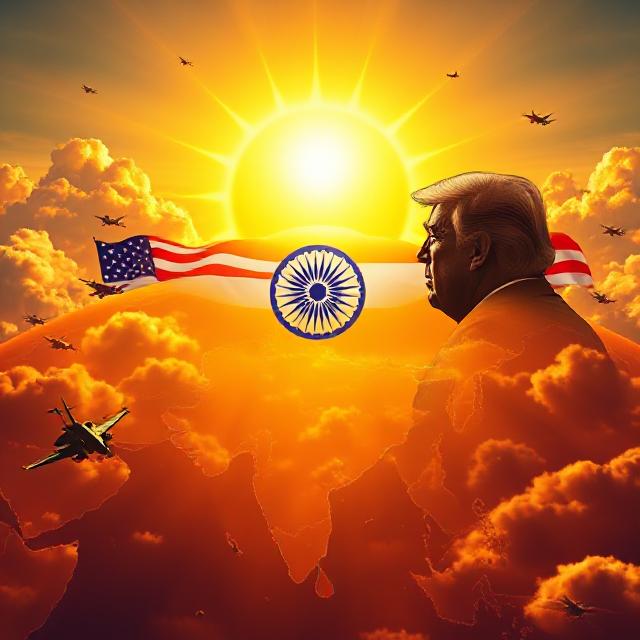
For decades, American foreign policy has been criticized as short-term and opportunistic. Yet, when it comes to India, Washington displayed rare consistency. From the Clinton years onward, Democratic and Republican administrations alike invested in a careful, bipartisan project: drawing India closer to the United States as a strategic counterweight to China.
That patient diplomacy—built brick by brick over 25 years—now stands on shaky ground. President Donald Trump’s renewed hostility toward India risks unraveling the most significant U.S. strategic realignment since the Cold War.
The Long Arc of U.S.–India Engagement
When President Bill Clinton visited India in 2000, he signaled a dramatic shift from decades of suspicion to cautious partnership. The Bush administration deepened this approach, recognizing that a rising China posed a challenge to the global order and that India, the world’s second-most populous nation, was the natural counterbalance.
George W. Bush took the boldest step: offering India a historic civil nuclear deal. By treating India as a responsible nuclear power rather than an outlier, Washington effectively ended India’s global isolation on the nuclear issue. This was a turning point—expertly managed on the Indian side by Prime Minister Manmohan Singh—and it transformed bilateral relations.
The Obama years took cooperation further. India was positioned as a cornerstone of Washington’s “pivot to Asia.” Trade surged, and the U.S. formally supported India’s aspirations for a permanent seat on the U.N. Security Council.
Trump’s first term, despite its unpredictability, gave political heft to the “Quad”—a grouping of the U.S., India, Japan, and Australia—and projected a personal rapport between Trump and Prime Minister Modi. Biden inherited this trajectory and expanded it, pushing for joint manufacturing in defense and technology, from fighter jets to semiconductor chips.
By 2025, India was exporting more smartphones to the U.S. than China—a symbolic victory in supply-chain realignment.
Trump 2.0: A Sudden Reversal
All of this makes Trump’s current shift even more startling. Without warning, his administration has moved India into its most restrictive category of partner countries—lumping it with pariah states such as Syria and Myanmar—while simultaneously extending overtures to Pakistan.
Reports of private meetings with Pakistan’s army chief and alleged business ties between Trump-linked firms and Pakistani institutions have fueled speculation of backroom deals. More dramatically, Trump publicly mocked India’s economy, dismissing it as “dead.”
The irony is striking. India has been the fastest-growing major economy for several years, is now the fourth largest in the world, and is projected to surpass Germany by 2028 to become the third-largest, after only the U.S. and China. It is the world’s second-largest arms importer and a vital hub for digital technology and consumer markets. Far from “dead,” India is central to the 21st-century global economy.
The Risk of Strategic Miscalculation
India is not an easy partner. Its history of colonization, Cold War ties with Moscow, and a deeply independent foreign policy tradition have made it cautious. Prime Minister Modi’s strategy of “multi-alignment” allowed India to keep ties with Washington, Moscow, and even Beijing simultaneously.
Yet, persistent U.S. diplomacy—combined with anxiety over China’s rise—was steadily nudging India into a closer embrace with Washington. That slow but crucial alignment may now be undone.
Trump’s hostility has united India’s political spectrum in outrage. A country that was moving past its ambivalence toward America is once again asking whether Washington can ever be trusted. The result may be a stronger tilt back toward Russia—and perhaps even a thaw with China.
America’s Reliability Question
For years, American diplomats argued that the U.S.–India relationship was destined to be one of the great strategic partnerships of the century: the world’s oldest democracy working hand in hand with its largest. That vision now looks deeply uncertain.
Even if Trump reverses course again—as he often does—the damage may be irreversible. India has seen a glimpse of American unpredictability at its harshest. For a nation obsessed with strategic autonomy, the lesson is clear: never put all your bets on Washington.
Trump may believe he is playing a tactical game with India. But in reality, he risks undoing 25 years of hard-won trust, and with it, America’s most promising counterweight to China. History may remember this as the moment when the U.S. lost India.

 Unmukt