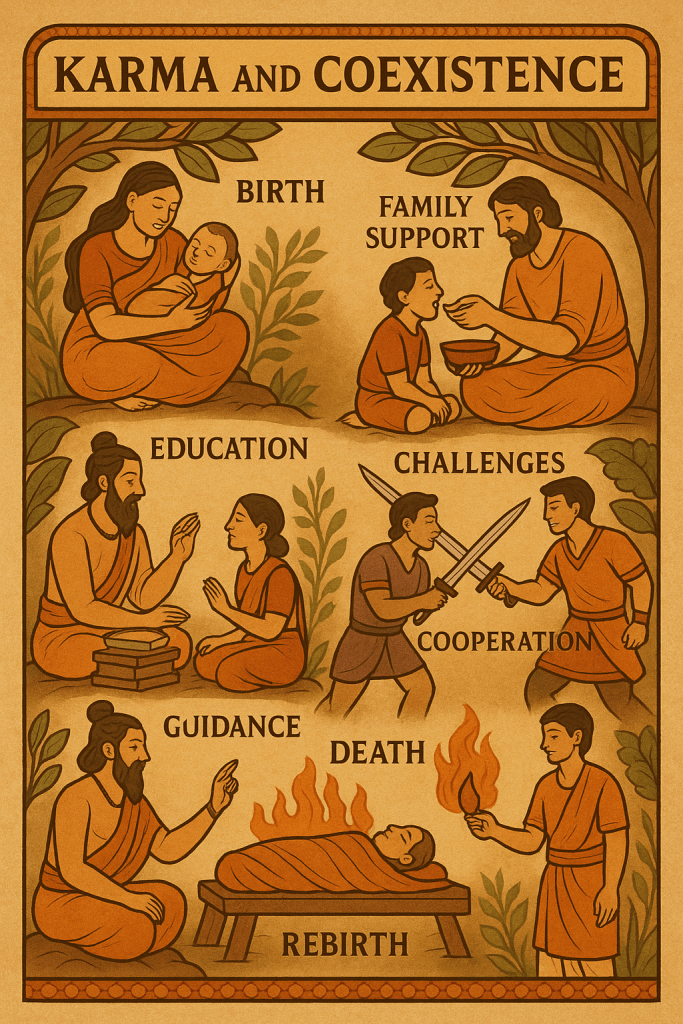
Let us reflect on the full arc of human life and how deeply interconnected it is:
- We are born through the sacred womb of a mother, not by our own will, but as a result of previous karma and divine arrangement. The very entry into this world is not in our hands.
- We are nurtured and raised by parents or caregivers who feed us, clothe us, and protect us — often sacrificing their own comfort for our survival.
- We are educated by teachers and guided by mentors, who shape our thoughts, character, and understanding of the world. It is they who help us recognize the dharma (righteous duty) aligned with our karma.
- We grow within a community and society that gives us language, law, order, infrastructure, and opportunity. Without the farmer, we have no food; without the artisan, no shelter; without the doctor, no healing. Every act of karma is carried out using resources and structures created by others.
- We are tested by life, including through difficult people — competitors, critics, and even enemies. Strangely, even they play a role in shaping our destiny by triggering our strength, resilience, and moral evolution.
- And when we die, it is our children, family, or society that cremates us, performs the last rites, and prays for our onward journey. Even at the end, we depend on others to fulfill what we cannot.
The Cycle of Karma and Rebirth
Hindu philosophy explains that until our karma is fully exhausted or perfected, we take birth again and again, each time to fulfill our soul’s unfinished duties or to learn deeper lessons. Whether we ascend to Vaikuntha (liberation) or return to Earth, it is karma that decides — and karma is only possible through relationships.
Even moksha (liberation) is not achieved through action alone, but through self-realization, surrender, and grace — all of which are cultivated in the presence of a Guru, community, or divine association.
Why Realizing Interdependence Matters
Understanding the collective nature of karma teaches us a profound truth:
“We are never truly independent — we are interdependent.”
This realization changes how we live:
It aligns us with the truth that individual progress is impossible without collective well-being.
It cultivates humility, breaking the ego that says “I alone achieved this.”
It fosters gratitude toward parents, teachers, co-workers, strangers — even adversaries.
It reminds us to honor and protect the ecosystem of life, for without it, we cannot even breathe.
It creates a sense of social dharma — a responsibility to give back, support others, and perform seva (selfless service).
From Individual Karma to Collective Harmony
In Bhagavad Gita (3.16), Lord Krishna says:
“एवं प्रवर्तितं चक्रं नानुवर्तयतीह यः । अघायुरिन्द्रियारामो मोघं पार्थ स जीवति ॥”
(Evam pravartitam chakram nānuvartayati iha yah,
aghāyur indriyārāmo mogham pārtha sa jīvati.”)
He who does not follow the cycle of duty and mutual cooperation lives in vain — a life of selfish indulgence.
This timeless verse reminds us that karma is not just personal action — it is our participation in the cosmic wheel of coexistence. Even a tree bears fruit not for itself, but for others. So too, we must perform our karma not in isolation, but in harmony with the world around us.
You Are Never Alone in Your Karma
While it is true that only your karma follows you beyond death, it is also true that you cannot perform your karma without others. Every breath, every step, every success — rests upon the shoulders of countless visible and invisible contributors.
This is the spiritual wisdom of sahabhāva (coexistence) and sahakāra (cooperation). To realize this is to walk the path of dharma — not with pride, but with gratitude; not with separation, but with unity.
“The soul performs its karma, but the world holds its hand while it does so.”
 Unmukt