Unmukt

Tag: finance

  • India’s Defence Exports Hit ₹23,622 Crore in 2024–25: A Quiet Revolution in Strategic Self-Reliance

    By Unmukts Editorial Team
    Published: July 30, 2025
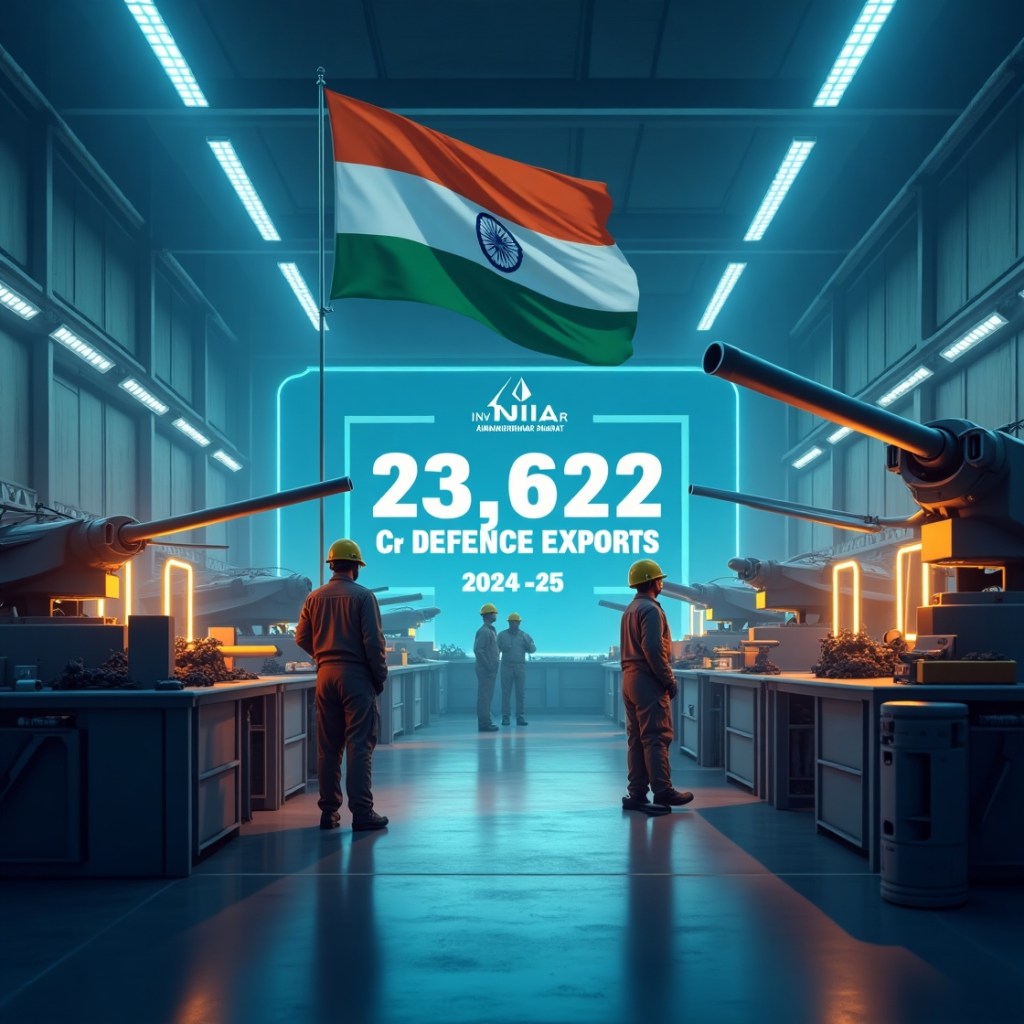
    When Defence Minister Rajnath Singh recently announced that India’s defence exports for 2024–25 touched a historic high of ₹23,622 crore, many nodded in agreement—but few grasped the full magnitude of what this number represents.

    This is not just a figure.
    It’s a 34-fold leap from 2013–14 levels, when exports stood at a mere ₹686 crore.
    It is also a testament to India’s silent transformation from a buyer to a builder—from importing submarines and jets to exporting cutting-edge defence technologies to nearly 80 countries.

    The Numbers That Tell a Story

    YearExport Value (₹ Crore)Growth from 2013–14
    2013–14686Base year
    2023–2421,08331x
    2024–2523,62234x

    This staggering increase of over 3,362% in just over a decade would be unthinkable without focused reforms and an attitudinal shift in how India perceives its defence sector—not as a cost centre, but as a core driver of self-reliance, innovation, and diplomacy.

    From “Buyer” to “Exporter”: What Changed?

    1. Policy Shifts and Strategic Vision

    Two major national missions have underpinned this growth:

    • Make in India: Launched in 2014, this initiative opened up India’s defence sector to private players and foreign investments.
    • Atmanirbhar Bharat: Championed after 2020, it redefined India’s military-industrial goals with self-reliance as a central pillar.

    The defence production ecosystem has since been backed by simplified export procedures, incentives for manufacturers, and an expanded Defence Acquisition Procedure (DAP) that prioritizes domestic sourcing.

    2. Opening the Gates for Private Sector Innovation

    In a sector historically dominated by Defence Public Sector Undertakings (DPSUs), the role of private companies has become increasingly dominant.

    In FY 2024–25:

    • Private players contributed ₹15,233 crore (approx. 64% of total exports)
    • DPSUs accounted for ₹8,389 crore, with a robust 42.85% year-on-year growth

    Startups and MSMEs, particularly in UAVs, radar systems, and niche weapons systems, have emerged as vital contributors.

    What Is India Exporting? And To Whom?

    India’s defence exports now cover a wide spectrum:

    • Light helicopters (e.g., Dhruv)
    • Coastal surveillance systems
    • Indigenous artillery systems
    • Ammunition, explosives, night vision equipment
    • Naval platforms, radars, communication systems

    These products are being sold to countries in Asia, Africa, Latin America, and even Europe—marking India’s growing credibility as a defence manufacturing hub.

    Beyond Exports: The Rise of Strategic Autonomy

    This export surge isn’t just about rupees and crores—it’s about a strategic shift. Defence exports amplify India’s soft power, strengthen bilateral ties, and position India as a responsible regional security provider.

    As India sets its next target of ₹50,000 crore in exports by 2029, this becomes not just a manufacturing challenge, but a strategic statement.

    What Can We Learn from This?

    For young Indians, startups, policy thinkers, and Unmukt readers who believe in a self-reliant, confident Bharat, this success is a blueprint:

    • Ambitious national goals matter.
    • Public-private collaboration works.
    • Global markets value Indian innovation—when backed by state policy and delivery capability.

    India’s record-breaking defence exports in 2024–25 are not just numbers. They are symbols of transformation—from dependence to determination, from a buyer mindset to an exporter’s confidence.

    In the world of geopolitics, economic strength, military resilience, and diplomatic assertiveness go hand in hand.

    As Unmukt, we believe this is just the beginning. Bharat is not just aiming to be the world’s factory—it is reclaiming its rightful place as a knowledge, defence, and innovation leader.
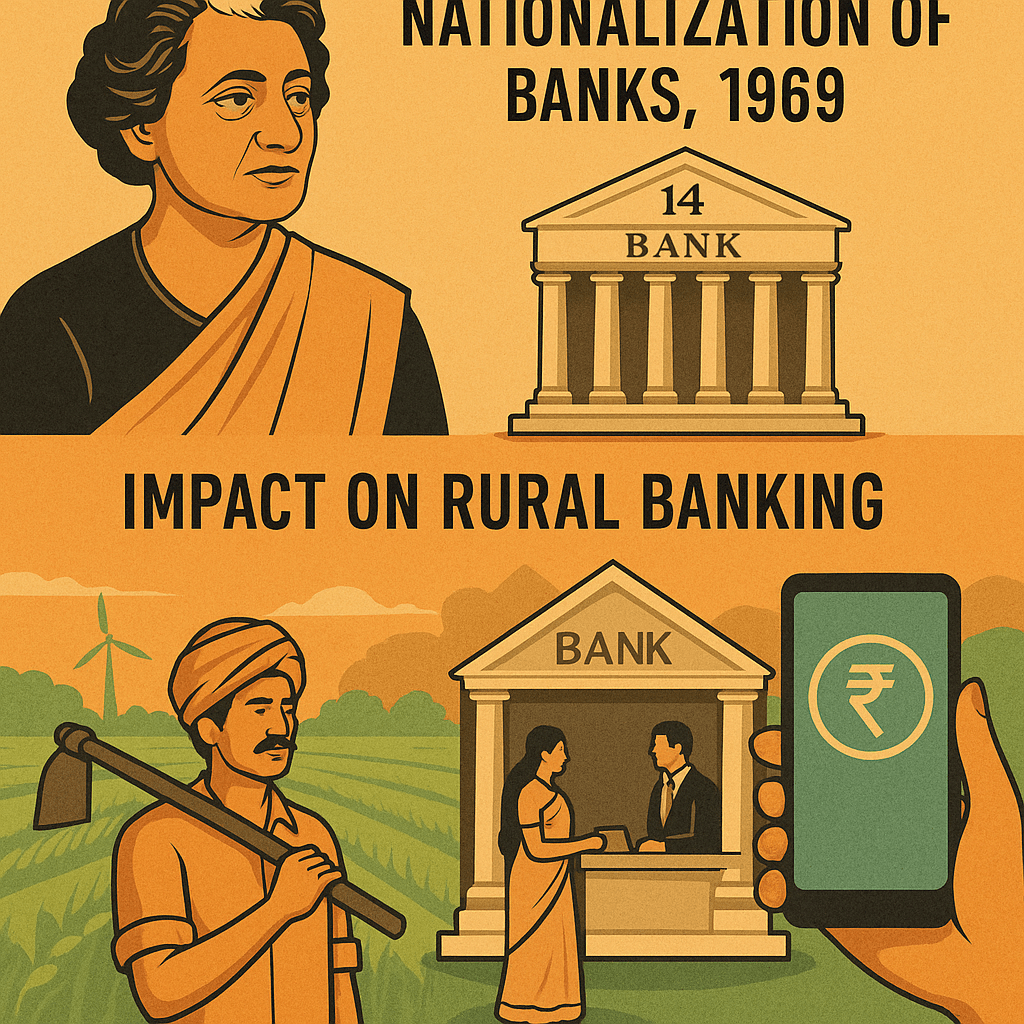
  • 1969 Bank Nationalization: Financial Control, Inclusion, and Governance Challenges

    As of May 15, 2025, reflecting on India’s economic history, the 1969 nationalization of 14 major commercial banks by Smt. Indira Gandhi stands as a pivotal moment. Aimed at expanding banking access to rural areas and prioritizing sectors like agriculture, the policy was heralded as a step toward social equity. However, economists debate whether it also served as a mechanism for financial control over citizens. This article examines the policy’s impact on rural India, the need for subsequent initiatives like the Pradhan Mantri Jan Dhan Yojana (PMJDY), and the governance challenges faced by Company Secretaries in government-owned entities navigating similar state-driven mandates.

    Objectives and Impact on Rural India

    The 1969 bank nationalization sought to democratize finance in a country where banking was largely urban-centric. In 1969, only 17% of bank branches were in rural areas, but by 1980, this number surged to over 15,000. The share of rural deposits grew from 3% in 1969 to 15% by 1985, and agricultural credit rose from 2% to 10% of total advances by 1975, per RBI data. This empowered rural farmers by reducing reliance on exploitative moneylenders and supported the Green Revolution’s agricultural boom.

    However, the policy had significant flaws. Many rural branches were unprofitable, leading to inefficiencies. Political interference skewed loan disbursal, often favoring politically connected individuals over the deserving. A lack of financial literacy left many accounts dormant, limiting the policy’s transformative potential. While it laid the foundation for financial inclusion, its implementation fell short of fully integrating rural India into the formal banking system.

    Economists’ Perspectives: A Tool for Financial Control?

    1. State Dominance Over Economic Activity

    Nobel laureate Amartya Sen, in Development as Freedom (1999), emphasizes economic freedom as a pillar of development. He argues that excessive state control over financial systems can curtail individual agency. While acknowledging nationalization’s intent to promote inclusion, Sen cautions that it enabled the state to influence citizens’ economic choices, such as directing credit to favored sectors or individuals. Historical records from the 1970s reveal instances where loans were disbursed based on political affiliations, indicating a form of financial control.

    2. Political Patronage and Bureaucratic Overreach

    Economist Jagdish Bhagwati, in India: Economic Reform and Growth (1993), critiques nationalization as part of the “license-permit raj.” He argues that it turned banks into tools of political patronage, allowing the government to control access to financial resources. In rural India, farmers often faced bureaucratic hurdles or needed political connections to secure loans, limiting their economic opportunities. Bhagwati contends this was not just about inclusion but about consolidating state power over citizens’ financial lives.

    3. Surveillance and Monetary Policy

    Former RBI Governor Raghuram Rajan, in The Third Pillar (2019), highlights how state-controlled banking systems enable financial surveillance. Nationalization gave the government unprecedented insight into citizens’ transactions. During the 1975–77 Emergency, the state used banks to freeze accounts of political opponents, a clear instance of financial control. By 2025, with digital banking and KYC norms, this surveillance has expanded, raising concerns about privacy and financial autonomy.

    4. Counterview: Focus on Financial Inclusion

    Economist Kaushik Basu, in a 2016 lecture, argues that nationalization’s primary goal was financial inclusion, not control. He credits the policy for bringing banking to rural India, reducing dependence on informal credit. The growth in rural deposits and agricultural lending supports this view, suggesting that political interference was an implementation failure rather than the policy’s intent.

    5. Mixed Outcomes

    Arvind Panagariya, in India: The Emerging Giant (2008), offers a balanced perspective. He acknowledges that nationalization empowered rural India but also created opportunities for state control. The Emergency and later events like demonetization in 2016, where public banks were instrumental in enforcing government policy, demonstrate how nationalization provided a mechanism for financial oversight, often at the expense of citizens’ autonomy.

    The Need for Jan Dhan Yojana

    If nationalization was so impactful, why did the Modi government launch the Pradhan Mantri Jan Dhan Yojana (PMJDY) in 2014? Despite the growth in rural banking post-1969, the 2011 Census revealed that only 54.4% of rural households had banking access. Many accounts remained dormant due to limited financial literacy and accessibility. PMJDY addressed these gaps by leveraging digital technology, opening over 53 crore accounts by 2025, with 67% in rural/semi-urban areas and deposits exceeding ₹2.3 lakh crore. Features like zero-balance accounts, RuPay cards, and overdraft facilities, combined with financial literacy campaigns, ensured greater usage, with over 80% of accounts active—a marked improvement over the nationalization era.

    Governance Challenges: The Role of a Company Secretary

    Similar to the dynamics of nationalization, government-owned companies often operate at the intersection of state control and public welfare. A Company Secretary in a 100% government-owned CPSE involved in land monetization faces unique challenges. They are responsible for ensuring corporate governance, legal compliance, and stakeholder coordination while navigating government mandates, such as those seen in asset monetization policies. For instance, the National Land Monetization Corporation (NLMC) can only acquire assets from CPSEs under strategic disinvestment at book value, as noted in prior correspondence. This limits flexibility, and political interference—akin to that seen in nationalized banks—can complicate compliance. A Company Secretary must balance transparency, manage board dynamics, and ensure financial accountability, often under bureaucratic pressure, mirroring the governance challenges of the nationalization era.

    Conclusion

    The 1969 bank nationalization was a landmark policy that expanded financial access in rural India, but it also served as a tool for state control, as debated by economists. While it empowered many, political interference and surveillance potential highlighted its dual nature. PMJDY built on this foundation, using modern technology to deepen inclusion. Yet, the legacy of nationalization persists in 2025, with public sector banks dominating the financial sector, raising ongoing questions about financial freedom versus state oversight. For Company Secretaries in government entities, these tensions underscore the need for robust governance to balance state objectives with public welfare, ensuring that policies serve citizens without compromising their autonomy.

  • Beyond the Battlefield: How Operation Sindoor Unlocks a $9 Billion Boom for India’s Defense Industry

    Introduction

    Operation Sindoor, executed on May 7–8, 2025, was not just a military success—it was an economic catalyst. With India’s air defense systems delivering flawless performance, the operation is expected to generate domestic and export revenues of up to ₹74,460 crore ($8.9 billion) over the next five years.

    Domestic Defense Renaissance

    India’s performance has triggered rapid procurement momentum:

    • QRSAM: A ₹30,000 crore Army order is expected after its precision during the drone assault.
    • Akash: Expansion to seven regiments with an added ₹12,240 crore spend.
    • VSHORADS: Fast-tracked production of 500 launchers and 3,000 missiles worth ₹5,500 crore.
    • Akashteer and BMD: Integration and automation systems receive increased funding.

    Indigenous development not only cuts reliance on imports but also delivers massive savings. For instance, SEOS targeting systems cost ₹2 crore domestically versus ₹12 crore from abroad, saving over ₹1,500 crore across future procurement.

    Export Windfall: Turning Trust into Trade

    With Chinese systems faltering in Pakistan, global eyes are turning to India. Nations such as Vietnam, the Philippines, and Kenya are likely buyers of Akash, QRSAM, and VSHORADS. SIDM and DRDO anticipate:

    • Akash Exports: ₹6,000–₹10,000 crore from 4–5 countries.
    • QRSAM/VSHORADS Deals: ₹1,500–₹3,500 crore expected in the next 3 years.
    • Chinese Market Disruption: India may capture 8–12% of China’s export losses, adding ₹750–₹1,500 crore.

    Indirect Gains and R&D Acceleration

    Operation Sindoor also boosts:

    • DRDO’s R&D Funding: Project Kusha and BMD Phase-II development gain momentum.
    • Global Trust: Western and Asian defense partnerships deepen, with potential co-development deals and tech-sharing initiatives.

    Challenges Ahead

    India must scale production through Bharat Electronics, BDL, and private players to meet surging demand. Competitive pricing and joint-venture diplomacy will be key to displacing Chinese systems in global markets.

    Conclusion

    Operation Sindoor has done more than secure Indian skies—it has unlocked an economic boom. With trust in India’s defense systems soaring, this moment could mark the transition from “Make in India” to “Export from India” in global defense markets.