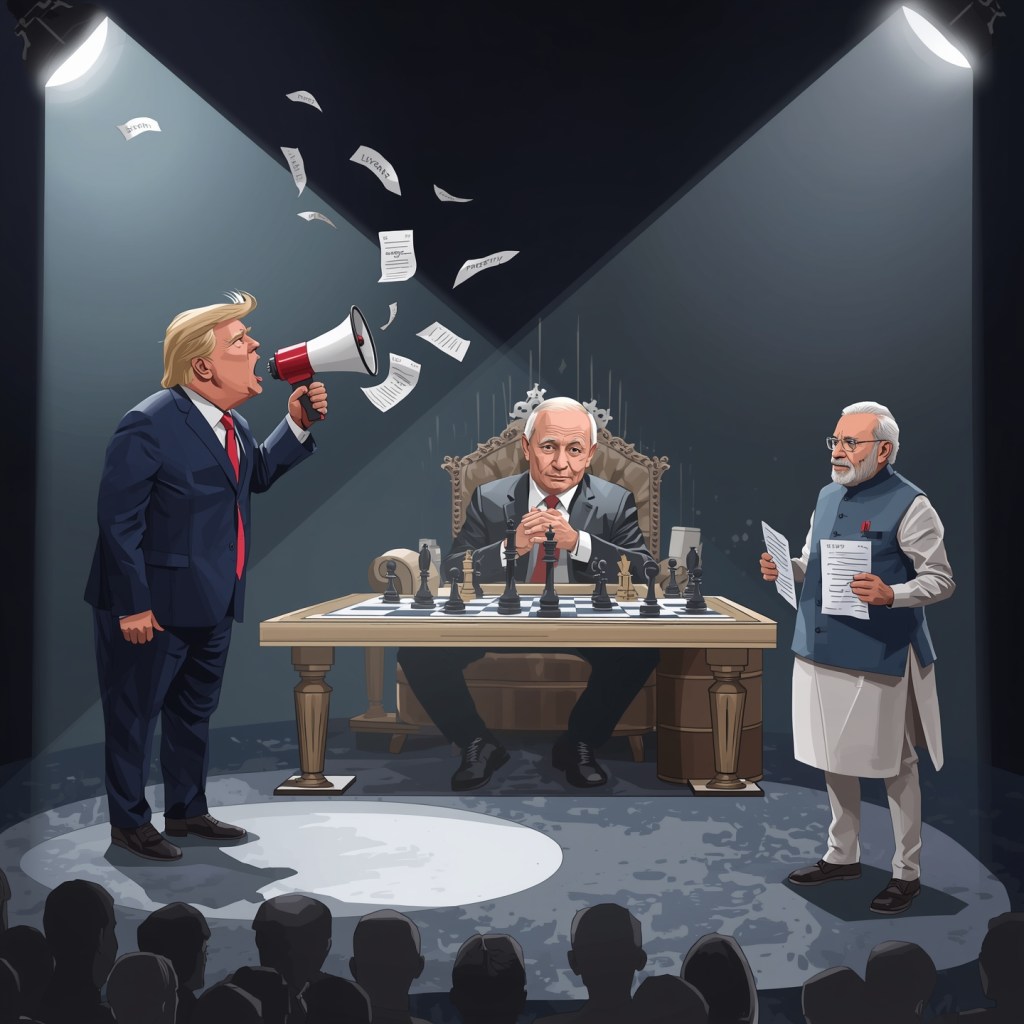
In the theater of global politics, Donald Trump’s method is disarmingly simple: create leverage, amplify it for media consumption, and then abandon it once the spotlight shifts. It is a style that may win headlines, but it rarely produces sustainable results.
The Leverage-Dump Cycle
Trump’s foreign policy, if it can be called that, revolves around momentary victories that fuel his domestic narrative. He brands himself as the master negotiator, but his “art of the deal” is often little more than tactical theater.
First, he identifies a pressure point – be it sanctions, tariffs, or rhetorical threats.
Then, he proclaims that his leverage is forcing change.
Finally, once the immediate headlines are secured, he abandons the issue or flips sides, leaving allies and adversaries confused and often alienated.
The problem is that leverage only works if it is backed by consistent strategy. Trump’s version is self-referential: he creates leverage in his own mind, celebrates it, and then discards it. In the short run, it excites his political base and dominates media cycles. In the long run, it erodes trust, weakens alliances, and strengthens adversaries.
India: Not a Pawn in Trump’s Game
Trump’s latest attempt to pull India into his narrative is a classic example. By claiming that he had “sanctioned” India to pressure Russia, he sought to project himself as a global power broker. The reality? India’s oil trade with Russia has doubled, not diminished.
New Delhi is not a pliable pawn in Trump’s improvisational chessboard. India’s foreign policy under Prime Minister Narendra Modi is defined by strategic autonomy. Whether it is purchasing Russian oil, strengthening ties with the United States, or engaging Europe and Africa, India pursues a multi-vector approach. It will not sacrifice its national interest to fuel an American politician’s election narrative.
This reality has eluded Trump. For him, India is often reduced to a talking point – a convenient prop in his domestic political theater. For India, however, Trump is one of many players in a world where multipolarity is the new normal.
Russia: The Patient Player
If Trump’s game is short-term theater, Vladimir Putin’s is long-term chess. While Trump performs for the cameras, Putin builds narratives grounded in history and sustained by military and economic realities.
In his meetings, Putin often subjects interlocutors to history lessons stretching back decades. Trump, famously allergic to detail, cannot sit through such sessions without distraction. The asymmetry is obvious: one plays to CNN and Fox News soundbites, the other plays to centuries of Russian statecraft.
During recent encounters, Putin allowed Trump his moments of triumph. He even threw him a “lollipop” by suggesting that had Trump been president, the Ukraine war might not have happened. It cost Putin nothing to say it, but it gave Trump a headline. Meanwhile, Russia’s fundamental objectives remain unchanged: Ukraine will not join NATO, and Moscow will not cede the territories it controls.
The Media Mirage
Trump’s approach resonates with his political base – the MAGA faithful who see him as a champion against elites. For them, the illusion is enough. But outside America, the cracks are visible. The American media, both left and right, has lambasted his foreign policy blunders. Analysts have called his maneuvers “the greatest foreign policy mistake” and “the undoing of decades of bipartisan effort.”
The world is not fooled. India sees through the noise, continuing to expand trade with Russia. Putin indulges Trump’s theatrics, but on his own terms. Europe remains skeptical. Even America’s traditional allies worry that another Trump presidency would mean volatility rather than strategy.
The Bottom Line
Donald Trump is not playing a grand game of geopolitics. He is playing a grand game of media – one where perception outweighs policy, and short-term drama eclipses long-term stability.
India and Russia, in their own ways, have adapted. India ignores the noise and quietly pursues its national interest. Russia humors Trump, using him when convenient, but remains anchored in its strategic objectives.
The world must understand: Trump’s greatest victories are not on the battlefield of diplomacy but in the arena of headlines. For allies and adversaries alike, the challenge is the same – to distinguish between the spectacle of leverage and the reality of strategy.
In a recent statement, India’s Defence Minister Rajnath Singh emphasized the essence of “Brand India” in the context of the nation’s burgeoning defence industry: “If an Indian company makes a promise, it will be fulfilled. If a product is designed to perform within a certain range or at a specific temperature, it will do so without exception. There should be no compromise on quality.” This bold assertion, made at the National Quality Conclave in Delhi, underscores India’s ambition to position itself as a trusted global supplier of defence products, particularly ammunition. The slogan “Don’t go for doubt, go for India” encapsulates this vision, aiming to instill confidence in international buyers. However, the statement also carries a subtle geopolitical undertone, seemingly promoting Indian ammunition as superior while positioning it as a counter to competitors like China and even Pakistan. This article explores India’s push for quality assurance in its ammunition industry, its strategic positioning against regional rivals, and the challenges and opportunities in becoming a trusted global supplier.
The Rise of India’s Ammunition Industry
India’s defence sector has undergone a significant transformation in recent years, driven by the government’s “Atmanirbhar Bharat” (Self-reliant India) initiative. Historically one of the world’s largest arms importers, India is now focusing on indigenous production to reduce dependency on foreign suppliers. The ammunition sector is a key pillar of this strategy. According to a 2024 report, India aims to halt ammunition imports by 2025-26, with local sources already supplying nearly 150 of the 175 ammunition types used by the Indian Army. This shift is supported by substantial investments, with 27.67% of the defence budget allocated to modernizing and expanding ammunition production facilities.
Private players like Adani Defence and Aerospace and SMPP, alongside state-owned entities like Munitions India, are scaling up production of critical ammunition, such as 155 mm artillery shells, which are significantly cheaper than their Western counterparts ($300-$400 per unit compared to $3,000 for European equivalents). Additionally, advancements like the 155 mm smart ammunition demonstrate India’s commitment to technological innovation. These developments not only bolster national security but also position India to capture a share of the global ammunition market, projected to grow at a CAGR of 3.5% through 2033.
Quality Assurance: The Cornerstone of Brand India
The Defence Minister’s emphasis on uncompromising quality reflects a strategic effort to build “Brand India” as a symbol of reliability. Past challenges, such as defective ammunition incidents reported in 2010 and 2016, highlighted quality control issues within the Ordnance Factory Board (OFB). These incidents, including a 2016 explosion that killed 19 soldiers, underscored the need for robust quality assurance mechanisms. The government’s response has been to streamline the OFB into seven Public Sector Defense Undertakings and foster private-sector participation to enhance efficiency and accountability.
Today, initiatives like the e-module launched by the Odisha Police in August 2024 for ammunition inventory management signal a move toward digitalization and precision in quality control. Companies are also adopting international standards, with platforms like India Index verifying suppliers for compliance, financial stability, and transparency to assure global buyers of consistent quality. Rajnath Singh’s assertion that Indian products will meet promised specifications—whether range, temperature resilience, or lethality—aims to erase doubts about reliability, positioning India as a dependable alternative to traditional suppliers like Russia and emerging competitors like China.
Strategic Positioning Against Pakistan and China
The Defence Minister’s remarks carry a geopolitical subtext, subtly promoting Indian ammunition as superior in the context of regional rivalries with Pakistan and China. India’s defence strategy is shaped by the dual threat posed by these nuclear-armed neighbors, with past conflicts and ongoing tensions driving modernization efforts. The Indian Army’s push to stockpile ammunition for a 15-day intense war, up from a previous 10-day reserve, reflects preparations for a potential two-front conflict.
Against Pakistan, India’s ammunition capabilities are implicitly showcased through its ability to produce cost-effective, high-quality munitions. For instance, India’s 155 mm artillery shells are not only cheaper but also tailored to meet modern warfare demands, unlike Pakistan’s reliance on Chinese imports, which account for 81% of its arms imports. The 2022 accidental misfire of a BrahMos missile into Pakistani territory, while embarrassing, highlighted India’s advanced missile capabilities, even if inadvertently.
China, a major arms exporter with 5.9% of the global market, poses a more complex challenge. Chinese ammunition and equipment, often sold at below-cost prices to countries like Pakistan, Bangladesh, and Myanmar, leverage Beijing’s Belt and Road Initiative for political influence. However, international buyers remain wary of Chinese products due to concerns about quality and political strings attached. India is capitalizing on this hesitation by offering reliable, competitively priced alternatives. For example, India’s $375 million deal to supply BrahMos missiles to the Philippines demonstrates its ability to secure high-value contracts in China’s backyard.
By emphasizing quality assurance, India is not only countering China’s market dominance but also positioning its ammunition as a strategic tool to strengthen ties with nations wary of Chinese influence. The slogan “Don’t go for doubt, go for India” subtly contrasts India’s reliability with perceived uncertainties surrounding Chinese products, appealing to international buyers seeking dependable suppliers.
Challenges in Becoming a Trusted Global Supplier
Despite its progress, India faces significant hurdles in establishing itself as a trusted global supplier. First, its defence export sector remains modest, accounting for only 0.2% of the global arms market as of 2015-19. While exports reached $2.5 billion in FY 2023-24, India dropped out of the top 25 arms exporters in FY 2022-23, indicating challenges in sustaining momentum. Key markets like Myanmar and Sri Lanka also procure from China, creating stiff competition.
Quality assurance remains a work in progress. Incidents like the 2020-2023 crashes of Advanced Light Helicopters (ALHs) and the rejection of the naval version of the LCA Tejas by the Indian Navy raise concerns about reliability among potential buyers. Additionally, India’s private sector, while growing, is hampered by bureaucratic ties to public-sector firms, which can stifle innovation and efficiency.
Financing is another bottleneck. Unlike China, France, or Turkey, which offer credit guarantees to buyers, Indian banks are reluctant to finance arms exports to countries with high credit or political risks. The government is addressing this through the Export-Import Bank (EXIM), which is expanding low-cost, long-term loans to attract buyers. However, scaling this initiative to compete with global players requires significant resources and diplomatic outreach.
Finally, India’s diversification of arms imports—from Russia to Western suppliers like France and the US—has created a trust deficit with some partners, potentially limiting technology transfers critical for indigenization. Balancing strategic autonomy with the need for advanced technology remains a delicate task.
Opportunities and the Path Forward
India’s ammunition industry is poised for growth, driven by increasing defence budgets, technological advancements, and a global demand for cost-effective solutions. The government’s focus on indigenization, with 75% of the capital procurement budget earmarked for domestic industries in FY 2023-24, is fostering innovation. Major platforms like the Pinaka rocket launcher, BrahMos missile, and Akash SAM are gaining traction in markets like Armenia, the Philippines, and Vietnam.
To realize the “Don’t go for doubt, go for India” vision, India must prioritize several strategies:
Strengthen Quality Assurance: Invest in advanced testing facilities, international certifications, and digital inventory management to ensure consistent quality. Collaborations with NATO countries, as seen with Reliance Defence, can enhance credibility.
Expand Financing Options: Scale up EXIM’s loan portfolio and explore government-backed credit guarantees to compete with China and Western suppliers.
Target Emerging Markets: Focus on countries in Africa, Southeast Asia, and Latin America, where China’s influence is growing but quality concerns persist. Diplomatic efforts, as suggested by the Stimson Center, can help identify trusted buyers.
Leverage Strategic Partnerships: Deepen ties with Western allies like the US and France for technology transfers while maintaining relations with Russia to ensure spare parts for existing systems.
Promote Brand India Globally: Use platforms like the National Quality Conclave to showcase success stories, such as the BrahMos deal, and counter negative perceptions from past incidents.
Conclusion
India’s ambition to become a trusted global supplier of ammunition is rooted in its commitment to quality assurance and the “Brand India” philosophy. By emphasizing reliability, as articulated by Rajnath Singh, India is positioning itself as a counterweight to China’s market dominance and a strategic partner to nations seeking dependable defence solutions. While challenges like quality control, financing, and competition persist, India’s cost-effective production, technological advancements, and diplomatic outreach offer significant opportunities. The slogan “Don’t go for doubt, go for India” is more than a marketing pitch—it’s a call to action for India to deliver on its promises and reshape the global defence landscape. As the nation continues to modernize its ammunition industry, it is not only preparing to defend its borders but also aiming to win the trust of international buyers, one reliable product at a time.

 Unmukt