Former U.S. President Donald Trump’s quest for the Nobel Peace Prize has taken an unexpected turn. What once looked like a promising campaign, backed by multiple countries, is now facing a credibility crisis — and the reason lies with one of his own nominators.
A Rare Wave of Support
Trump’s nomination for the Nobel Peace Prize was endorsed by five countries: Pakistan, Israel, Armenia, Azerbaijan, and Cambodia. Each cited his role in mediating conflicts or pushing for negotiations, particularly in the Armenia–Azerbaijan peace deal and in efforts surrounding the Russia–Ukraine war. Pakistan’s endorsement was particularly strong, with its Army Chief, General Asim Munir, personally crediting Trump with helping to de-escalate tensions between India and Pakistan.
For Trump, the support seemed like a validation of his self-styled image as a global peacemaker. He often reminded audiences that his leadership had brought nuclear-armed rivals to the table and claimed credit for reducing hostilities across regions.
The Nuclear Threat That Backfired
But the same General Munir who once championed Trump has now become his greatest liability. Speaking in the United States, Munir issued an alarming statement: Pakistan, he warned, could “destroy half the world” with nuclear weapons if its survival were at stake.
Such rhetoric is in direct contradiction to the values of the Nobel Peace Prize, which celebrates efforts to prevent war and build reconciliation. The Nobel Committee has reportedly taken the statement seriously. And Trump’s silence on Munir’s words has fueled speculation that he is unwilling to distance himself from the threat, lest he lose a key nominator’s backing.
The Irony of the Obstacle
This irony cannot be overlooked. The very figure who bolstered Trump’s claim for the Nobel Prize may now be the reason his candidacy collapses. In the eyes of the Nobel Committee, association with nuclear threats — even indirectly — risks disqualifying any candidate from consideration as a peacemaker.
A Fragile Bid
The Nobel decisions are expected in October. Even if Trump succeeds in advancing peace talks between Russia and Ukraine, his bid is overshadowed by Munir’s outburst. For Trump, the dream of being recognized as a global peace icon faces an obstacle he could not have predicted: the words of the man who helped nominate him.
In the end, the episode is a reminder of how reputations in international diplomacy are fragile. One misplaced statement — even by an ally — can undo years of carefully built narratives. For Trump, the path to the Nobel Prize is no longer about his efforts alone, but about whether the world believes his cause for peace is free of the shadows of nuclear threats.
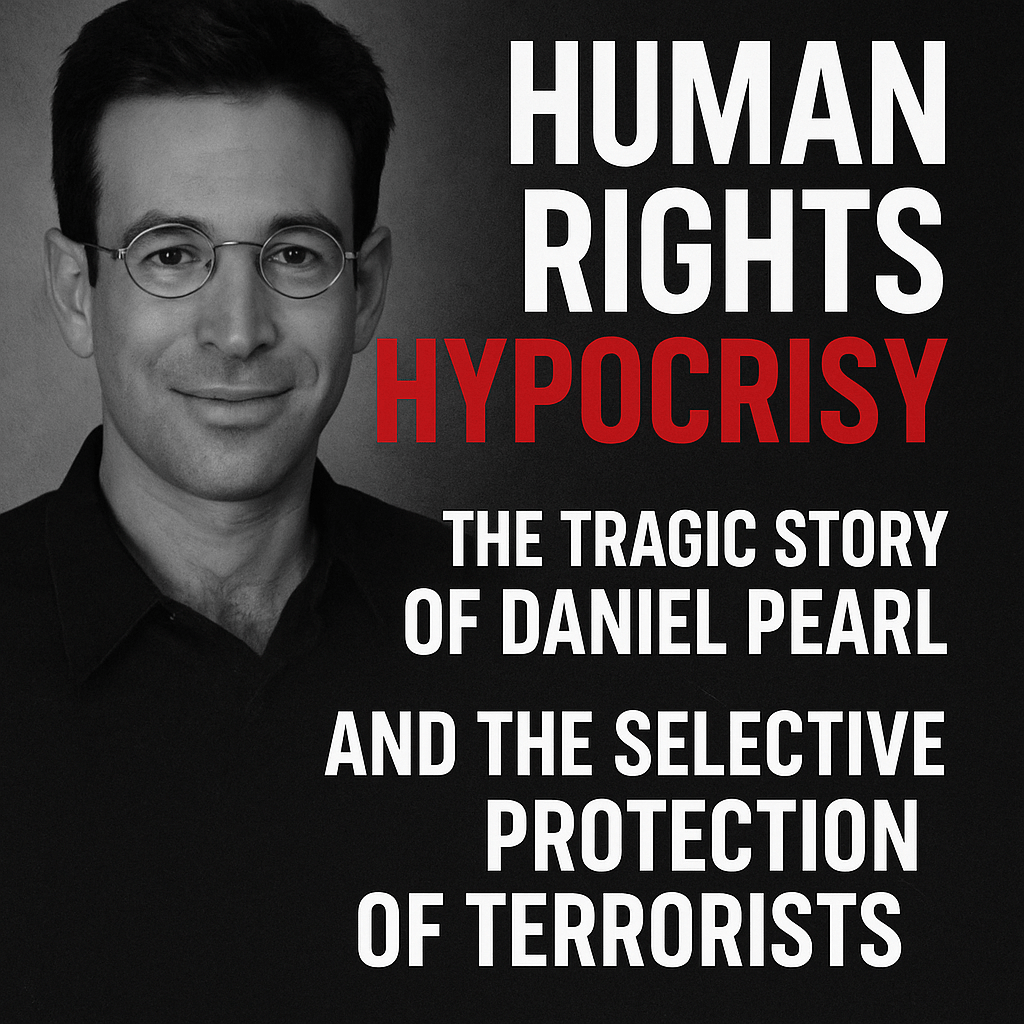
Human rights are meant to protect the dignity, freedom, and well-being of every individual, regardless of nationality, race, or belief. These principles are supposed to be universal and applicable to all people. However, a disturbing trend has emerged over the years—one where terrorists are granted the very protections intended for innocent victims, often in stark contrast to the silence or neglect of the victims of terrorism themselves. This hypocrisy of human rights advocacy is especially evident in the tragic story of Daniel Pearl, the Wall Street Journal journalist who became a victim of one of the most horrific terrorist acts of the early 21st century.
Daniel Pearl’s Tragic Murder
In 2002, Daniel Pearl, an investigative journalist based in Pakistan, was abducted by a group of Islamist extremists while he was working on a story about the growing threats of radical terrorism in the region. His investigation had led him to Al-Qaeda links and the global jihadist network, and his work focused on uncovering the connections between Islamic extremists and various state and non-state actors.
On January 23, 2002, while researching, Daniel was kidnapped in Karachi by a group led by Ahmed Omar Saeed Sheikh, a British-Pakistani terrorist who was later convicted for his role in the crime. Shortly thereafter, Pearl’s captors made it clear that his life was at risk, and on February 21, 2002, they released a gruesome video showing his brutal beheading. This heinous act shocked the world and exposed the true face of radical Islamic terrorism.
Daniel Pearl was not just a journalist; he was a man dedicated to revealing the truth about the growing terror networks operating under the guise of religious extremism. His murder was a tragic loss not only to his family but also to the world of journalism and the pursuit of truth. But what happened in the aftermath of his murder speaks volumes about the hypocrisy in the treatment of terrorists and terror victims.
The Failure to Hold Terrorists Accountable
In the years following Pearl’s murder, his killers—especially the mastermind, Ahmed Omar Saeed Sheikh—became a symbol of the international community’s inability to take decisive action against those who commit acts of terrorism. Despite being sentenced to death by a Pakistani court, Sheikh’s trial was mired in controversy, and in 2020, a Pakistani court shockingly acquitted him of charges related to Pearl’s death, citing a lack of evidence and pointing to the possibility of political motivations behind the case.
While Daniel Pearl’s family and the global community sought justice, the Pakistani government, a key ally in the War on Terror, showed a disturbing reluctance to fully investigate and prosecute those involved in Pearl’s murder. The question remains: why did the world remain largely silent in the face of such a blatant act of terror? And more importantly, why did human rights organizations often choose to focus their energies on protecting terrorists, rather than demanding justice for victims like Daniel Pearl?
Human Rights Hypocrisy: Terrorists and Victims in the Same Light
The tragic story of Daniel Pearl serves as a glaring example of the hypocrisy inherent in certain aspects of the human rights movement. In many instances, terrorists—individuals who destroy lives, spread fear, and violate the most basic rights of others—are often given legal protections and media attention, while their victims are left behind in the shadows.
This hypocrisy is particularly evident when we look at the way certain human rights organizations rallied around individuals linked to terrorist acts. Take the example of Aafia Siddiqui, often referred to as the “Lady al-Qaeda.” Siddiqui was convicted in 2010 for attempting to murder U.S. soldiers in Afghanistan and for her connections to terrorist groups like Al-Qaeda. Yet, despite her involvement in terror, human rights groups began campaigning for her release, focusing on her alleged mistreatment in U.S. custody, rather than her role in terrorism.
At the same time, the victims of the terrorism Siddiqui and others like her supported were often left out of the discussion. For example, the 9/11 attacks left nearly 3,000 people dead, yet those who died are often overshadowed by campaigns that prioritize the rights of terrorists over those of the victims.
The case of Daniel Pearl fits perfectly into this pattern. While the terrorists responsible for his murder have, in some cases, received legal protections, the victim’s rights—the rights of a journalist who was simply doing his job to report on the truth—were ignored by both the Pakistani authorities and many in the international community. Human rights organizations that often rally behind accused terrorists conveniently overlook the impact of their violence on innocent people.
The Double Standard: Victims of Terror vs. Terrorists
The human rights double standard becomes even more troubling when examining the global response to the terrorist threat. On one hand, human rights groups demand that those accused of terrorism be afforded due process, even when there is clear evidence of their involvement in heinous acts. On the other hand, these same organizations often remain silent or downplay the rights of victims, such as Daniel Pearl and others who have been affected by terrorism.
Take, for example, the Paris terrorist attacks in 2015, where dozens of innocent civilians were slaughtered by Islamic extremists. While there was outrage over the attacks and support for the victims’ families, there was also considerable attention on the rights of the attackers. Human rights groups, once again, were quick to argue that the accused terrorists must be afforded their legal rights, including protection from torture and inhumane treatment, but the voices of the victims and their families were often drowned out in the debate.
Conclusion: The World Must Choose Justice Over Hypocrisy
The death of Daniel Pearl should serve as a stark reminder of the hypocrisy inherent in the selective application of human rights principles. While the terrorists responsible for his death—and those like them—are often shielded by human rights activists, the victims of their violence are often ignored or forgotten. The world must recognize that human rights should be about justice for everyone, not just those who commit atrocities. Terrorists should not be shielded by legal protections while their victims continue to suffer in silence.
Daniel Pearl’s death was not just a tragedy for his family but for the world. It was a reminder of the need to hold terrorists accountable and protect the rights of the innocent. Until the international community truly upholds human rights for all—victims and perpetrators alike—the hypocrisy of human rights will continue to tarnish the ideals that should be protecting us all.
This story serves as a call to action for justice, truth, and a true commitment to universal human rights. Only then can we begin to create a world where victims of terror are protected and terrorists are held to account for their actions.
For years, the phrase “Atank ka koi dharm nahi hota” (Terrorism has no religion) has been repeated in media, politics, and public discourse. It sounds noble, inclusive, and idealistic. But is it really true? Or is it a blanket used to hide a very uncomfortable reality?
Let’s break the silence.
Terrorism Has No Dharma — But It Clearly Has a Majhab
In the Indian spiritual context, “Dharma” means righteousness, a path of moral duty. No true Dharma – be it Sanatan, Buddhism, Sikhism, or Jainism – preaches hatred, violence, or mass murder. So yes, terrorism has no Dharma.
But what many hesitate to say openly is this:
Terrorism does have a religious identity — a Majhab. And in most modern global and regional terror incidents, that Majhab is Islam, particularly the radicalized versions followed by extremist groups.
Look at the Pattern – The Truth is Not Hidden
Across the world — from 9/11 in New York, the 26/11 attacks in Mumbai, Pulwama, to the beheadings of French cartoonists, London stabbings, ISIS genocide of Yazidis, or Boko Haram in Nigeria — a majority of terrorists were not just claiming Islamic identity but also justifying their actions in the name of jihad.
They didn’t hide their intent.
They shouted “Allahu Akbar” as they killed.
They issued fatwas.
They quoted verses.
They targeted non-Muslims, ex-Muslims, and even moderate Muslims who refused to conform.
Victims: Almost Always Non-Muslims
From the Kashmiri Pandits, to Hindus in Bengal, Sikhs in Afghanistan, Jews in Israel, Christians in Africa and the Middle East, and even atheists and rationalists in Bangladesh — the victims of Islamic terrorism have overwhelmingly been non-Muslims.
So, when someone says terrorism has no religion, one must ask:
Then why do all these terrorists follow the same one?
And why are their targets always those outside it?
Why the Silence? Why the Hypocrisy?
Calling out this pattern is not “Islamophobia.”
It is not hate.
It is truth-telling.
Moderate Muslims themselves are often victims of this radicalization. But when the global system refuses to name the source of ideological terrorism, it does a disservice to the real victims — and even to reformers within Islam who want change.
If we continue this politically correct denial, we empower radical groups hiding behind religious freedom while they exploit religion to spread terror.
Conclusion: Speak the Truth, Not Just What Sounds Good
Yes, terrorism has no Dharma – because no righteous path justifies it.
But terrorism certainly has a Majhab – and until we recognize that, fight it ideologically, and demand accountability from within, the victims will keep increasing — and they’ll keep being non-Muslims.


 Unmukt