Unmukt

Tag: makeinindia

  • Trump Calls India a Dead Economy. Rahul Gandhi Nods. Facts Say Otherwise

    In a recent statement, former U.S. President Donald Trump described India as a “dead economy.” Shockingly, Indian political leader Rahul Gandhi echoed this sentiment, using it to attack the current government. What both these men fail to grasp — or deliberately ignore — is the reality of India’s economic and geopolitical strength.

    Let’s start with the facts:

    • 🇮🇳 India’s GDP growth in FY 2024-25: 7%
    • 🇺🇸 U.S. GDP growth in H1 2025: 1.25%
    • 🇷🇺 Russia’s GDP growth in 2024: -4.1%

    India is, by far, the fastest-growing major economy in the world — driven by manufacturing, services, exports, infrastructure, and a digitally empowered population.

    Meanwhile, the U.S. is barely growing, and Russia is shrinking. So who is the “dead economy” here?

    The Hypocrisy of Trump

    Donald Trump calls China America’s biggest threat, yet his policies end up helping China.
    How?

    He imposes tariffs on Apple and other U.S. multinational products manufactured in India — a democratic ally. These punitive actions discourage American companies from diversifying away from China.

    Instead of supporting India as a reliable partner, Trump treats it as a threat. This isn’t strategy — this is short-sighted populism that benefits Beijing, not Washington.

    Rahul Gandhi’s Echo Chamber Politics

    What’s worse than Trump’s ignorance? An Indian leader endorsing it.

    Rahul Gandhi, who constantly speaks of “saving democracy,” found himself aligning with a man known for undermining democratic values — simply because he saw an opportunity to score political points.

    When a national leader amplifies a foreign voice that demeans India’s rise, it’s not dissent — it’s disgrace.

    India needs an opposition that holds the government accountable while standing for the nation, not one that joins hands with foreign critics just to attack political rivals.

    India Is Not the Problem. India Is the Solution.

    India is not an expansionist power. It doesn’t threaten global stability — it strengthens it. As the world faces rising authoritarianism and economic stagnation, India offers something rare:

    • A democratic system that works
    • A young population ready to innovate and build
    • A geopolitical balance that offers stability to both the East and the West
    • A thriving market that welcomes global investment and fair competition

    If anything, a strong and self-confident India solves problems for the West — by offering a counterweight to China, a partner in tech and defence, and a responsible voice in global affairs.

    India has many challenges. But calling it a “dead economy” is not just inaccurate — it’s insulting. And when Indian leaders echo these falsehoods, they undermine the very nation they claim to serve.

    At Unmukt, we believe in Dharma-based politics — rooted in truth, strength, and national pride. India doesn’t need validation from foreign leaders. But it does need its own citizens, especially its leaders, to stand with her — not against her.

    Let critics speak. Let the facts roar louder.
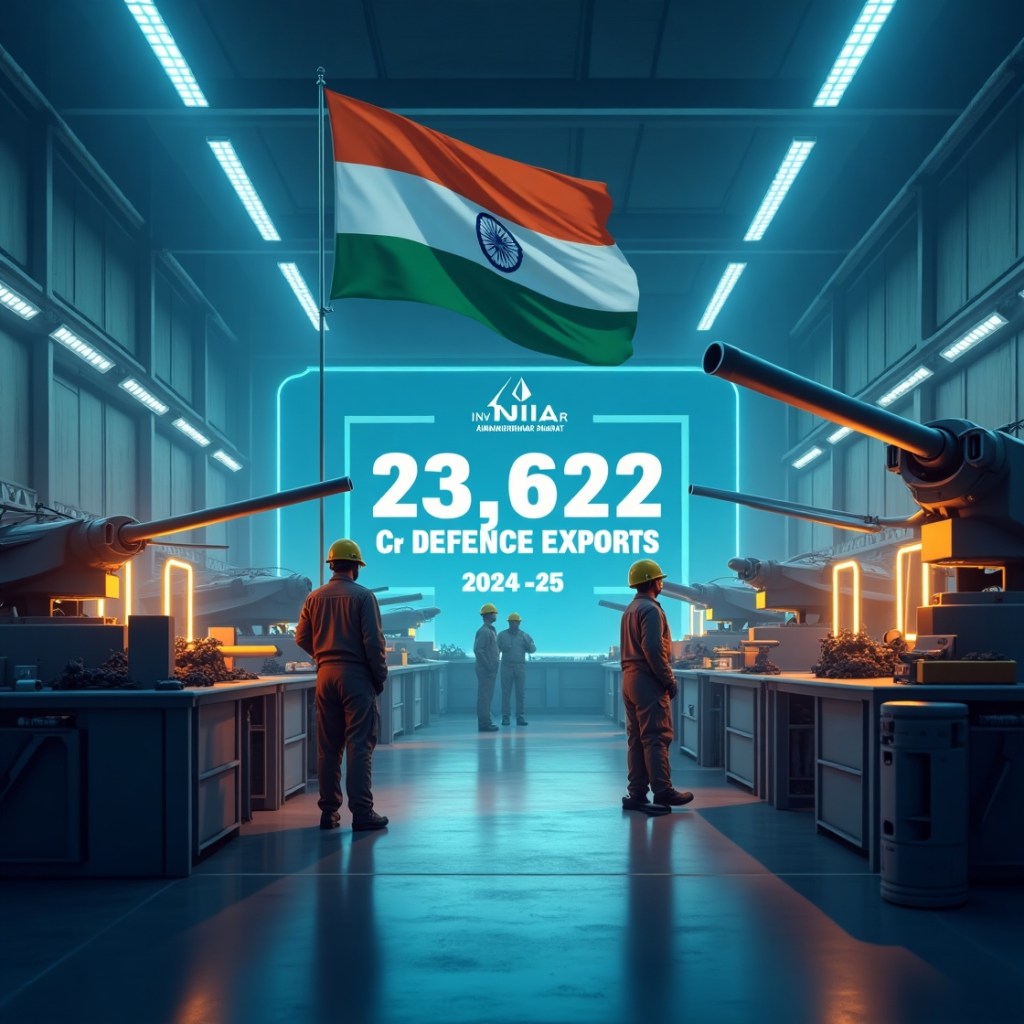
  • India’s Defence Exports Hit ₹23,622 Crore in 2024–25: A Quiet Revolution in Strategic Self-Reliance

    By Unmukts Editorial Team
    Published: July 30, 2025

    When Defence Minister Rajnath Singh recently announced that India’s defence exports for 2024–25 touched a historic high of ₹23,622 crore, many nodded in agreement—but few grasped the full magnitude of what this number represents.

    This is not just a figure.
    It’s a 34-fold leap from 2013–14 levels, when exports stood at a mere ₹686 crore.
    It is also a testament to India’s silent transformation from a buyer to a builder—from importing submarines and jets to exporting cutting-edge defence technologies to nearly 80 countries.

    The Numbers That Tell a Story

    YearExport Value (₹ Crore)Growth from 2013–14
    2013–14686Base year
    2023–2421,08331x
    2024–2523,62234x

    This staggering increase of over 3,362% in just over a decade would be unthinkable without focused reforms and an attitudinal shift in how India perceives its defence sector—not as a cost centre, but as a core driver of self-reliance, innovation, and diplomacy.

    From “Buyer” to “Exporter”: What Changed?

    1. Policy Shifts and Strategic Vision

    Two major national missions have underpinned this growth:

    • Make in India: Launched in 2014, this initiative opened up India’s defence sector to private players and foreign investments.
    • Atmanirbhar Bharat: Championed after 2020, it redefined India’s military-industrial goals with self-reliance as a central pillar.

    The defence production ecosystem has since been backed by simplified export procedures, incentives for manufacturers, and an expanded Defence Acquisition Procedure (DAP) that prioritizes domestic sourcing.

    2. Opening the Gates for Private Sector Innovation

    In a sector historically dominated by Defence Public Sector Undertakings (DPSUs), the role of private companies has become increasingly dominant.

    In FY 2024–25:

    • Private players contributed ₹15,233 crore (approx. 64% of total exports)
    • DPSUs accounted for ₹8,389 crore, with a robust 42.85% year-on-year growth

    Startups and MSMEs, particularly in UAVs, radar systems, and niche weapons systems, have emerged as vital contributors.

    What Is India Exporting? And To Whom?

    India’s defence exports now cover a wide spectrum:

    • Light helicopters (e.g., Dhruv)
    • Coastal surveillance systems
    • Indigenous artillery systems
    • Ammunition, explosives, night vision equipment
    • Naval platforms, radars, communication systems

    These products are being sold to countries in Asia, Africa, Latin America, and even Europe—marking India’s growing credibility as a defence manufacturing hub.

    Beyond Exports: The Rise of Strategic Autonomy

    This export surge isn’t just about rupees and crores—it’s about a strategic shift. Defence exports amplify India’s soft power, strengthen bilateral ties, and position India as a responsible regional security provider.

    As India sets its next target of ₹50,000 crore in exports by 2029, this becomes not just a manufacturing challenge, but a strategic statement.

    What Can We Learn from This?

    For young Indians, startups, policy thinkers, and Unmukt readers who believe in a self-reliant, confident Bharat, this success is a blueprint:

    • Ambitious national goals matter.
    • Public-private collaboration works.
    • Global markets value Indian innovation—when backed by state policy and delivery capability.

    India’s record-breaking defence exports in 2024–25 are not just numbers. They are symbols of transformation—from dependence to determination, from a buyer mindset to an exporter’s confidence.

    In the world of geopolitics, economic strength, military resilience, and diplomatic assertiveness go hand in hand.

    As Unmukt, we believe this is just the beginning. Bharat is not just aiming to be the world’s factory—it is reclaiming its rightful place as a knowledge, defence, and innovation leader.