Unmukt

Tag: politics

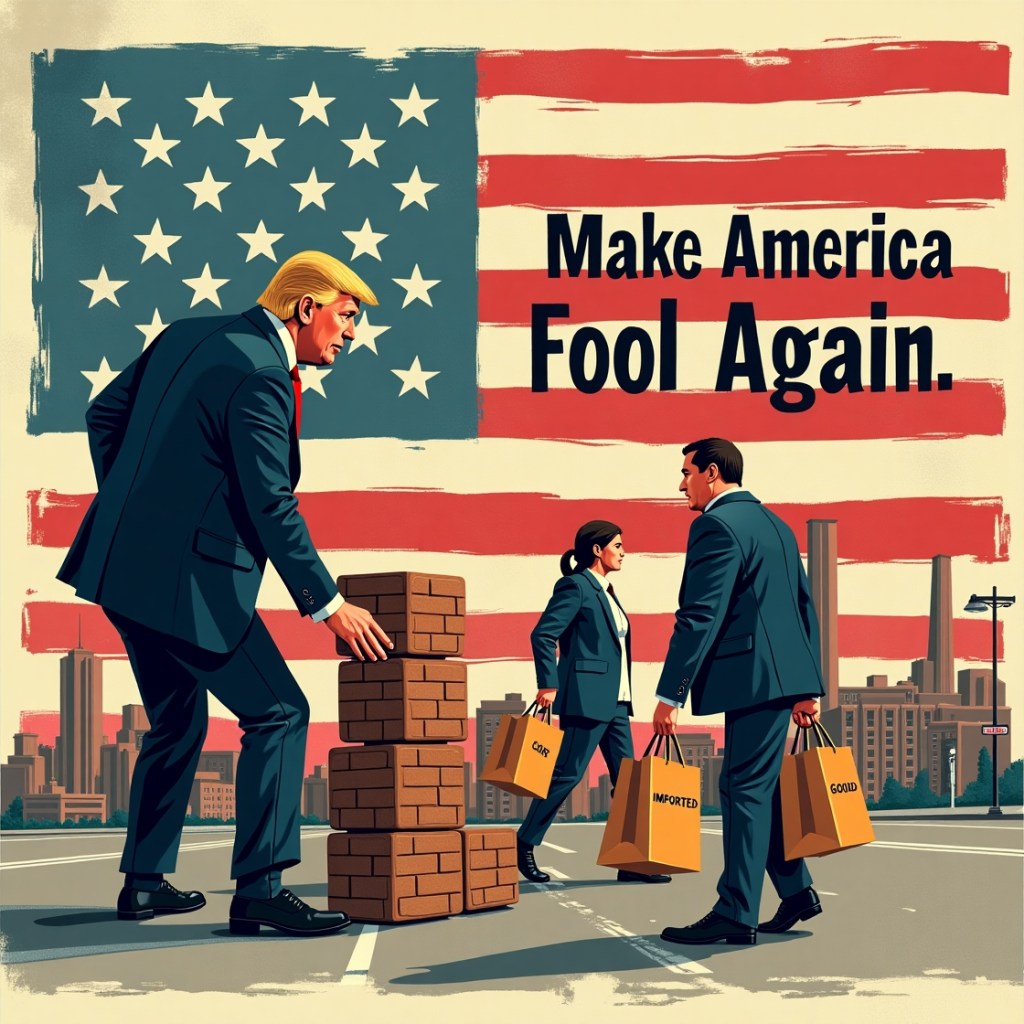
  • Make America Fool Again: The Self-Inflicted Cost of Trump’s Tariff Nationalism

    In the age of performative patriotism and economic brinkmanship, Donald Trump’s favorite rallying cry—“Make America Great Again”—may need a reboot: “Make America Fool Again.” At the heart of this irony lies a simple but devastating reality—tariffs. While marketed as weapons of economic warfare against foreign “cheaters,” these tariffs have become boomerangs, hitting American consumers harder than anyone else.

    The Illusion of Economic Toughness

    Trump’s tariff-heavy strategy is pitched as bold nationalism: taxing foreign imports to promote American-made goods and force foreign governments to yield to U.S. demands. On paper, it sounds tough. In practice, it’s economically self-defeating in a nation where most consumer goods—from iPhones to bananas—are sourced globally.

    The U.S. consumer economy is import-dependent by design. Over 70% of retail goods involve foreign components or are directly imported. In this environment, tariffs function not as pressure on foreign manufacturers—but as an invisible tax on American families.

    Who Really Pays?

    Let’s cut through the rhetoric: Americans pay these tariffs. Corporations simply pass the added costs to the customer. In 2025 alone, U.S. households are expected to pay $1,270 to $2,400 more per year, solely due to tariff-related inflation. Prices for groceries, clothing, furniture, electronics, and cars have jumped—without corresponding wage increases.

    Even basic foods are not spared. Bananas, coffee, and wine—items not grown at scale in the U.S.—have no domestic alternative. The tariff on them isn’t protective; it’s punitive to consumers.

    Case Study: Autos, Goods, and Stock Shocks

    Tariffs on imported autos have driven vehicle prices up by 11%. At the same time, American car manufacturers suffer too—many rely on imported parts. The result? No winners.

    Consumer goods giants like Procter & Gamble and Nestlé have announced price hikes across product lines. Even the stock market responds negatively, with dips in shares of consumer-oriented companies whenever new tariffs are announced.

    A Strategy Without Substitutes

    While Trump’s team insists tariffs will push the U.S. to “de-risk” from China, the reality is that alternatives (like Vietnam or Mexico) often rely on Chinese supply chains themselves. Meanwhile, U.S. manufacturing lacks the scale, workforce, or cost advantage to replace imports meaningfully. The result is disruption without a solution.

    Nationalism at Whose Cost?

    This is where the slogan flips: “America First” has become America Pays First. These tariffs act as regressive taxes, hurting middle- and lower-income Americans most. They dampen consumer spending, slow economic growth, and hollow out household budgets—all under the banner of economic patriotism.

    Trump presents himself as the dealmaker, the protector of American interests. But in the arena of global trade, he’s wielding a sledgehammer where surgical tools are needed.

    As political theater, tariffs may look decisive. But behind the scenes, they erode the very fabric of the U.S. consumer economy. What began as a campaign promise to restore greatness has, in effect, triggered the largest stealth tax hike on American households in three decades.

    The irony is stark. In trying to punish others, America punishes itself.

    So, the new slogan practically writes itself:
    “Make America Fool Again.”

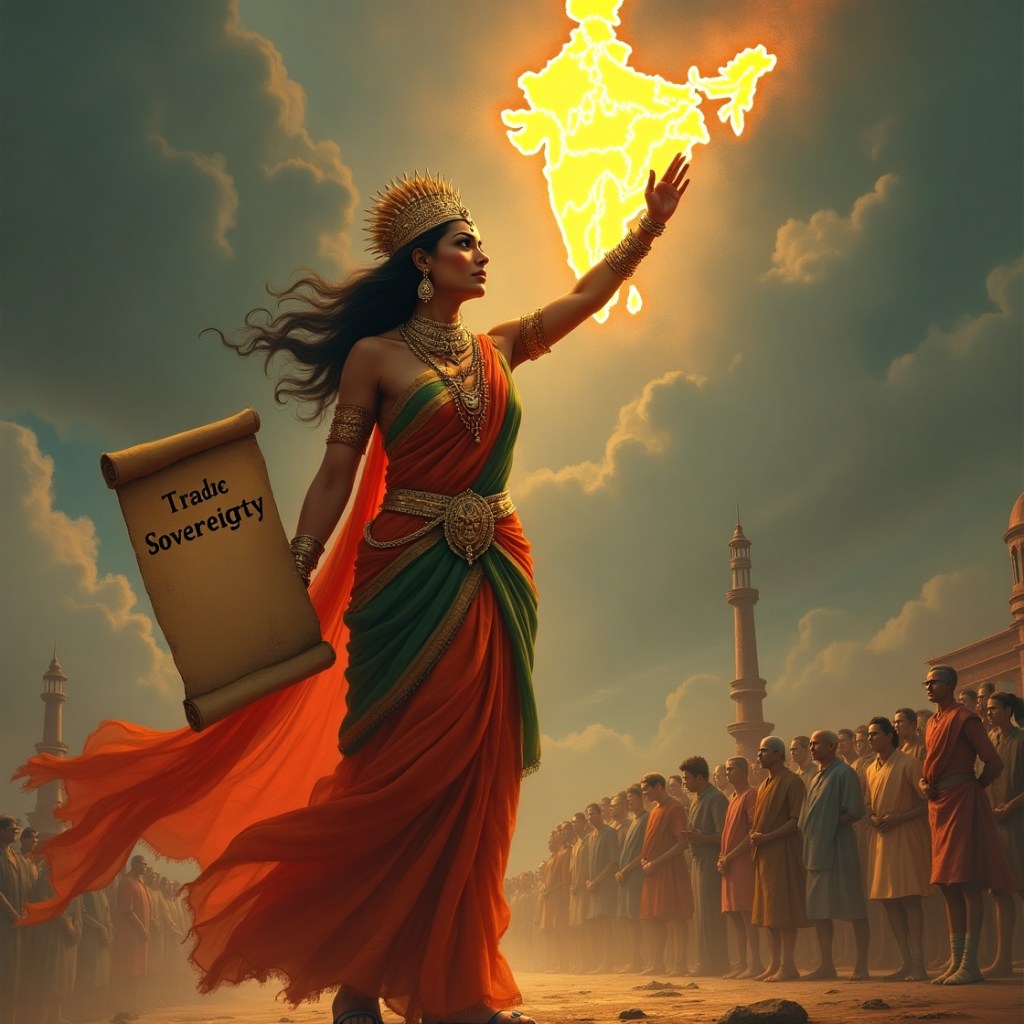
  • Modi Didn’t Blink: How India Protected Its Trade Sovereignty from Trump’s 25% Tariff Threat

    “They expected India to bow. Instead, India built a backbone.”

    In an age where many nations retreat under U.S. pressure, India stood tall. When Donald Trump returned to the White House in 2025 and announced sweeping 25% tariffs on Indian exports, many global observers braced for panic in New Delhi.

    But that panic never came.

    Instead, they saw a familiar face—Narendra Modi, calm, calculated, and completely unshaken.

    No Panic. No Compromise. No Deal Under Duress.

    The Modi government could have taken the easy route:
    Make a few trade concessions, appease Trump’s ego, beg for tariff exemptions—and spin it as diplomacy.

    But this time, India chose something far more powerful: Dignity.

    Despite looming tariffs, there was:

    • No sudden outreach from Indian envoys.
    • No last-minute offers on agriculture, dairy, or digital trade.
    • No weakening of India’s strategic relationship with Russia, which lies at the center of this trade conflict.

    Instead, India waited. Watched. And sent a clear message to Washington:

    We don’t trade our sovereignty—not for discounts, not for praise, not for fear.

    Modi in Parliament: A Defining Moment

    Just day before yesterday, in a charged Parliament session, PM Modi delivered a masterstroke without raising his voice:

    “No foreign leader has ever asked me to stop any internal operation in India.”

    This one line, subtle but piercing, was a direct counter to Trump’s old claims that he “mediated” between India and Pakistan—a lie that had embarrassed Indian diplomacy in the past.

    By affirming that no leader has dared question India’s internal affairs, Modi wasn’t just defending Kashmir or Manipur or economic autonomy—he was drawing a red line for the world.

    A line that says:
    This is New India. Strong, sovereign, and unafraid.

    The India of 2025 Is Not the India of 1991

    In the past, India bent.

    • In the ’90s, India opened markets under IMF pressure.
    • In the 2000s, India hesitated on nuclear autonomy until George Bush stepped in.
    • Even during the first Trump term, India showed restraint, trying to “keep the relationship warm.”

    But today, the tone has changed.

    Modi understands that India’s market of 1.4 billion, its tech and manufacturing potential, and its civilizational strength can’t be treated like a pawn in someone else’s game.

    Why Modi’s Boldness Matters

    Let’s be clear: Trump’s tariffs are real. They will hurt sectors like textiles, jewelry, and some pharma exports. But short-term pain is sometimes necessary for long-term independence.

    Because if India caved now, it would set a dangerous precedent:

    • That Washington can dictate Indian trade partners.
    • That a tariff threat can reverse our Russia strategy.
    • That India must “ask permission” before doing business with the world.

    But thanks to Modi, that precedent will never be set.

    What the World Needs to Learn from India

    China never compromises its red lines. Iran survives with zero Western sympathy. Even tiny Cuba resists American bullying.

    So why should India, a rising global power, act like a junior partner?

    By refusing to blink, Modi has elevated India’s position globally—from “strategic ally” to sovereign equal.

    The U.S. now knows:

    • India won’t trade policy for praise.
    • It won’t choose between friends because someone shouted louder.
    • And it won’t let elections in Washington decide its trade map.

    You can debate Modi’s domestic record. You can critique his style. But on the global stage, one fact is undeniable:

    He is the first Indian Prime Minister who doesn’t flinch , not before China, not before Pakistan, and now, not even before America.

    As Trump throws tariffs like tantrums, India responds not with fear but with strategic silence backed by steel nerves.

    That’s leadership.
    That’s sovereignty.
    That’s Modi.

  • India’s Defence Exports Hit ₹23,622 Crore in 2024–25: A Quiet Revolution in Strategic Self-Reliance

    By Unmukts Editorial Team
    Published: July 30, 2025

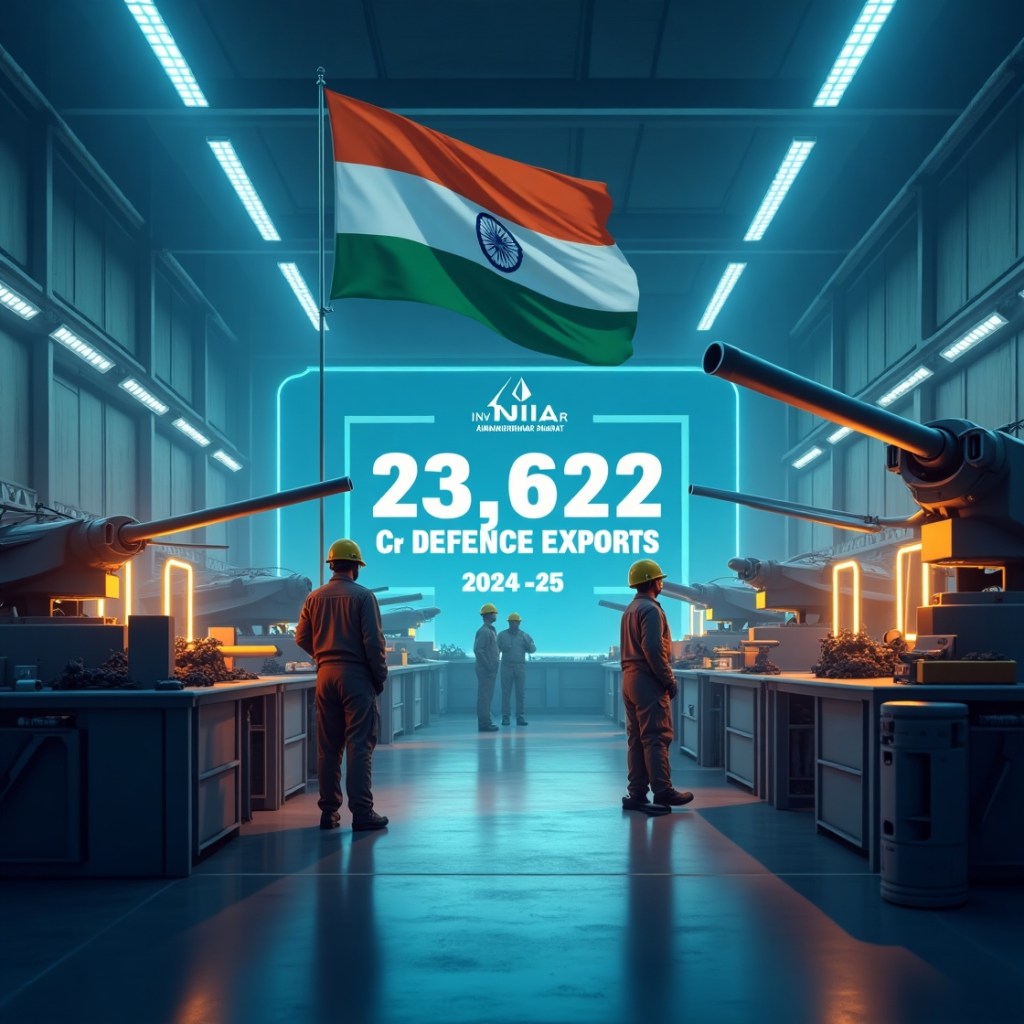
    When Defence Minister Rajnath Singh recently announced that India’s defence exports for 2024–25 touched a historic high of ₹23,622 crore, many nodded in agreement—but few grasped the full magnitude of what this number represents.

    This is not just a figure.
    It’s a 34-fold leap from 2013–14 levels, when exports stood at a mere ₹686 crore.
    It is also a testament to India’s silent transformation from a buyer to a builder—from importing submarines and jets to exporting cutting-edge defence technologies to nearly 80 countries.

    The Numbers That Tell a Story

    YearExport Value (₹ Crore)Growth from 2013–14
    2013–14686Base year
    2023–2421,08331x
    2024–2523,62234x

    This staggering increase of over 3,362% in just over a decade would be unthinkable without focused reforms and an attitudinal shift in how India perceives its defence sector—not as a cost centre, but as a core driver of self-reliance, innovation, and diplomacy.

    From “Buyer” to “Exporter”: What Changed?

    1. Policy Shifts and Strategic Vision

    Two major national missions have underpinned this growth:

    • Make in India: Launched in 2014, this initiative opened up India’s defence sector to private players and foreign investments.
    • Atmanirbhar Bharat: Championed after 2020, it redefined India’s military-industrial goals with self-reliance as a central pillar.

    The defence production ecosystem has since been backed by simplified export procedures, incentives for manufacturers, and an expanded Defence Acquisition Procedure (DAP) that prioritizes domestic sourcing.

    2. Opening the Gates for Private Sector Innovation

    In a sector historically dominated by Defence Public Sector Undertakings (DPSUs), the role of private companies has become increasingly dominant.

    In FY 2024–25:

    • Private players contributed ₹15,233 crore (approx. 64% of total exports)
    • DPSUs accounted for ₹8,389 crore, with a robust 42.85% year-on-year growth

    Startups and MSMEs, particularly in UAVs, radar systems, and niche weapons systems, have emerged as vital contributors.

    What Is India Exporting? And To Whom?

    India’s defence exports now cover a wide spectrum:

    • Light helicopters (e.g., Dhruv)
    • Coastal surveillance systems
    • Indigenous artillery systems
    • Ammunition, explosives, night vision equipment
    • Naval platforms, radars, communication systems

    These products are being sold to countries in Asia, Africa, Latin America, and even Europe—marking India’s growing credibility as a defence manufacturing hub.

    Beyond Exports: The Rise of Strategic Autonomy

    This export surge isn’t just about rupees and crores—it’s about a strategic shift. Defence exports amplify India’s soft power, strengthen bilateral ties, and position India as a responsible regional security provider.

    As India sets its next target of ₹50,000 crore in exports by 2029, this becomes not just a manufacturing challenge, but a strategic statement.

    What Can We Learn from This?

    For young Indians, startups, policy thinkers, and Unmukt readers who believe in a self-reliant, confident Bharat, this success is a blueprint:

    • Ambitious national goals matter.
    • Public-private collaboration works.
    • Global markets value Indian innovation—when backed by state policy and delivery capability.

    India’s record-breaking defence exports in 2024–25 are not just numbers. They are symbols of transformation—from dependence to determination, from a buyer mindset to an exporter’s confidence.

    In the world of geopolitics, economic strength, military resilience, and diplomatic assertiveness go hand in hand.

    As Unmukt, we believe this is just the beginning. Bharat is not just aiming to be the world’s factory—it is reclaiming its rightful place as a knowledge, defence, and innovation leader.

  • Operation Sindoor: Facts, Fiction, and the Fight for Narrative Control

    In the age of digital disinformation, wars are no longer fought just on the battlefield — they’re fought on WhatsApp, Twitter, and newsrooms. Operation Sindoor, India’s swift and precise military response to a Pakistan-backed terror attack, became not only a story of strategic success but also a case study in how facts are often buried beneath layers of political spin, foreign commentary, and media speculation.

    What Triggered Operation Sindoor?

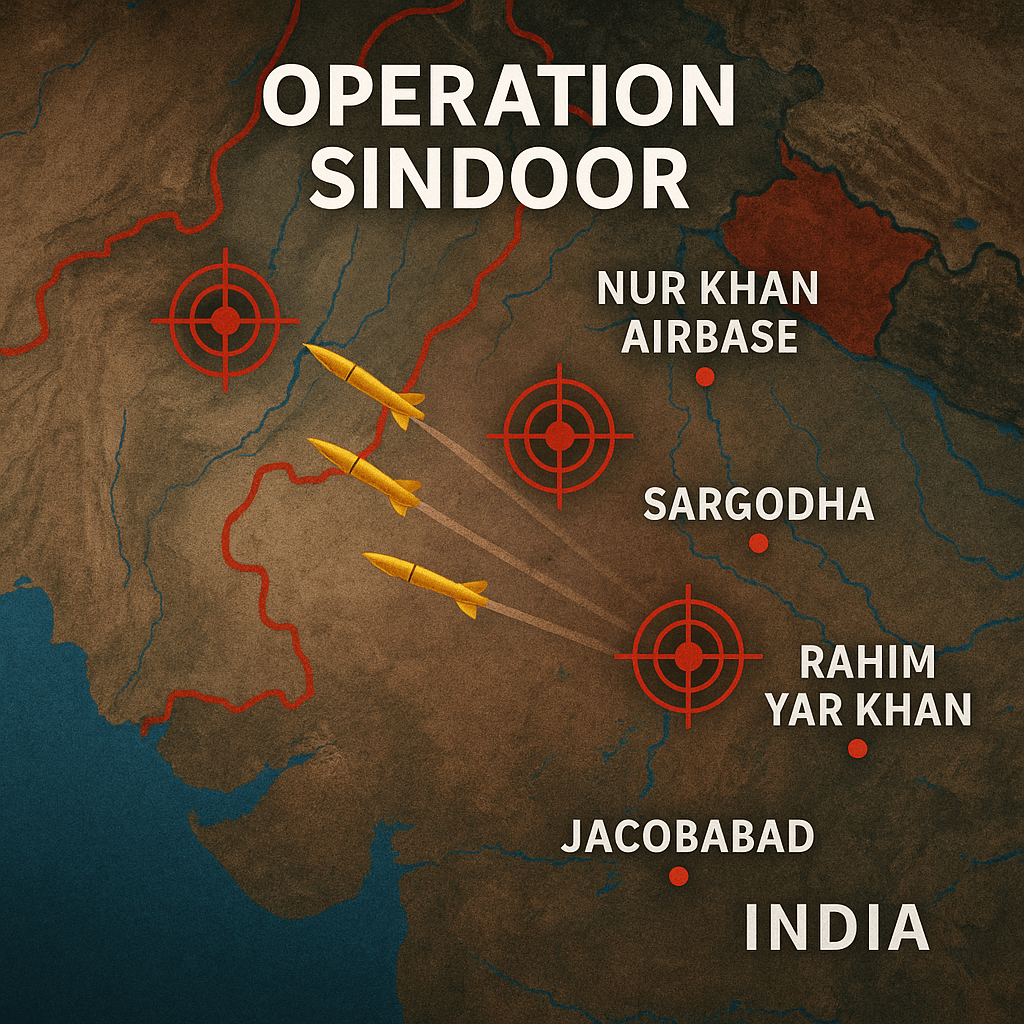
    On April 22, 2025, a brutal terror attack in Pahalgam, Jammu & Kashmir, claimed the lives of 26 civilians, including pilgrims. Intelligence traced the plot to Pakistan-based terrorist groups, prompting India to launch Operation Sindoor — a 23-minute air and missile operation that began at 4:03 AM on May 7, 2025.

    Targets of the Operation Included:

    • Nur Khan Airbase (Rawalpindi)
    • Mushaf Base (Sargodha)
    • Rahim Yar Khan airbase
    • Shahbaz Airbase (Jacobabad)
    • Radar sites in Pasrur and Lahore

    Satellite images later confirmed damage to runways, bunkers, and radar systems. The strikes were precise, time-bound, and aimed at disabling Pakistan’s offensive capabilities while avoiding civilian casualties.

    Ceasefire: No Mediation, Just a Phone Call

    Contrary to various media reports and speculative comments, especially from former U.S. President Donald Trump, the ceasefire was not the result of international mediation.

    On May 10, 2025, Pakistan’s Director General of Military Operations (DGMO) made a direct hotline call to his Indian counterpart, requesting a halt to hostilities. India’s DGMO and the Ministry of External Affairs (MEA) confirmed that the ceasefire was arranged bilaterally.

    MEA Statement:

    There was no international mediation. The ceasefire was arranged solely via military channels.”
    — Vikram Misri, Foreign Secretary, Government of India

    Then why didn’t Prime Minister Modi publicly respond to Trump’s claim? Because diplomacy is about clarity, not volume. When the Ministry of Defence and MEA have issued a formal position, repeating it from the Prime Minister’s podium only adds fuel to unfounded rumors.

    Rafale Jet Shot Down? Absolutely False

    Following Operation Sindoor, Pakistani media and some fringe outlets claimed that a Rafale jet was shot down during the operation.

    The Reality:

    • India’s Defence Secretary R. K. Singh confirmed that no Indian aircraft, including Rafale, was lost in combat.
    • Dassault Aviation, the Rafale manufacturer, also denied any loss.
    • India’s Press Information Bureau (PIB) flagged the Pakistani claim as “completely false.”

    The truth? One Rafale returned early due to a minor sensor malfunction. It was back in the skies within three days. There was no shoot-down, no crash, and no damage. Just a lie wrapped in clickbait.

    The “3 Jets Down” at Shangri-La? Misinterpretation

    At the Shangri-La Dialogue in Singapore, India’s Chief of Defence Staff, General Anil Chauhan, mentioned that three aircraft were grounded for checks during the operation.

    This was twisted by some commentators into claims that “three Indian jets were downed.” In reality, these aircraft were not hit by enemy fire — they were temporarily grounded as a safety measure and were operational again within 48 hours.

    What the CDS Actually Said:

    “We studied a tactical mistake that temporarily grounded three jets. But within 48 hours, they were back in action.”

    There is a big difference between a strategic review and a battlefield loss. The former makes you stronger. The latter didn’t happen.

    Who Saved Indian Skies? Not Just S-400s

    Another myth that made the rounds was that India’s Russian-made S-400 missile defence system saved the country from Pakistan’s drone and missile strikes.

    While the S-400 was deployed to cover high-altitude sectors, the real heroes were India’s indigenous air defence systems:

    • Akash SAMs
    • MR-SAMs (jointly with Israel)
    • L/70 Anti-Aircraft Guns
    • Akashteer Command & Control Network

    These systems intercepted over 90% of incoming drones and missiles, particularly low-cost swarms launched by Pakistan. The indigenous network played the lead role, not the imported ones.

    Strategic Outcome: India Won the Fight and the Message

    CategoryOutcome
    Military ResponseIndia disabled 4 airbases, 2 radar sites, and multiple launch pads.
    DiplomacyNo mediation accepted. Ceasefire on India’s terms via DGMO hotline.
    DisinformationRafale claims, Trump mediation, and aircraft losses debunked.
    Defence SystemsIndigenous systems proved highly effective — a win for Atmanirbhar Bharat.

    Operation Sindoor showcased India’s technological edge, military precision, and diplomatic maturity. But it also revealed how easily misinformation can dilute real victories.

    In today’s world, where narratives move faster than missiles, citizens must learn to verify before they amplify.

    So next time someone says, “Trump stopped the war” or “Pakistan shot down a Rafale,” ask them for evidence — and show them this article.

  • Selective Outrage Is Not Justice: A Critical Look at Naseeruddin Shah and His Legacy

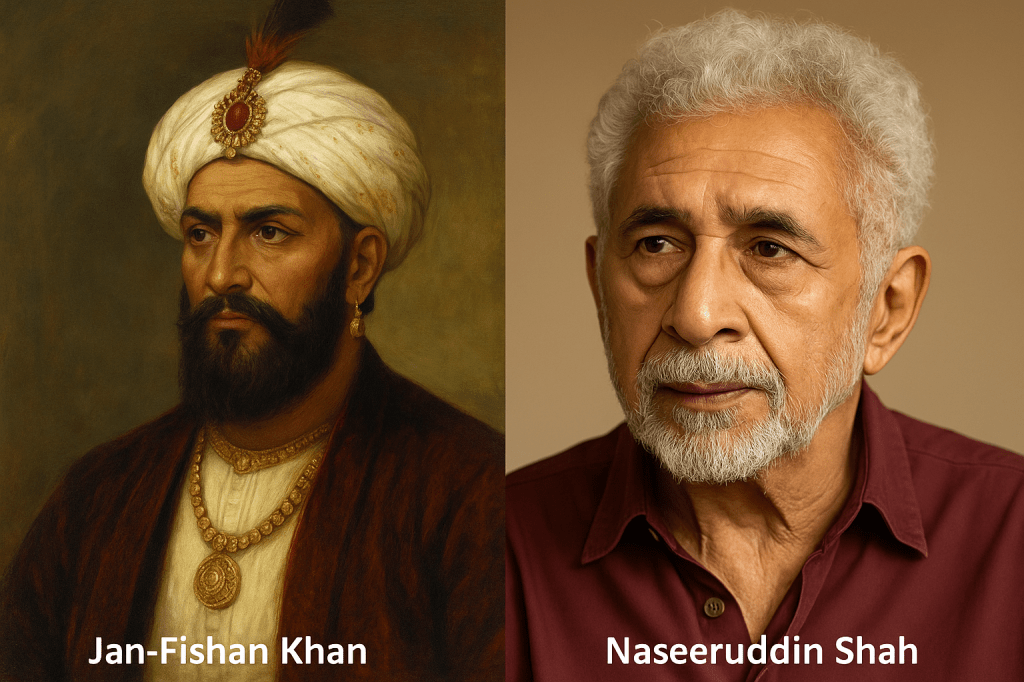
    In the era of information and ideological warfare, words shape narratives and narratives shape society. When public intellectuals speak, their influence can be powerful—but when that voice becomes selective, partisan, and blind to the pain of others, it is not justice; it is propaganda. One such voice that demands scrutiny is that of Naseeruddin Shah—a celebrated actor and descendent of Jan-Fishan Khan, a 19th-century Afghan noble who allied with the British during the First Anglo-Afghan War.

    Today, as India wrestles with real issues of communalism, cultural identity, and historical pain, it is time to ask: Whose side is Naseeruddin Shah really on—and why is his compassion so one-sided?

    When Morality Becomes Selective: Shah’s Silence on Hindu Victims

    In his recent article in The Indian Express, Shah laments the “rising intolerance” in India and references mob killings of Muslims allegedly over cow slaughter or theft. While mob justice in any form is unacceptable in a civilized society, what stands out is Shah’s continued and deliberate silence on several brutal killings of Hindus—both in India and abroad.

    Where was his voice when:

    • Kashmiri Pandits were driven out of their homeland and murdered in cold blood?
    • A Hindu father and son were lynched in Murshidabad, West Bengal, allegedly by a mob led by a TMC leader—dragged from their home and hacked to death?
    • Hindus were massacred in Bangladesh, temples desecrated, and women raped in the name of religion?
    • Hindus in Pakistan continue to be second-class citizens, with abductions and forced conversions occurring regularly?

    Why does his pen only bleed when the victim fits a particular identity?

    This is not justice—it is selective outrage, rooted not in empathy but in ideological opportunism.

    History Repeats: From Jan-Fishan Khan to Naseeruddin Shah

    To understand this mindset, we must go back to Shah’s roots. His great-great-grandfather, Jan-Fishan Khan, was a nobleman in 19th-century Afghanistan who chose to support the British colonialists over his fellow Afghans during the First Anglo-Afghan War. In return, he was rewarded with land and titles in India—a princely estate in Sardhana.

    His decision was not based on loyalty to a homeland or principles, but on opportunism and survival. He fought not for independence or unity, but to align with foreign rulers who would later dominate the subcontinent for over a century.

    Today, his descendant Naseeruddin Shah continues that legacy—not by swords, but with words. By constantly speaking only against one section of society, while ignoring the injustices faced by Hindus, he furthers a neo-colonial narrative that paints Hindus as the only oppressors, and others as permanent victims.

    Just like Jan-Fishan Khan turned away from his own people for foreign patronage, Shah today turns his back on Hindu suffering to maintain relevance among ideological elites.

    What True Justice Looks Like

    At Unmukt, we believe in a society where:

    • Every victim matters, regardless of their religion.
    • Mob violence is condemned whether the victim is Muslim, Hindu, or of any faith.
    • Historical truth is acknowledged, not whitewashed.
    • Public voices must stand for balance, courage, and honesty—not political convenience.

    Justice is not a tool to gain applause from one side. It is a sacred duty to speak the truth for all people, even when it is uncomfortable.

    Our Message to the Intellectual Class

    If you truly care about India, you must speak for Kashmiri Pandits, Murshidabad Hindus, Bangladeshi Hindus, Dalits, Muslims, and everyone else who suffers—without filters.

    To highlight the murder of a Muslim by a mob while remaining silent about a Hindu being butchered by a mob in Murshidabad, is not compassion—it is communal selectivity.

    If you can’t see the pain of a Hindu victim, you are not a humanitarian.
    You are an ideological actor in disguise.

    India does not need another Mir Jafar or Jan-Fishan Khan or Naseeruddin Shah. Instead, India needs truthful voices, who will rise not for reward, but for Dharma—the path of balance, truth, and responsibility. It’s time to call out selective morality.

    It’s time to say:
    “Either speak for all victims — or don’t claim the moral high ground at all.”

  • Varna vs. Caste: Reclaiming the Dharma of Merit

    Varna Was Never About Birth

    In the Bhagavad Gita, Lord Krishna says:

    चातुर् वर्ण्यं मया सृष्टं गुणकर्मविभागशः।
    तस्य कर्तारमपि मां विद्ध्यकर्तारमव्ययम्॥

    भगवद्गीता ४.१३

    “Chaturvarnyam maya srishtam guna-karma-vibhagashah”
    (I created the fourfold varna system based on qualities and actions.) — BG 4.13

    This single verse debunks the modern myth that one’s birth determines one’s role or worth. Varna, in its true Vedic sense, was a system designed to align individuals with their natural disposition (guna) and skillset (karma).

    • A person full of curiosity, discipline, and spiritual insight was a Brahmana — regardless of birth.
    • One with courage, leadership, and responsibility was a Kshatriya.
    • The trade-minded, wealth-creators were Vaishyas.
    • And those who specialized in support services and craftsmanship were Shudras.

    This was not a hierarchy, but a division of responsibility for the harmonious functioning of society just as a body functions with head, arms, stomach, and legs, each with dignity.

    Caste (Jati) Was a Later Distortion

    Over centuries, the fluid varna system slowly hardened into birth-based jatis — thousands of local sub-castes. This was not divine; it was a social evolution influenced by politics, orthodoxy, and later, colonial bureaucracy.

    The British census of 1901 classified Indians by rigid caste categories, freezing what was once dynamic. The colonial state weaponized caste to divide and control, labeling people in ways even the Vedas never did.

    Sant Ravidas: The Soul That Rose Beyond Birth

    You don’t need reservation or privilege to rise — Sant Ravidas proved that.

    Born into a humble cobbler family considered “untouchable,” he became one of the greatest saints of the Bhakti movement. His verses are immortalized in the Guru Granth Sahib, and he became a spiritual guide even to royal figures like Mira Bai.

    So where did his merit come from?

    • Not from a quota.
    • Not from a school.
    • But from inner awakening, sadhana, and divine insight.

    Just like Ved Vyasa, the compiler of the Mahabharata, born to a fisherwoman.
    Just like Valmiki, the hunter-turned-sage who wrote the Ramayana.

    They did not rise because of their caste they rose because of their karma and tapasya.

    Modern India: Merit Still Shines Without Quotas

    Today, despite not having reservation:

    • Students from upper cast continue to top IIT-JEE, UPSC, NEET, and other elite exams.
    • Many from upper castes still perform with excellence in fields of science, technology, law, literature, and civil service.

    How?

    Because their power comes from:

    • Discipline
    • Respect for knowledge
    • Family traditions of learning
    • No entitlement—only effort

    This proves one thing: real merit doesn’t need shortcuts.

    This Is Not About Brahmin or upper cast Superiority

    Let’s be clear. This is not a call for caste pride or supremacy.

    Every community has heroes. Every community deserves dignity.

    But today, when Brahmins or upper castes are blamed for every problem, or when ancient Hindu systems are wrongly labeled as inherently oppressive, it becomes important to defend the truth.

    Dharma is not oppression.
    Learning is not privilege.
    Sanatan culture is not discrimination.

    A Call for Civilizational Clarity

    If we want to build Ek Bharat Shreshtha Bharat, we must:

    • Uphold the original spirit of varna — qualities and actions, not birth.
    • End caste-based hatred, from any side.
    • Respect merit and effort, regardless of category.
    • And most importantly, revive the dharma of unity — not the politics of blame.

    Let every child in India rise not by caste or certificate, but by knowledge, character, and courage.
    Let us rebuild a Bharat where Ravidas, Valmiki, and Vyasa still inspire us to see beyond birth — and live by truth.

  • The 1971 War: India’s Strategic Triumph, Missed Opportunities, and Lasting Challenges

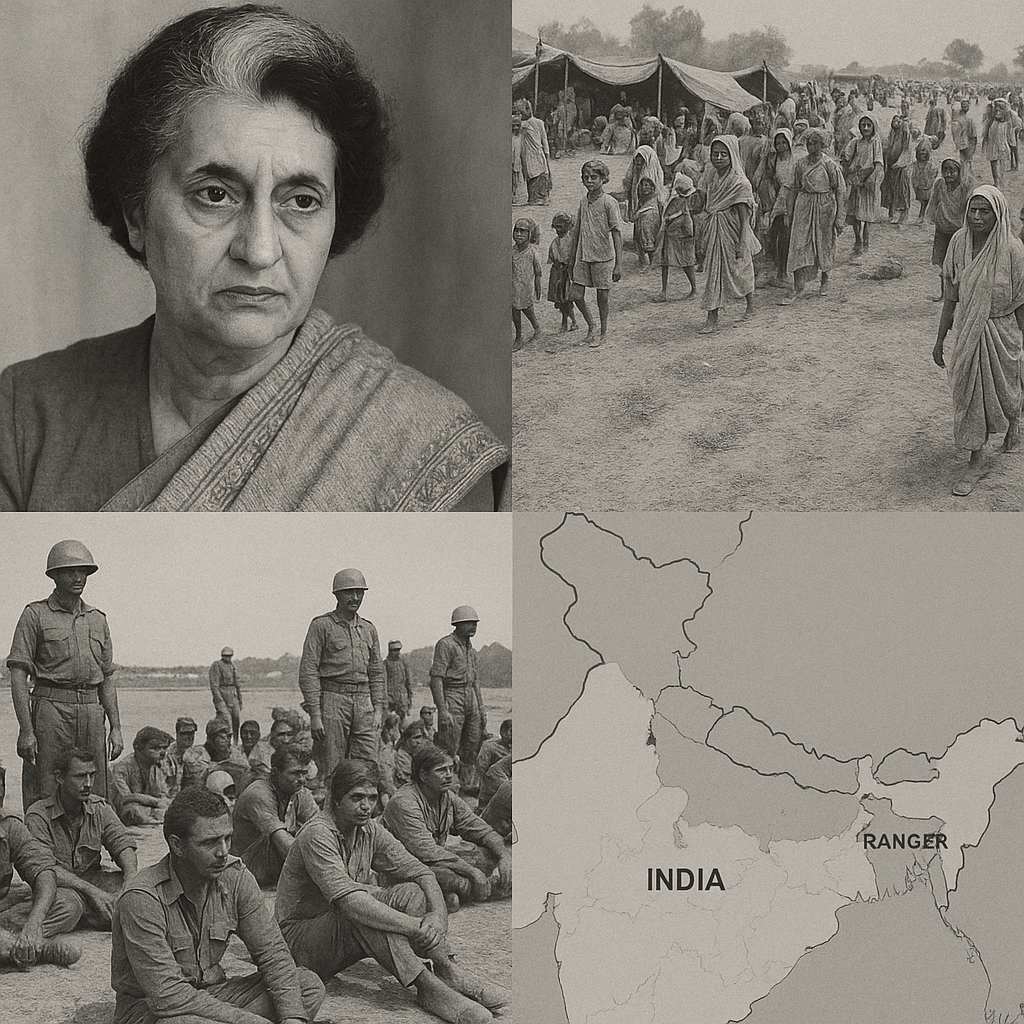
    Today, as India reflects on its historical milestones, the 1971 India-Pakistan War remains a defining moment in the nation’s geopolitical journey. Led by Smt. Indira Gandhi, India’s decisive intervention resulted in the creation of Bangladesh, a humanitarian triumph that reshaped South Asia. However, debates persist over whether India could have secured greater strategic gains, such as annexing the Rangpur area to widen the Siliguri Corridor—transforming the “Chicken’s Neck” into a “Chicken’s Chest”—and ensuring the return of its soldiers still missing in Pakistan. This article examines the war’s outcomes, evaluates the decision to forego territorial annexation, and explores the unresolved issue of Indian POWs, assessing the long-term implications for India.

    The 1971 War and Bangladesh Liberation

    In 1971, East Pakistan (now Bangladesh) faced brutal repression after the Awami League’s electoral victory was denied by West Pakistan’s military regime. The ensuing crackdown, which killed an estimated 300,000 to 3 million people, triggered a humanitarian crisis, with 10 million refugees fleeing into India, primarily West Bengal, Assam, and Tripura. Smt. Indira Gandhi, recognizing both the humanitarian imperative and strategic opportunity, supported the Mukti Bahini (Bangladesh liberation forces) with military training, arms, and diplomatic backing. Following months of preparation, India intervened militarily in December 1971, leading to a 13-day war that ended with Pakistan’s surrender on December 16, 1971. The war resulted in the creation of Bangladesh and the capture of 93,000 Pakistani soldiers as prisoners of war (POWs)—one of the largest military surrenders in modern history.

    Humanitarian and Strategic Triumph

    • Refugee Crisis Resolution: The war alleviated the burden of 10 million refugees on India, with over 90% returning to Bangladesh by 1973, reducing economic and social strain.
    • Weakening Pakistan: The division of Pakistan into two nations diminished its military threat, eliminating its two-front strategy against India.
    • Global Recognition: India’s intervention earned international praise for halting a genocide, enhancing its soft power. The Indo-Soviet Treaty of 1971 ensured Soviet support, countering US and Chinese opposition.
    • Regional Influence: The 1972 India-Bangladesh Treaty of Friendship initially solidified Bangladesh as a friendly neighbor, giving India a strategic buffer against Pakistan.

    The Chicken’s Neck Dilemma: Should India Have Taken Rangpur?

    The Siliguri Corridor, a narrow strip (20–40 km wide) connecting India’s mainland to its northeastern states, is a strategic vulnerability known as the “Chicken’s Neck.” Bordered by Nepal, Bhutan, and Bangladesh, it is susceptible to being severed in a conflict, particularly by China via the Chumbi Valley, 130 km away. Some strategists argue that India, at the peak of its post-1971 influence, could have annexed the Rangpur area in northern Bangladesh to widen this corridor into a “Chicken’s Chest,” enhancing security and connectivity.

    Potential Benefits of Annexation

    • Strategic Depth: Widening the corridor would have reduced the risk of the Northeast being isolated in a conflict. In 2025, with China’s military buildup in the Chumbi Valley and border tensions (e.g., post-2020 Galwan clash), this vulnerability remains a concern. A broader corridor would have improved military logistics, crucial for addressing insurgencies like the ongoing Naga peace talks.
    • Economic Integration: Enhanced connectivity would have boosted trade and infrastructure in the Northeast, a region lagging economically. The 2025 Economic Survey notes the Northeast’s GDP growth at 5.2%, below the national average of 6.8%, partly due to connectivity bottlenecks.
    • Geopolitical Leverage: With 93,000 Pakistani POWs in custody and Bangladesh’s gratitude under Sheikh Mujibur Rahman, India could have negotiated territorial adjustments as a mutual security arrangement, offering economic or diplomatic concessions in return.

    Challenges and Risks

    • Diplomatic Fallout: Annexing Rangpur would have contradicted India’s humanitarian narrative, risking its global image as a defender of self-determination. It would have violated the 1972 India-Bangladesh Treaty of Friendship, potentially turning Bangladesh into a resentful neighbor.
    • International Backlash: The US and China, already hostile during the Cold War, could have rallied global opposition, isolating India. The USSR, India’s ally, might have opposed such a move as a violation of sovereignty norms.
    • Regional Instability: Annexation could have destabilized Bangladesh’s fragile post-independence government, fueling anti-India sentiment. In India’s Northeast, where separatist movements like the Mizo National Front (1966–1986) were active, it might have escalated ethnic tensions.
    • Long-Term Costs: By 2025, India-Bangladesh relations are strained over water sharing, migration, and Bangladesh’s ties with China (e.g., the $1.2 billion Padma Bridge project). Annexation in 1971 would likely have made Bangladesh a hostile neighbor, aligning it with China or Pakistan, undermining India’s regional influence.

    Verdict on Rangpur

    Indira Gandhi’s decision to forego annexing Rangpur was strategically prudent. While widening the Chicken’s Neck offered clear benefits, the diplomatic, ethical, and practical costs—international condemnation, regional instability, and long-term hostility—outweighed the gains. A hostile Bangladesh could have provided China with a foothold closer to the Siliguri Corridor, negating any strategic advantage. However, India might have explored diplomatic negotiations for a mutual security arrangement, such as joint control or transit rights, to address the corridor’s vulnerability without territorial annexation.

    The Unresolved POW Issue: A Lingering Grievance

    Despite India’s release of 93,000 Pakistani POWs by 1974 under the Shimla Agreement, the fate of Indian soldiers believed to be held in Pakistan remains unresolved. Known as the “Missing 54″—30 Army and 24 Air Force personnel—these soldiers were captured primarily on the Western Front. India claims a total of 83 personnel are missing, with some families believing they are still alive in Pakistani jails, facing harsh conditions. Pakistan has consistently denied holding them, with its latest statement in 2025 reiterating this position, though earlier contradictions fuel India’s suspicions.

    • Missed Leverage: Public sentiment on X in 2025 reflects frustration that India did not use the 93,000 Pakistani POWs as leverage to secure the return of its soldiers or other concessions, such as addressing the Chicken’s Neck vulnerability. Some argue this was a diplomatic oversight, prioritizing goodwill over strategic gains.
    • Emotional Toll: Families of the Missing 54 have waited over five decades for closure. Advocacy groups, as noted in recent articles by CAPS India, highlight the emotional toll, with daughters of these soldiers continuing their fight for justice.
    • Diplomatic Stalemate: India’s repeated demands, including the latest exchange of lists in July 2024, have yielded no progress. The recent Operation Sindoor (May 2025) and ongoing tensions with Pakistan further complicate resolution, with Pakistan’s allies like China and Turkey reducing international pressure on this issue.

    Long-Term Implications for India

    Strategic Lessons

    The 1971 war was a tactical triumph but highlighted missed strategic opportunities. While India weakened Pakistan and gained regional influence, the failure to secure its POWs or address vulnerabilities like the Chicken’s Neck underscores the need for a balanced approach in geopolitics. The Shimla Agreement prioritized short-term stability over long-term gains, a decision debated in strategic circles in 2025.

    India-Bangladesh Relations

    By 2025, India-Bangladesh relations are strained, with Bangladesh’s growing ties with China and unresolved issues like migration (e.g., the 2019 NRC in Assam identifying 1.9 million potential illegal immigrants) fueling tensions. Annexing Rangpur would likely have worsened this dynamic, potentially creating a hostile neighbor aligned with India’s adversaries.

    Geopolitical Vulnerabilities

    The Siliguri Corridor remains a strategic concern, with China’s presence in the Chumbi Valley and Bangladesh posing risks. The 2025 Economic Survey emphasizes the need for infrastructure development in the Northeast, suggesting that India must address this vulnerability through diplomatic and economic means rather than territorial adjustments.

    Conclusion

    The 1971 India-Pakistan War, under Indira Gandhi’s leadership, was a defining moment that showcased India’s military prowess and humanitarian resolve, leading to the creation of Bangladesh. However, strategic decisions made in its aftermath have left lasting challenges. Not annexing Rangpur to widen the Siliguri Corridor was likely the right choice, avoiding diplomatic fallout and regional instability, though India could have pursued non-territorial solutions to address this vulnerability. The failure to secure the return of its POWs, however, remains a significant oversight, with the “Missing 54” symbolizing a lingering grievance as of today. The war’s legacy underscores the complexities of balancing humanitarian ideals with strategic interests, a lesson India must heed as it navigates contemporary geopolitical challenges with Pakistan, China, and Bangladesh.

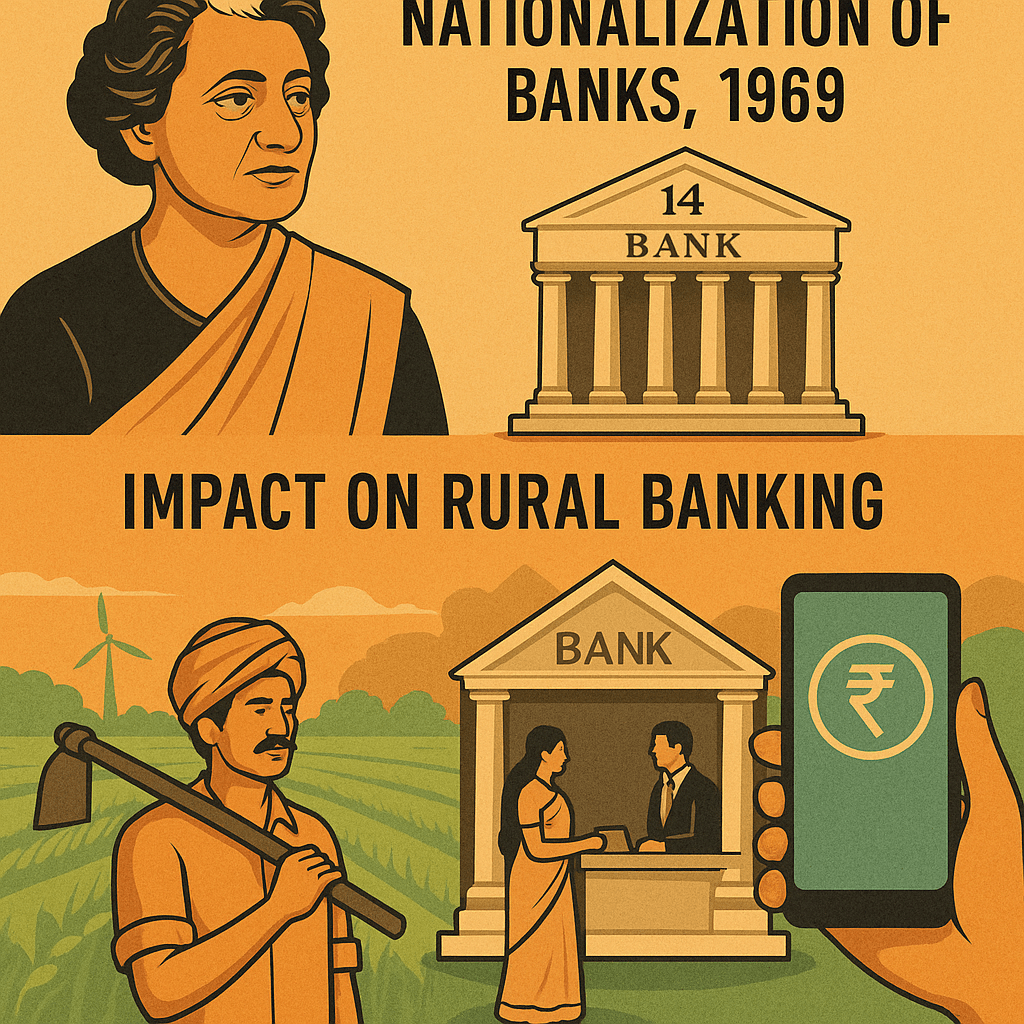
  • 1969 Bank Nationalization: Financial Control, Inclusion, and Governance Challenges

    As of May 15, 2025, reflecting on India’s economic history, the 1969 nationalization of 14 major commercial banks by Smt. Indira Gandhi stands as a pivotal moment. Aimed at expanding banking access to rural areas and prioritizing sectors like agriculture, the policy was heralded as a step toward social equity. However, economists debate whether it also served as a mechanism for financial control over citizens. This article examines the policy’s impact on rural India, the need for subsequent initiatives like the Pradhan Mantri Jan Dhan Yojana (PMJDY), and the governance challenges faced by Company Secretaries in government-owned entities navigating similar state-driven mandates.

    Objectives and Impact on Rural India

    The 1969 bank nationalization sought to democratize finance in a country where banking was largely urban-centric. In 1969, only 17% of bank branches were in rural areas, but by 1980, this number surged to over 15,000. The share of rural deposits grew from 3% in 1969 to 15% by 1985, and agricultural credit rose from 2% to 10% of total advances by 1975, per RBI data. This empowered rural farmers by reducing reliance on exploitative moneylenders and supported the Green Revolution’s agricultural boom.

    However, the policy had significant flaws. Many rural branches were unprofitable, leading to inefficiencies. Political interference skewed loan disbursal, often favoring politically connected individuals over the deserving. A lack of financial literacy left many accounts dormant, limiting the policy’s transformative potential. While it laid the foundation for financial inclusion, its implementation fell short of fully integrating rural India into the formal banking system.

    Economists’ Perspectives: A Tool for Financial Control?

    1. State Dominance Over Economic Activity

    Nobel laureate Amartya Sen, in Development as Freedom (1999), emphasizes economic freedom as a pillar of development. He argues that excessive state control over financial systems can curtail individual agency. While acknowledging nationalization’s intent to promote inclusion, Sen cautions that it enabled the state to influence citizens’ economic choices, such as directing credit to favored sectors or individuals. Historical records from the 1970s reveal instances where loans were disbursed based on political affiliations, indicating a form of financial control.

    2. Political Patronage and Bureaucratic Overreach

    Economist Jagdish Bhagwati, in India: Economic Reform and Growth (1993), critiques nationalization as part of the “license-permit raj.” He argues that it turned banks into tools of political patronage, allowing the government to control access to financial resources. In rural India, farmers often faced bureaucratic hurdles or needed political connections to secure loans, limiting their economic opportunities. Bhagwati contends this was not just about inclusion but about consolidating state power over citizens’ financial lives.

    3. Surveillance and Monetary Policy

    Former RBI Governor Raghuram Rajan, in The Third Pillar (2019), highlights how state-controlled banking systems enable financial surveillance. Nationalization gave the government unprecedented insight into citizens’ transactions. During the 1975–77 Emergency, the state used banks to freeze accounts of political opponents, a clear instance of financial control. By 2025, with digital banking and KYC norms, this surveillance has expanded, raising concerns about privacy and financial autonomy.

    4. Counterview: Focus on Financial Inclusion

    Economist Kaushik Basu, in a 2016 lecture, argues that nationalization’s primary goal was financial inclusion, not control. He credits the policy for bringing banking to rural India, reducing dependence on informal credit. The growth in rural deposits and agricultural lending supports this view, suggesting that political interference was an implementation failure rather than the policy’s intent.

    5. Mixed Outcomes

    Arvind Panagariya, in India: The Emerging Giant (2008), offers a balanced perspective. He acknowledges that nationalization empowered rural India but also created opportunities for state control. The Emergency and later events like demonetization in 2016, where public banks were instrumental in enforcing government policy, demonstrate how nationalization provided a mechanism for financial oversight, often at the expense of citizens’ autonomy.

    The Need for Jan Dhan Yojana

    If nationalization was so impactful, why did the Modi government launch the Pradhan Mantri Jan Dhan Yojana (PMJDY) in 2014? Despite the growth in rural banking post-1969, the 2011 Census revealed that only 54.4% of rural households had banking access. Many accounts remained dormant due to limited financial literacy and accessibility. PMJDY addressed these gaps by leveraging digital technology, opening over 53 crore accounts by 2025, with 67% in rural/semi-urban areas and deposits exceeding ₹2.3 lakh crore. Features like zero-balance accounts, RuPay cards, and overdraft facilities, combined with financial literacy campaigns, ensured greater usage, with over 80% of accounts active—a marked improvement over the nationalization era.

    Governance Challenges: The Role of a Company Secretary

    Similar to the dynamics of nationalization, government-owned companies often operate at the intersection of state control and public welfare. A Company Secretary in a 100% government-owned CPSE involved in land monetization faces unique challenges. They are responsible for ensuring corporate governance, legal compliance, and stakeholder coordination while navigating government mandates, such as those seen in asset monetization policies. For instance, the National Land Monetization Corporation (NLMC) can only acquire assets from CPSEs under strategic disinvestment at book value, as noted in prior correspondence. This limits flexibility, and political interference—akin to that seen in nationalized banks—can complicate compliance. A Company Secretary must balance transparency, manage board dynamics, and ensure financial accountability, often under bureaucratic pressure, mirroring the governance challenges of the nationalization era.

    Conclusion

    The 1969 bank nationalization was a landmark policy that expanded financial access in rural India, but it also served as a tool for state control, as debated by economists. While it empowered many, political interference and surveillance potential highlighted its dual nature. PMJDY built on this foundation, using modern technology to deepen inclusion. Yet, the legacy of nationalization persists in 2025, with public sector banks dominating the financial sector, raising ongoing questions about financial freedom versus state oversight. For Company Secretaries in government entities, these tensions underscore the need for robust governance to balance state objectives with public welfare, ensuring that policies serve citizens without compromising their autonomy.

  • Darwin and Indian Family Businesses: A Case Study in Survival of the Fittest

    Darwin’s theory of “survival of the fittest” emphasizes adaptability and resilience in changing environments, originally framed in the context of natural selection. When extended to the realm of business—particularly Indian family businesses—this theory finds a compelling real-world parallel. These enterprises, some of which have thrived for over a century, exemplify evolutionary fitness not through brute force, but through innovation, cultural rootedness, and strategic foresight.

    As of today, Indian family businesses remain a vital engine of the economy, continuing to grow in the face of global competition, technological disruption, and internal challenges. Let’s explore how they mirror Darwinian survival principles and why their longevity defies conventional business logic.

    How Indian Family Businesses Embody “Survival of the Fittest

    1. Adaptability to Changing Environments

    India’s oldest family businesses have evolved across colonial rule, independence, liberalization, and globalization. The Tata Group, founded in 1868, began as a trading firm and expanded into steel, automobiles, and IT. Its transformation from industrial-era manufacturing to digital-era innovation (e.g., TCS) is a textbook example of Darwinian adaptation.

    In contrast, many traditional textile firms that failed to modernize during British rule were eventually wiped out—showing that inability to evolve leads to extinction, in nature and in business.

    2. Resilience Through Cultural and Social Ties

    Family businesses in India are often embedded in joint family systems, which extend to business relationships. Trust, loyalty, and informal governance allow them to endure through crises. The Murugappa Group, established in 1900, diversified into agriculture, engineering, and financial services, maintaining internal cohesion while responding to external change.

    These cultural moorings act as stabilizing mechanisms, enabling long-term survival even during political or economic turbulence.

    3. Innovation and Modernization

    Survival in modern markets demands innovation. Reliance Industries, which began as a textile trading firm in the 1960s, disrupted India’s telecom industry in 2016 with Jio. By 2025, Jio leads India’s 5G revolution and digital ecosystem, a testament to how family businesses must continually reinvent themselves to stay fit in Darwinian terms.

    4. Niche Market Mastery

    Smaller family-run firms often dominate niche sectors—jewelry, spices, textiles—where heritage and expertise provide a durable edge. The Gitanjali Group globalized traditional Indian jewelry through modern branding and retail, showing how specialization is a form of adaptive fitness.

    Why They Thrive Despite Intense Competition

    1. Long-Term Vision Over Short-Term Gains

    Unlike other businesses, which chase quarterly profits, family firms often prioritize intergenerational wealth and legacy. The Aditya Birla Group, dating back to 1857, continues to invest in sustainable industries like cement, metals, and renewable energy—opting for long-term survival over short-term spikes.

    2. Trust and Reputation as Capital

    Brands like Britannia (part of the Wadia Group, founded in 1736) thrive on legacy, not just marketing. Indian consumers often trust family-run brands more due to perceived authenticity and continuity, which creates a moat against newer entrants.

    3. Policy Tailwinds

    Post-1991 liberalization opened global markets. Initiatives like Make in India and MSME incentives have empowered family businesses, especially in cities like Surat, where textile exports are dominated by generational firms. These businesses are not just surviving—they are scaling.

    4. Cultural Alignment and Succession Planning

    In India, businesses are often an extension of the family’s identity. Succession, when managed well, ensures continuity. The Godrej Group (est. 1897) has seen multiple generational transitions while investing in green products and sustainability—ensuring continued relevance.

    Challenges and Darwinian Pressures

    Despite their advantages, Indian family businesses are not immune to natural selection:

    Internal Conflicts: Feuds within the Singhania family (Raymond Group) have weakened the brand and distracted from business strategy.

    Global Disruption: Multinational tech and consumer giants pose existential threats to slower-moving firms.

    Digital Lag: Traditional mindsets sometimes resist digital transformation, risking obsolescence in a data-driven economy.

    Conclusion:

    Evolution, Not Inheritance, Ensures Survival

    Indian family businesses are not relics of the past—they are living organisms in an economic ecosystem. Their longevity proves that fitness is not about being the strongest or richest, but about being the most adaptive.

    By balancing tradition with transformation, culture with competitiveness, they remain relevant in 2025 and beyond. Darwin would likely agree: in both nature and business, those who evolve with their environment endure the test of time.

  • The Sensitivity of a Good Government: A Democratic Appraisal

    The success of any democracy hinges not just on the power it wields but on how sensitively that power is exercised. A truly good government is not only strong against external threats but also just, inclusive, responsive, and tolerant of dissent within.

    Lets evaluates government sensitivity from two perspectives: the timeless principles of Chanakya, the ancient Indian political strategist, and the expectations of a modern democratic society. This article reflect on whether India’s current government aligns with these benchmarks, especially in light of recent debates.

    1. Sensitivity to National Security

    A government’s foremost duty is to protect its citizens and territorial integrity. In this regard, the current Indian government has shown decisive action—be it in the form of surgical strikes post-Uri, the Balakot airstrike, or its firm stand during the Doklam and Galwan standoffs with China.

    • Chanakya believed in preemptive strength and strategic deterrence. The government’s proactive stance reflects this principle, treating security not as reaction but as preparation.

     Verdict: The government has shown high sensitivity and effectiveness in national security.

    2. Responsiveness to Dissent and Criticism

    Chanakya advised rulers to avoid arrogance and listen to advisors. In a modern democracy, this wisdom translates to respecting dissent, ensuring press freedom, and protecting institutional checks.

    While some actions (e.g., raids on certain media houses, NGOs, and arrests under stringent laws) have triggered criticism, it is also true that state action is justified when foreign-funded actors violate national interest, as seen in the NewsClick case with reported Chinese links.

    • The key question is: Are patriotic critics also facing suppression, or only those with dubious agendas? Sensitivity lies in distinguishing the two.

    Verdict: National security must be upheld, but sensitivity to fair criticism and transparency in action is vital to maintain democratic credibility.

    3. Inclusiveness Toward All Communities

    A sensitive government fosters harmony. Critics of the Citizenship Amendment Act (CAA) claimed it discriminated based on religion. The government clarified that CAA targets only persecuted minorities in Pakistan, Afghanistan, and Bangladesh, and does not affect Indian Muslims.

    However, protests and violent reactions created confusion and unrest.

    • Chanakya emphasized just rule over all subjects, ensuring that no group feels alienated.

    Verdict: The intention of the law may be just, but the government’s communication and engagement could have been more inclusive to prevent polarisation.

    4. Institutional Independence

    A Chanakyan state requires strong and independent institutions. Modern critics raise concerns over the independence of the judiciary, Election Commission, and investigative agencies.

    Yet, it’s also true that:

    • Judges in India are appointed through a collegium system, not by the government.
    • The new law for appointing the Election Commission includes representation from opposition, which didn’t exist before.

    Still, public trust depends on the perception of independence—not just the procedure.

    Verdict: The government must strengthen transparency and public confidence in autonomous institutions.

    5. Transparency and Accountability

    A sensitive government must allow scrutiny. RTI amendments, electoral bond secrecy, and reduced media questioning have led to concerns of reduced transparency.

    The electoral bonds system aimed to curb black money in politics, but without public disclosure, it became opaque to voters.

    • Chanakya warned against rulers becoming unaccountable and detached from their subjects.

    Verdict: Intent may be reform-driven, but greater openness and citizen access to political funding data are essential hallmarks of sensitivity.

    Conclusion: Is the Current Government Sensitive?

    If measured against national interest and strength, the government has been decisive and strategic. From defense modernization to diplomacy, digital outreach to welfare delivery, the state has shown competence.

    However, sensitivity also demands:

    • Respect for dissent that is within the law
    • More transparent governance
    • Active efforts to keep every citizen—irrespective of background—feeling heard

    In Chanakya’s terms, a king (or elected ruler) must uphold Dharma (just conduct), listen to truth even when unpleasant, and act with foresight.

    A sensitive government is not one that avoids using power—but one that uses it judiciously, proportionally, and accountably.