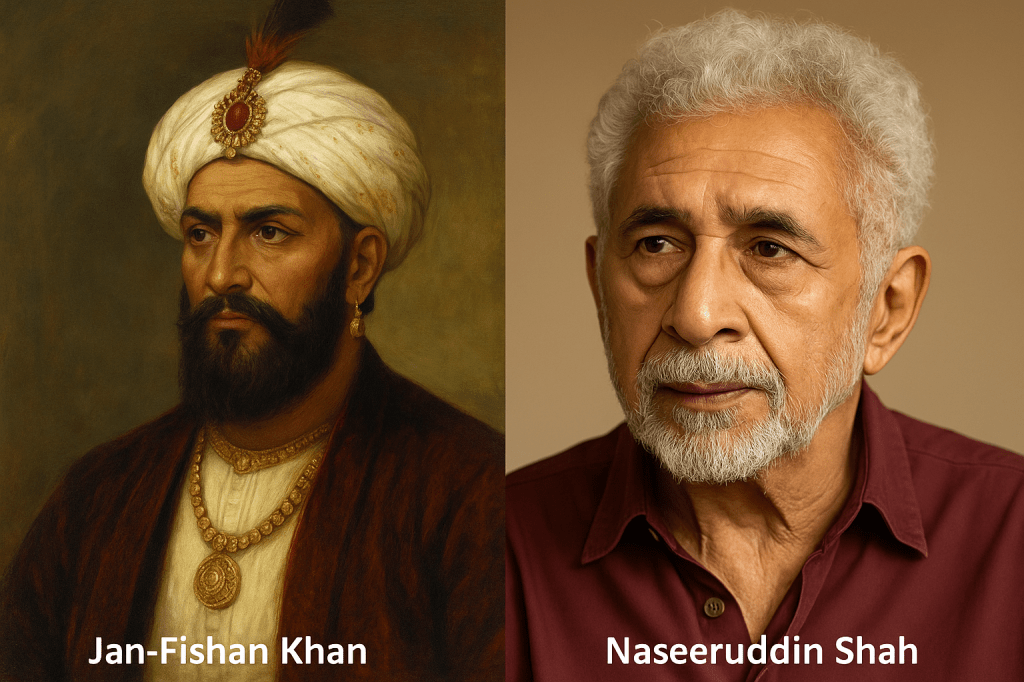
In the era of information and ideological warfare, words shape narratives and narratives shape society. When public intellectuals speak, their influence can be powerful—but when that voice becomes selective, partisan, and blind to the pain of others, it is not justice; it is propaganda. One such voice that demands scrutiny is that of Naseeruddin Shah—a celebrated actor and descendent of Jan-Fishan Khan, a 19th-century Afghan noble who allied with the British during the First Anglo-Afghan War.
Today, as India wrestles with real issues of communalism, cultural identity, and historical pain, it is time to ask: Whose side is Naseeruddin Shah really on—and why is his compassion so one-sided?
When Morality Becomes Selective: Shah’s Silence on Hindu Victims
In his recent article in The Indian Express, Shah laments the “rising intolerance” in India and references mob killings of Muslims allegedly over cow slaughter or theft. While mob justice in any form is unacceptable in a civilized society, what stands out is Shah’s continued and deliberate silence on several brutal killings of Hindus—both in India and abroad.
Where was his voice when:
- Kashmiri Pandits were driven out of their homeland and murdered in cold blood?
- A Hindu father and son were lynched in Murshidabad, West Bengal, allegedly by a mob led by a TMC leader—dragged from their home and hacked to death?
- Hindus were massacred in Bangladesh, temples desecrated, and women raped in the name of religion?
- Hindus in Pakistan continue to be second-class citizens, with abductions and forced conversions occurring regularly?
Why does his pen only bleed when the victim fits a particular identity?
This is not justice—it is selective outrage, rooted not in empathy but in ideological opportunism.
History Repeats: From Jan-Fishan Khan to Naseeruddin Shah
To understand this mindset, we must go back to Shah’s roots. His great-great-grandfather, Jan-Fishan Khan, was a nobleman in 19th-century Afghanistan who chose to support the British colonialists over his fellow Afghans during the First Anglo-Afghan War. In return, he was rewarded with land and titles in India—a princely estate in Sardhana.
His decision was not based on loyalty to a homeland or principles, but on opportunism and survival. He fought not for independence or unity, but to align with foreign rulers who would later dominate the subcontinent for over a century.
Today, his descendant Naseeruddin Shah continues that legacy—not by swords, but with words. By constantly speaking only against one section of society, while ignoring the injustices faced by Hindus, he furthers a neo-colonial narrative that paints Hindus as the only oppressors, and others as permanent victims.
Just like Jan-Fishan Khan turned away from his own people for foreign patronage, Shah today turns his back on Hindu suffering to maintain relevance among ideological elites.
What True Justice Looks Like
At Unmukt, we believe in a society where:
- Every victim matters, regardless of their religion.
- Mob violence is condemned whether the victim is Muslim, Hindu, or of any faith.
- Historical truth is acknowledged, not whitewashed.
- Public voices must stand for balance, courage, and honesty—not political convenience.
Justice is not a tool to gain applause from one side. It is a sacred duty to speak the truth for all people, even when it is uncomfortable.
Our Message to the Intellectual Class
If you truly care about India, you must speak for Kashmiri Pandits, Murshidabad Hindus, Bangladeshi Hindus, Dalits, Muslims, and everyone else who suffers—without filters.
To highlight the murder of a Muslim by a mob while remaining silent about a Hindu being butchered by a mob in Murshidabad, is not compassion—it is communal selectivity.
If you can’t see the pain of a Hindu victim, you are not a humanitarian.
You are an ideological actor in disguise.
India does not need another Mir Jafar or Jan-Fishan Khan or Naseeruddin Shah. Instead, India needs truthful voices, who will rise not for reward, but for Dharma—the path of balance, truth, and responsibility. It’s time to call out selective morality.
It’s time to say:
“Either speak for all victims — or don’t claim the moral high ground at all.”
 Unmukt