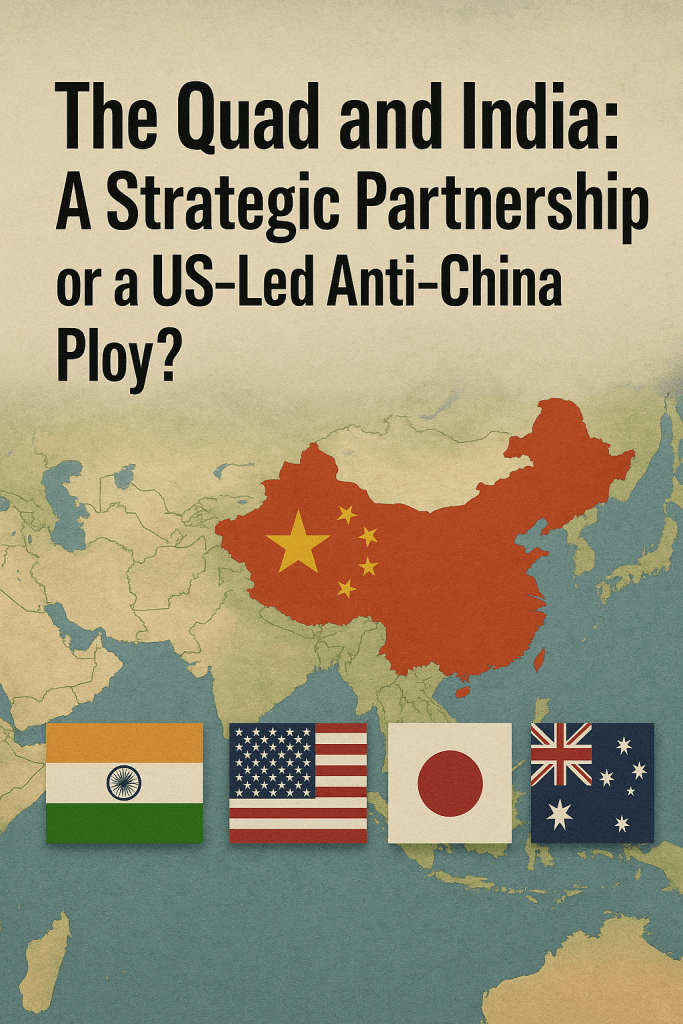
In the turbulent waters of the Indo-Pacific, the Quadrilateral Security Dialogue (Quad)—uniting India, United States, Japan, and Australia—stands as a beacon of strategic alignment. Revived in 2017 to promote a “free, open, and prosperous Indo-Pacific,” the Quad’s unspoken mission is to counter China’s maritime ambitions and regional dominance. For India, a rising power grappling with China’s border provocations and Pakistan’s terrorism, the Quad promises enhanced security, economic growth, and global influence. Yet, skepticism persists: Is India a linchpin in a transformative partnership, or merely a pawn in a US-led strategy to contain China? As the recent India-Pakistan escalation (May 2025) underscores the Quad’s limitations, this article explores its true value for India, India’s indispensability to the group, and whether New Delhi could achieve its ambitions alone.
The Quad’s Strategic Lifeline for India
India’s integration into the Quad, cemented after China’s assertive moves (e.g., 2017 Doklam standoff, 2020 Galwan clash), aligns with its goal of countering Beijing’s influence while advancing broader interests. Far from being a passive partner, India leverages the Quad to amplify its strategic, economic, and diplomatic clout.
1. Fortifying Against China
The Quad bolsters India’s capacity to counter China’s “String of Pearls” network—ports like Gwadar (Pakistan) and Hambantota (Sri Lanka)—and its naval expansion in the Indian Ocean Region (IOR). The Malabar naval exercises, involving all Quad members, enhance India’s interoperability with world-class navies, securing sea lanes critical for 90% of its trade by volume. Bilateral agreements, such as COMCASA and BECA with the US, provide advanced technologies (e.g., P-8I aircraft, geospatial intelligence), strengthening India’s maritime and border defenses. The Quad’s strategic pressure on China indirectly limits Beijing’s support for Pakistan, as seen in its restrained response during the India-Pakistan escalation, where reported missile supplies to Pakistan were not escalated further.
2. Economic and Technological Leap
The Quad’s Blue Dot Network offers sustainable infrastructure alternatives to China’s Belt and Road Initiative (BRI), aligning with India’s Act East policy to deepen ties with ASEAN. Initiatives in supply chain resilience—focusing on semiconductors and critical minerals—reduce India’s reliance on Chinese imports, fueling Make in India. Investments from Quad partners, such as Japan’s $35 billion in India’s Northeast and Australia’s critical minerals cooperation, drive economic growth, cementing India’s status as the world’s 4th largest economy (2025). Collaboration in emerging technologies (AI, 5G, cybersecurity, space) positions India to compete with China’s technological edge, critical for both economic and defense advancements.
3. Diplomatic Ascendancy
The Quad elevates India as a leading Indo-Pacific power, amplifying its voice in global forums like the UN and G20. During the Pahalgam terror attack (April 2025) and India’s retaliatory Operation Sindoor, Quad members condemned terrorism without criticizing India’s strikes, unlike China and Turkey, reflecting India’s diplomatic clout. The Quad’s non-binding structure preserves India’s strategic autonomy, allowing unilateral actions (e.g., against Pakistan) while benefiting from collective support. By countering the China-Pakistan Economic Corridor (CPEC) and China’s regional influence, the Quad enhances India’s leverage in South Asia and beyond.
4. Leadership in Non-Traditional Security
The Quad’s focus on climate change (renewable energy), health security (vaccine diplomacy), and humanitarian assistance and disaster relief (HADR) enhances India’s soft power. Building on the 2004 Tsunami Core Group, the Quad strengthens India’s role as a regional first responder. Its Women, Peace, and Security agenda aligns with India’s gender-inclusive peacekeeping efforts, bolstering its global image as a responsible power.
The India-Pakistan Escalation: Testing the Quad’s Limits
The Pahalgam terror attack (April 22, 2025) and India’s Operation Sindoor (May 7, 2025), targeting terror camps in Pakistan and PoK, highlighted the Quad’s constrained role in bilateral disputes. India’s precision strikes, executed with indigenous systems (Akash, S-400) and bilateral intelligence (e.g., US-derived), showcased its self-reliance. Quad members condemned the attack but urged restraint, offering no direct support, prompting X users to label the Quad “ineffective” or a “US ploy” that fails India in South Asian crises.
Yet, the Quad’s indirect contributions were significant. Its diplomatic weight ensured global focus on condemning terrorism, not India’s response, with Quad partners avoiding the critical tone of China and Turkey. The group’s strategic pressure on China likely limited Beijing’s escalation of support for Pakistan (e.g., beyond reported missile supplies), preserving regional stability. While the Quad’s China-centric, maritime focus doesn’t address Pakistan directly, its role in countering the China-Pakistan axis supports India’s broader security calculus.
Can India Stand Alone?
India’s skeptics argue it doesn’t need the Quad. With the world’s 4th largest defense budget (~$80 billion), a modernizing navy (INS Vikrant, nuclear submarines), and nuclear capabilities, India executed Operation Sindoor independently. Its economy drives self-reliance (Atmanirbhar Bharat), attracting investments from non-Quad nations (e.g., UAE, Singapore). Diplomatically, India’s non-alignment and ties with Russia, ASEAN, and the Global South ensure global influence, as seen in widespread condemnation of the Pahalgam attack. India counters China unilaterally—banning apps, restricting investments, and fortifying the LAC—while leading in climate (International Solar Alliance) and HADR.
However, going solo has limits. China’s $300 billion defense budget, largest navy, and economic dominance outmatch India’s resources. Developing advanced tech (e.g., 5G, AI) and infrastructure independently is cost-intensive, and facing China’s global influence (e.g., UNSC vetoes) alone risks isolation. The Quad’s collective strength—US superpower status, Japan’s tech leadership, Australia’s Pacific reach—reduces India’s burden, accelerates progress, and counters the China-Pakistan axis more effectively. Without the Quad, India could face a bolder Beijing, potentially escalating support for Pakistan, as hinted in May 2025.
Is India Being Used Against China?
The notion that the Quad is a US-orchestrated effort to leverage India against China resonates in public discourse. X users describe India as a “frontline state” in a US-led “anti-China axis,” noting that the US, Japan, and Australia rely on India’s IOR dominance and rivalry with China (e.g., LAC tensions) to counter Beijing’s BRI and naval expansion. India’s strategic location and military weight make it a natural partner, but critics argue it bears disproportionate risks—provoking China’s ire while Quad partners gain strategic benefits with less exposure.
This view oversimplifies India’s role. New Delhi actively shapes the Quad, emphasizing non-traditional security (climate, health) to avoid a militarized anti-China stance. India’s non-aligned stance and ASEAN ties ensure the Quad isn’t a Western bloc, broadening its appeal. The tangible benefits—tech transfers, investments, diplomatic leverage—align with India’s goals, proving mutual dependence. The Quad’s neutrality in the India-Pakistan escalation fueled frustration, with X posts questioning its reciprocity, but India’s strategic autonomy ensures it’s no mere tool, extracting value while maintaining independence.
A Quad Without India: Viable or Hollow?
Could the Quad survive without India? Technically, yes—it existed briefly in 2007 with limited Indian commitment but collapsed under Chinese pressure. Today, India’s IOR presence, naval power, and democratic weight are irreplaceable. Without India:
• IOR Influence Wanes: China’s BRI ports and Djibouti base face less opposition, as Japan and Australia focus on the Pacific.
• Maritime Strength Fades: Malabar exercises lose relevance, and sea lane security falters.
• Diplomatic Credibility Suffers: The Quad risks becoming a US-led alliance, alienating ASEAN and the Global South.
• Economic and Tech Gaps: India’s market and IT sector drive supply chain and tech initiatives; its absence slows progress.
A US-Japan-Australia triad could pivot to AUKUS or Pacific alliances, but these lack India’s regional heft. X users emphasize India’s indispensable role, though some see a Pacific-focused alternative. Without India, the Quad would be a diminished, Pacific-centric shell, unable to counter China’s Indo-Pacific ambitions effectively.
Conclusion: A Strategic Symbiosis
The Quad is a strategic lifeline for India, amplifying its ability to counter China, secure maritime routes, modernize its economy, and lead globally, while preserving autonomy. Its limitations in bilateral conflicts like the India-Pakistan escalation underscore India’s need for self-reliance, but its indirect benefits—diplomatic cover, pressure on China—prove its worth. India’s robust capabilities enable independent action, but the Quad’s collective strength addresses challenges (China’s superiority, resource constraints) that New Delhi cannot fully overcome alone.
Is the Quad a US gambit to use India against China? Partially, but India’s agency transforms it into a symbiotic partnership. By shaping the Quad’s inclusive agenda, India maximizes benefits while mitigating risks. The Quad’s viability hinges on India’s participation; without it, the group loses strategic and diplomatic weight. For India, the Quad is a pragmatic multiplier, not a necessity, enabling it to navigate a complex geopolitical landscape with unmatched finesse.
 Unmukt