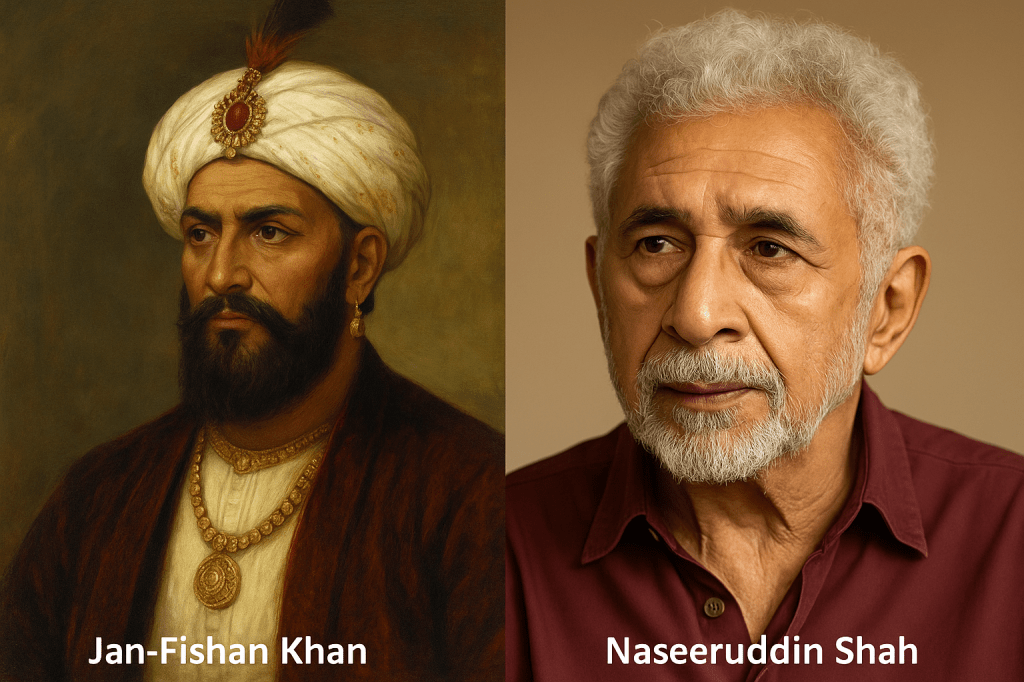
In the era of information and ideological warfare, words shape narratives and narratives shape society. When public intellectuals speak, their influence can be powerful—but when that voice becomes selective, partisan, and blind to the pain of others, it is not justice; it is propaganda. One such voice that demands scrutiny is that of Naseeruddin Shah—a celebrated actor and descendent of Jan-Fishan Khan, a 19th-century Afghan noble who allied with the British during the First Anglo-Afghan War.
Today, as India wrestles with real issues of communalism, cultural identity, and historical pain, it is time to ask: Whose side is Naseeruddin Shah really on—and why is his compassion so one-sided?
When Morality Becomes Selective: Shah’s Silence on Hindu Victims
In his recent article in The Indian Express, Shah laments the “rising intolerance” in India and references mob killings of Muslims allegedly over cow slaughter or theft. While mob justice in any form is unacceptable in a civilized society, what stands out is Shah’s continued and deliberate silence on several brutal killings of Hindus—both in India and abroad.
Where was his voice when:
Kashmiri Pandits were driven out of their homeland and murdered in cold blood?
A Hindu father and son were lynched in Murshidabad, West Bengal, allegedly by a mob led by a TMC leader—dragged from their home and hacked to death?
Hindus were massacred in Bangladesh, temples desecrated, and women raped in the name of religion?
Hindus in Pakistan continue to be second-class citizens, with abductions and forced conversions occurring regularly?
Why does his pen only bleed when the victim fits a particular identity?
This is not justice—it is selective outrage, rooted not in empathy but in ideological opportunism.
History Repeats: From Jan-Fishan Khan to Naseeruddin Shah
To understand this mindset, we must go back to Shah’s roots. His great-great-grandfather, Jan-Fishan Khan, was a nobleman in 19th-century Afghanistan who chose to support the British colonialists over his fellow Afghans during the First Anglo-Afghan War. In return, he was rewarded with land and titles in India—a princely estate in Sardhana.
His decision was not based on loyalty to a homeland or principles, but on opportunism and survival. He fought not for independence or unity, but to align with foreign rulers who would later dominate the subcontinent for over a century.
Today, his descendant Naseeruddin Shah continues that legacy—not by swords, but with words. By constantly speaking only against one section of society, while ignoring the injustices faced by Hindus, he furthers a neo-colonial narrative that paints Hindus as the only oppressors, and others as permanent victims.
Just like Jan-Fishan Khan turned away from his own people for foreign patronage, Shah today turns his back on Hindu suffering to maintain relevance among ideological elites.
What True Justice Looks Like
At Unmukt, we believe in a society where:
Every victim matters, regardless of their religion.
Mob violence is condemned whether the victim is Muslim, Hindu, or of any faith.
Historical truth is acknowledged, not whitewashed.
Public voices must stand for balance, courage, and honesty—not political convenience.
Justice is not a tool to gain applause from one side. It is a sacred duty to speak the truth for all people, even when it is uncomfortable.
Our Message to the Intellectual Class
If you truly care about India, you must speak for Kashmiri Pandits, Murshidabad Hindus, Bangladeshi Hindus, Dalits, Muslims, and everyone else who suffers—without filters.
To highlight the murder of a Muslim by a mob while remaining silent about a Hindu being butchered by a mob in Murshidabad, is not compassion—it is communal selectivity.
If you can’t see the pain of a Hindu victim, you are not a humanitarian. You are an ideological actor in disguise.
India does not need another Mir Jafar or Jan-Fishan Khan or Naseeruddin Shah. Instead, India needs truthful voices, who will rise not for reward, but for Dharma—the path of balance, truth, and responsibility. It’s time to call out selective morality.
It’s time to say: “Either speak for all victims — or don’t claim the moral high ground at all.”
Let us reflect on the full arc of human life and how deeply interconnected it is:
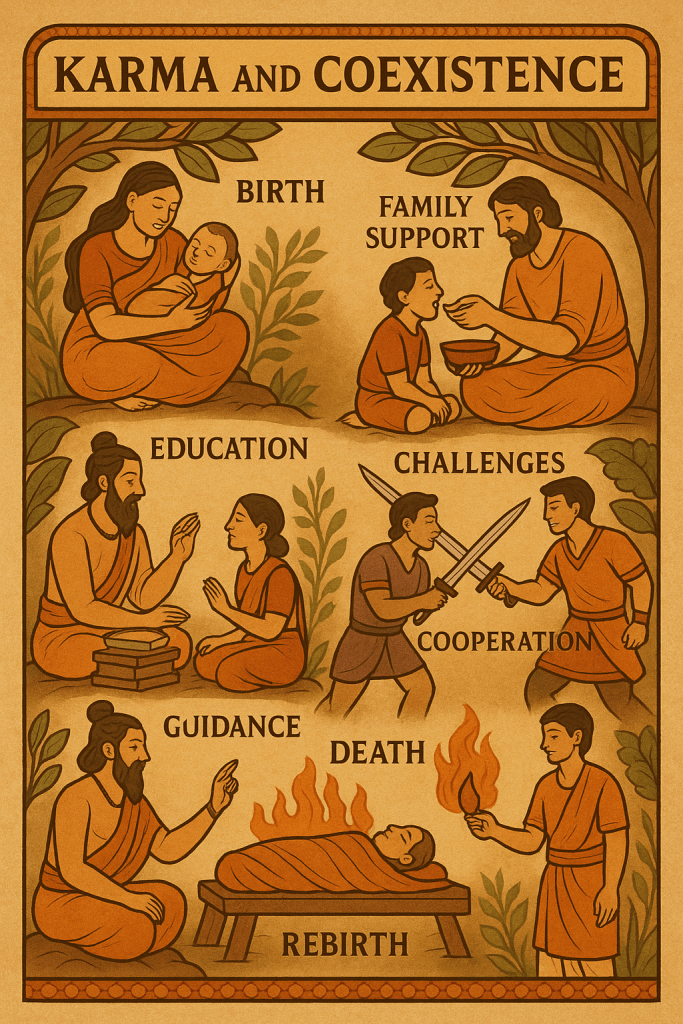
We are born through the sacred womb of a mother, not by our own will, but as a result of previous karma and divine arrangement. The very entry into this world is not in our hands.
We are nurtured and raised by parents or caregivers who feed us, clothe us, and protect us — often sacrificing their own comfort for our survival.
We are educated by teachers and guided by mentors, who shape our thoughts, character, and understanding of the world. It is they who help us recognize the dharma (righteous duty) aligned with our karma.
We grow within a community and society that gives us language, law, order, infrastructure, and opportunity. Without the farmer, we have no food; without the artisan, no shelter; without the doctor, no healing. Every act of karma is carried out using resources and structures created by others.
We are tested by life, including through difficult people — competitors, critics, and even enemies. Strangely, even they play a role in shaping our destiny by triggering our strength, resilience, and moral evolution.
And when we die, it is our children, family, or society that cremates us, performs the last rites, and prays for our onward journey. Even at the end, we depend on others to fulfill what we cannot.
The Cycle of Karma and Rebirth
Hindu philosophy explains that until our karma is fully exhausted or perfected, we take birth again and again, each time to fulfill our soul’s unfinished duties or to learn deeper lessons. Whether we ascend to Vaikuntha (liberation) or return to Earth, it is karma that decides — and karma is only possible through relationships.
Even moksha (liberation) is not achieved through action alone, but through self-realization, surrender, and grace — all of which are cultivated in the presence of a Guru, community, or divine association.
Why Realizing Interdependence Matters
Understanding the collective nature of karma teaches us a profound truth:
“We are never truly independent — we are interdependent.”
This realization changes how we live:
It aligns us with the truth that individual progress is impossible without collective well-being.
It cultivates humility, breaking the ego that says “I alone achieved this.”
It fosters gratitude toward parents, teachers, co-workers, strangers — even adversaries.
It reminds us to honor and protect the ecosystem of life, for without it, we cannot even breathe.
It creates a sense of social dharma — a responsibility to give back, support others, and perform seva (selfless service).
He who does not follow the cycle of duty and mutual cooperation lives in vain — a life of selfish indulgence.
This timeless verse reminds us that karma is not just personal action — it is our participation in the cosmic wheel of coexistence. Even a tree bears fruit not for itself, but for others. So too, we must perform our karma not in isolation, but in harmony with the world around us.
You Are Never Alone in Your Karma
While it is true that only your karma follows you beyond death, it is also true that you cannot perform your karma without others. Every breath, every step, every success — rests upon the shoulders of countless visible and invisible contributors.
This is the spiritual wisdom of sahabhāva (coexistence) and sahakāra (cooperation). To realize this is to walk the path of dharma — not with pride, but with gratitude; not with separation, but with unity.
“The soul performs its karma, but the world holds its hand while it does so.”
In a world plagued by violence and ideological conflicts, the provocative assertion that “terrorists are the second most dangerous, seculars are the first” challenges us to confront an uncomfortable question: do those who champion secularism, in their pursuit of political correctness or electoral gain, inadvertently enable heinous acts of terrorism? This article delves into the claim that secular narratives, driven by vote-bank politics or fear of communal backlash, may downplay or justify atrocities committed by Islamist groups targeting non-Muslims. By examining cases like the 2025 Pahalgam attack in Kashmir, the targeting of Jews in Israel, the Yazidi genocide in Iraq, and grooming scandals in Great Britain, we explore whether secular apologism emboldens perpetrators. The role of figures like Priyanka Gandhi, whose symbolic gestures amplify certain narratives, underscores the broader implications of prioritizing political agendas over justice and security.
The Pahalgam Attack: Religious Targeting in Kashmir
On April 22, 2025, a horrific terrorist attack in Pahalgam’s Baisaran Valley, Jammu and Kashmir, claimed the lives of 26 tourists, predominantly Hindus, with one Nepalese national among them. The attackers, reportedly linked to the group Kashmir Resistance, allegedly singled out victims based on their religion, shooting those who could not recite Islamic verses or identified as non-Muslims (News18: ‘Label Pakistan As State Sponsor Of Terrorism’). Survivors recounted chilling details, such as being asked to recite the Kalima or strip to confirm their identity before being executed (Times of India: Pahalgam terror attack). This attack, deemed one of the deadliest since the 2019 Pulwama bombing, reignited debates about targeted violence against Hindus in Kashmir.
The response from some global media outlets, such as The New York Times, BBC, and Al Jazeera, drew criticism for using terms like “militants” or “gunmen” instead of “terrorists,” which critics argue sanitizes the ideological and religious motives behind the attack (Times of India: US House panel slams NYT). The US House Foreign Affairs Committee condemned this framing, accusing outlets of “whitewashing” the attack’s religious targeting (Times of India: US House panel slams NYT). Such language, critics contend, reflects a secular tendency to downplay Islamist violence to avoid offending certain communities, potentially driven by political considerations or fear of backlash.
Israel: Targeting Non-Muslims and Hostage Crises
The claim extends to Israel, where terrorist groups like Hamas have been accused of targeting non-Muslims, particularly Jews, in attacks such as the October 7, 2023, assault. This attack killed over 1,200 people, with Hamas taking 251 hostages, many of whom remain in captivity (Reuters: Hamas attack on Israel). The deliberate targeting of Jewish civilians, including at a music festival, mirrors the religious profiling seen in Pahalgam. Michael Rubin, a former US official, likened the Pahalgam attack to Hamas’s tactics, noting that both targeted specific religious groups to sow fear (News18: ‘Label Pakistan As State Sponsor Of Terrorism’).
Some secular voices, particularly in Western media and activist circles, have been criticized for framing these attacks as resistance against occupation rather than terrorism driven by religious extremism. For instance, narratives emphasizing “Justice for Palestine,” as seen in Priyanka Gandhi’s public display of a bag with this slogan in 2019, are accused of overshadowing the plight of victims and hostages ([X Post: @sankrant]). Such rhetoric, while advocating for Palestinian rights, can inadvertently legitimize or downplay the actions of groups like Hamas, which explicitly target non-Muslims, according to critics.
Yazidi Genocide: Atrocities and Sexual Slavery
The Yazidi community in northern Iraq faced unimaginable horrors at the hands of the Islamic State (ISIS) in 2014, with over 5,000 murdered and thousands of women and girls abducted as sex slaves (Radio Times: Will Yazidi women get justice?). ISIS justified these acts by labeling Yazidis as “heretics” due to their non-Muslim faith, claiming that raping non-Muslims was a form of worship (Reuters: Captive Islamic State militant). Survivors like Kovan, who endured a decade of captivity, recounted being sold multiple times, raped daily, and forced into conversions (Radio Times: Will Yazidi women get justice?).
Despite international recognition of these acts as genocide, justice remains elusive. Few perpetrators have faced trial, with many detained in Syrian prisons like Panorama without prosecution for their crimes against Yazidis (Radio Times: Will Yazidi women get justice?). Some secular narratives, particularly in academic and activist circles, have been accused of framing ISIS’s actions as a byproduct of geopolitical failures (e.g., Western interventions in Iraq) rather than religious extremism, thus diluting accountability (Just Security: Rape as a Tactic of Terror). This reluctance to confront the ideological roots of such violence is seen as a form of apologism that enables impunity.
Grooming Scandals in Great Britain: Vote-Bank Politics?
In Great Britain, the grooming gang scandals, particularly in cities like Rotherham and Rochdale, involved the systematic sexual abuse of thousands of minor girls, predominantly by men of Pakistani descent (The Guardian: Rotherham child abuse scandal). Between the 1990s and 2010s, over 1,400 girls in Rotherham alone were abused, with authorities accused of failing to act due to fears of being labeled racist or alienating Muslim communities ([X Post: @sankrant]). A 2014 report by Alexis Jay revealed that police and social services ignored evidence of abuse to avoid “community tensions,” a decision critics attribute to vote-bank politics (BBC: Rotherham child sexual exploitation report).
Secular politicians and institutions, wary of losing support from minority communities, allegedly prioritized political correctness over justice. This inaction allowed perpetrators to operate with impunity for years, reinforcing the narrative that secularism, when driven by electoral motives, can enable heinous crimes. The claim that secularists justify such acts to preserve a “united vote bank” stems from this perceived reluctance to confront criminality within specific communities ([X Post: @sankrant]).
Secularism and Vote-Bank Politics: The Role of Priyanka Gandhi
The reference to Priyanka Gandhi carrying a bag with “Justice for Palestine” highlights how political figures can shape narratives around contentious issues. In 2019, Priyanka Gandhi, a prominent Indian National Congress leader, was photographed with a bag bearing this slogan, sparking debate about her stance on Israel-Palestine conflicts ([X Post: @sankrant]). Critics argue that such gestures, while symbolic of solidarity with Palestinians, risk aligning with narratives that downplay or justify violence by groups like Hamas, which target non-Muslims. This aligns with the broader claim that secular leaders, in pursuit of minority votes, may overlook or rationalize acts of violence to maintain political support.
In India, secularism is often equated with protecting minority rights, particularly for Muslims, who constitute a significant voting bloc. Critics contend that this leads to selective outrage, where violence against Hindus, such as in Pahalgam, is underplayed to avoid alienating Muslim voters. For instance, the lack of strong condemnation from some secular leaders after the Pahalgam attack, compared to their vocal support for other causes, fuels perceptions of bias (Times of India: Pahalgam terror attack).
The Psychology of Secular Apologism
The article’s central claim—that seculars are more dangerous than terrorists—draws on the idea that enabling or justifying violence indirectly causes greater harm than the acts themselves. This perspective invokes the concept of Stockholm syndrome, where fear leads individuals to sympathize with or rationalize the actions of oppressors (Hindu Post: Why Liberals Justify Islamic Terrorism). The 2019 Pulwama attack, which killed 40 CRPF personnel, saw some liberal intellectuals framing the attacker’s actions as a response to socio-economic marginalization, a narrative critics argue excuses terrorism (Hindu Post: Why Liberals Justify Islamic Terrorism).
This phenomenon is attributed to a desire to maintain a comfortable narrative that avoids confronting the religious or ideological roots of violence. By focusing on geopolitical or socio-economic factors, secularists may inadvertently provide cover for perpetrators, allowing them to evade accountability. This is particularly evident in media coverage that avoids the term “terrorist” or downplays religious motivations, as seen in the Pahalgam attack (Times of India: US House panel slams NYT).
Counterarguments: The Role of Secularism
Defenders of secularism argue that it promotes equality and protects minority rights in diverse societies. In India, secularism is enshrined in the Constitution to ensure no community is marginalized, particularly in the context of historical communal tensions ([Indian Constitution: Preamble]). Critics of the “seculars are dangerous” narrative contend that attributing terrorism to secularism oversimplifies complex issues. For instance, the Pahalgam attack’s religious targeting may reflect local insurgent dynamics rather than a global secular conspiracy (Al Jazeera: Kashmir attack).
Moreover, secular leaders like Priyanka Gandhi may argue that advocating for causes like Palestine is about human rights, not endorsing terrorism. The grooming scandals in Britain, while a failure of governance, are attributed to institutional lapses rather than secular ideology per se (BBC: Rotherham report). Proponents of secularism emphasize that condemning terrorism unequivocally does not require abandoning minority rights or fostering communal division.
The Broader Implications
The claim that seculars enable terrorism by prioritizing vote-bank politics or political correctness has significant implications:
Erosion of Trust: Perceived double standards in addressing violence (e.g., strong condemnation of Hindu hardliners but softer responses to Islamist terrorism) fuel distrust in institutions and media (Hindu Post: Why Liberals Justify Islamic Terrorism).
Impunity for Perpetrators: Failure to confront the ideological roots of terrorism, as seen in the Yazidi genocide or grooming scandals, allows perpetrators to operate without fear of justice (Radio Times: Will Yazidi women get justice?).
Polarization: Accusing seculars of enabling terrorism risks deepening communal divides, particularly in diverse societies like India, where Hindus and Muslims coexist amidst historical tensions (Outlook India: Post-Pulwama Violence).
Recommendations
To address these concerns, a balanced approach is needed:
Clear Condemnation: Political leaders and media must unequivocally condemn terrorism, regardless of the perpetrators’ identity, to avoid perceptions of bias.
Transparent Justice: Governments should prioritize accountability for crimes like the Pahalgam attack or Yazidi genocide, ensuring perpetrators face trial without political interference (Just Security: Rape as a Tactic of Terror).
Media Accountability: Outlets should adopt consistent terminology (e.g., “terrorist” for ideologically driven attacks) to avoid sanitizing violence (Times of India: US House panel slams NYT).
Community Engagement: Secular leaders should engage with all communities to address grievances without appeasing vote banks, fostering trust and unity.
Conclusion
The assertion that seculars are more dangerous than terrorists is a provocative critique of perceived apologism for heinous acts. Cases like the Pahalgam attack, Hamas’s targeting of non-Muslims, the Yazidi genocide, and Britain’s grooming scandals highlight instances where secular narratives may downplay religious extremism for political gain. While secularism aims to promote equality, its misapplication—through vote-bank politics or fear of communal backlash—can enable impunity and erode trust. A critical examination of these dynamics is essential to ensure justice for victims and prevent further polarization. By prioritizing accountability and consistent condemnation of violence, societies can address the root causes of terrorism without sacrificing the principles of fairness and inclusivity.
For years, the phrase “Atank ka koi dharm nahi hota” (Terrorism has no religion) has been repeated in media, politics, and public discourse. It sounds noble, inclusive, and idealistic. But is it really true? Or is it a blanket used to hide a very uncomfortable reality?
Let’s break the silence.
Terrorism Has No Dharma — But It Clearly Has a Majhab
In the Indian spiritual context, “Dharma” means righteousness, a path of moral duty. No true Dharma – be it Sanatan, Buddhism, Sikhism, or Jainism – preaches hatred, violence, or mass murder. So yes, terrorism has no Dharma.
But what many hesitate to say openly is this:
Terrorism does have a religious identity — a Majhab. And in most modern global and regional terror incidents, that Majhab is Islam, particularly the radicalized versions followed by extremist groups.
Look at the Pattern – The Truth is Not Hidden
Across the world — from 9/11 in New York, the 26/11 attacks in Mumbai, Pulwama, to the beheadings of French cartoonists, London stabbings, ISIS genocide of Yazidis, or Boko Haram in Nigeria — a majority of terrorists were not just claiming Islamic identity but also justifying their actions in the name of jihad.
They didn’t hide their intent.
They shouted “Allahu Akbar” as they killed.
They issued fatwas.
They quoted verses.
They targeted non-Muslims, ex-Muslims, and even moderate Muslims who refused to conform.
Victims: Almost Always Non-Muslims
From the Kashmiri Pandits, to Hindus in Bengal, Sikhs in Afghanistan, Jews in Israel, Christians in Africa and the Middle East, and even atheists and rationalists in Bangladesh — the victims of Islamic terrorism have overwhelmingly been non-Muslims.
So, when someone says terrorism has no religion, one must ask:
Then why do all these terrorists follow the same one?
And why are their targets always those outside it?
Why the Silence? Why the Hypocrisy?
Calling out this pattern is not “Islamophobia.”
It is not hate.
It is truth-telling.
Moderate Muslims themselves are often victims of this radicalization. But when the global system refuses to name the source of ideological terrorism, it does a disservice to the real victims — and even to reformers within Islam who want change.
If we continue this politically correct denial, we empower radical groups hiding behind religious freedom while they exploit religion to spread terror.
Conclusion: Speak the Truth, Not Just What Sounds Good
Yes, terrorism has no Dharma – because no righteous path justifies it.
But terrorism certainly has a Majhab – and until we recognize that, fight it ideologically, and demand accountability from within, the victims will keep increasing — and they’ll keep being non-Muslims.


 Unmukt