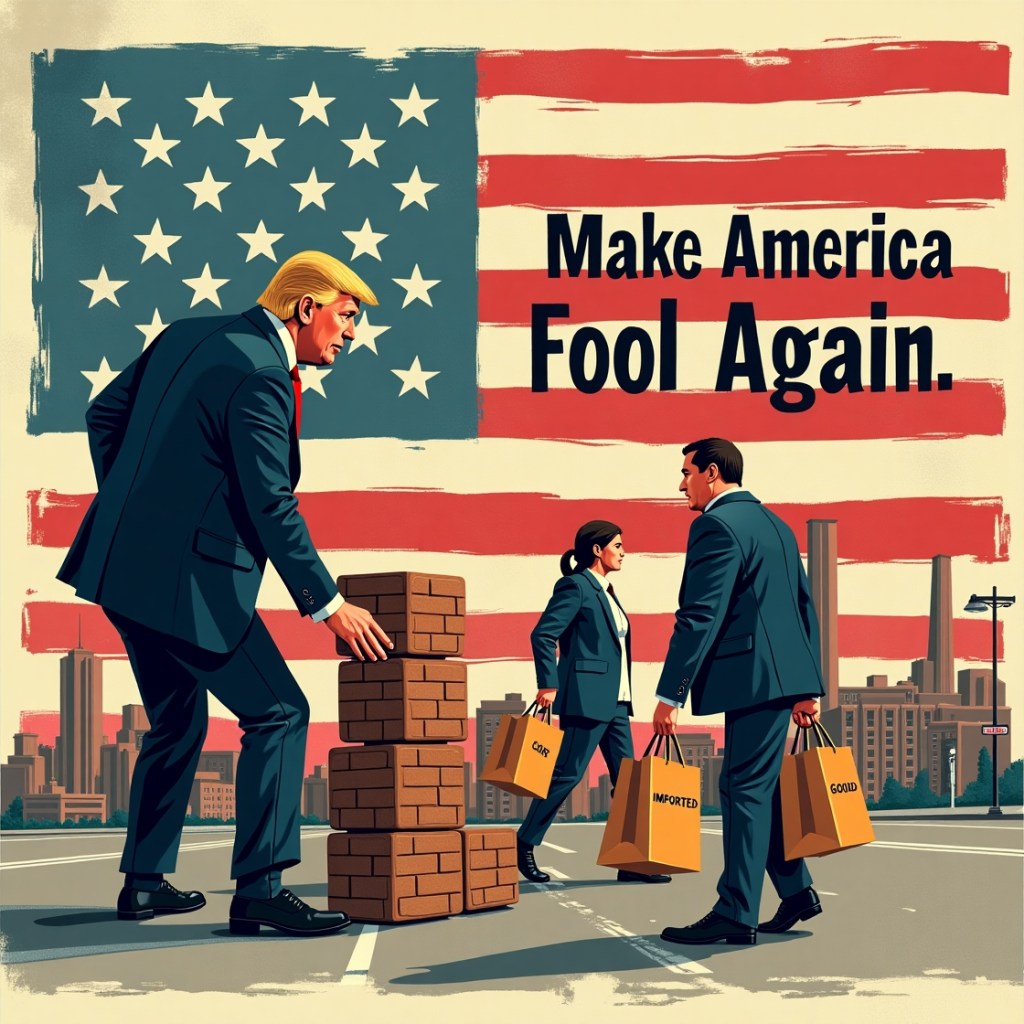
In the age of performative patriotism and economic brinkmanship, Donald Trump’s favorite rallying cry—“Make America Great Again”—may need a reboot: “Make America Fool Again.” At the heart of this irony lies a simple but devastating reality—tariffs. While marketed as weapons of economic warfare against foreign “cheaters,” these tariffs have become boomerangs, hitting American consumers harder than anyone else.
The Illusion of Economic Toughness
Trump’s tariff-heavy strategy is pitched as bold nationalism: taxing foreign imports to promote American-made goods and force foreign governments to yield to U.S. demands. On paper, it sounds tough. In practice, it’s economically self-defeating in a nation where most consumer goods—from iPhones to bananas—are sourced globally.
The U.S. consumer economy is import-dependent by design. Over 70% of retail goods involve foreign components or are directly imported. In this environment, tariffs function not as pressure on foreign manufacturers—but as an invisible tax on American families.
Who Really Pays?
Let’s cut through the rhetoric: Americans pay these tariffs. Corporations simply pass the added costs to the customer. In 2025 alone, U.S. households are expected to pay $1,270 to $2,400 more per year, solely due to tariff-related inflation. Prices for groceries, clothing, furniture, electronics, and cars have jumped—without corresponding wage increases.
Even basic foods are not spared. Bananas, coffee, and wine—items not grown at scale in the U.S.—have no domestic alternative. The tariff on them isn’t protective; it’s punitive to consumers.
Case Study: Autos, Goods, and Stock Shocks
Tariffs on imported autos have driven vehicle prices up by 11%. At the same time, American car manufacturers suffer too—many rely on imported parts. The result? No winners.
Consumer goods giants like Procter & Gamble and Nestlé have announced price hikes across product lines. Even the stock market responds negatively, with dips in shares of consumer-oriented companies whenever new tariffs are announced.
A Strategy Without Substitutes
While Trump’s team insists tariffs will push the U.S. to “de-risk” from China, the reality is that alternatives (like Vietnam or Mexico) often rely on Chinese supply chains themselves. Meanwhile, U.S. manufacturing lacks the scale, workforce, or cost advantage to replace imports meaningfully. The result is disruption without a solution.
Nationalism at Whose Cost?
This is where the slogan flips: “America First” has become America Pays First. These tariffs act as regressive taxes, hurting middle- and lower-income Americans most. They dampen consumer spending, slow economic growth, and hollow out household budgets—all under the banner of economic patriotism.
Trump presents himself as the dealmaker, the protector of American interests. But in the arena of global trade, he’s wielding a sledgehammer where surgical tools are needed.
As political theater, tariffs may look decisive. But behind the scenes, they erode the very fabric of the U.S. consumer economy. What began as a campaign promise to restore greatness has, in effect, triggered the largest stealth tax hike on American households in three decades.
The irony is stark. In trying to punish others, America punishes itself.
So, the new slogan practically writes itself:

 Unmukt