Unmukt

Tag: tariff

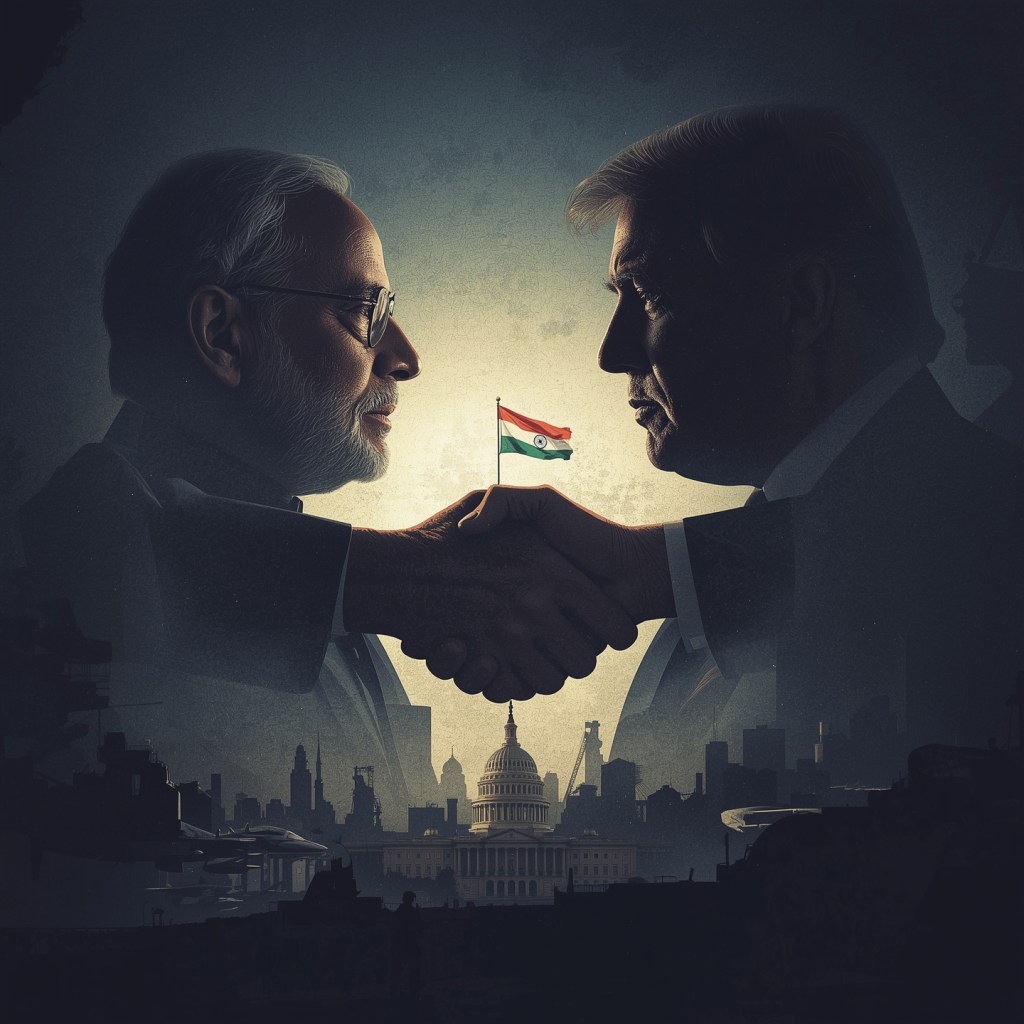
  • Public Fights, Private Handshakes: The Real Story Behind the Indo–U.S. “Tariff War”

    By the time you read this, a top-level U.S. defence delegation will either be packing their bags for New Delhi or already in meetings with India’s strategic leadership. On paper, this shouldn’t be happening. Not after President Donald Trump slapped two layers of tariffs on Indian goods — 25% on most imports from 1 August, plus another 25% announced on 7 August over India’s purchase of Russian oil. Together, they threatened to take the trade friction to a painful 50%.

    Yet, in classic Washington style, the drama on the surface hides a very different current beneath. While the tariff headlines dominate, the Indo–U.S. relationship is quietly moving forward on nearly every other front.

    The Defence and Security Front

    The upcoming visit of the U.S. defence ministry’s high-level team is not routine — it is a deliberate signal. Washington wants India to know that defence cooperation remains a priority. This is reinforced by the fact that the 21st edition of the joint Indo–U.S. military exercise will go ahead in Alaska this month.

    And here’s the geopolitical theatre twist: that’s the very location where Trump is scheduled to meet Russian President Vladimir Putin. On one side, Trump will be shaking hands with Putin; on the other, Indian and American soldiers will be training side by side.

    Diplomatic Continuity: The 2+2 Dialogue

    Preparations for the annual “2+2” ministerial dialogue — involving the defence and foreign ministers from both countries — are well underway. It’s one of the highest forms of institutional dialogue between the two nations, and it signals long-term commitment, not short-term posturing.

    Trade Talks Against the Grain

    Despite the tariff tensions, the American trade negotiation team is still coming to India on 25 August. There’s even optimism about concluding a barter-style trade agreement by October. India has drawn its “red lines” clearly — agriculture, livestock, and fisheries are off the table. Washington, at least for now, seems willing to proceed under those terms.

    Why the Mixed Signals?

    The answer lies in the difference between political theatre and strategic planning.

    • Trump’s tariff moves play well to his domestic base, particularly ahead of the midterm elections.
    • But U.S. institutions — the Pentagon, State Department, and trade machinery — know the cost of letting 25 years of carefully built Indo–U.S. cooperation unravel.
    • There’s also the possibility that Trump is quietly preparing to roll back the extra 25% tariff if the Putin talks produce the right optics.

    The Unmukt Take

    The “tariff war” may be more performance than policy. The reality is that India and the U.S. are not on the verge of a rupture; they are, in fact, deepening cooperation in defence, diplomacy, and trade — even as they spar in public.

    This is a story not of collapsing ties, but of dual narratives: one for the cameras, another for the confidential briefing rooms. And in international politics, it’s often the private handshake that writes the real history.

  • BRICS 2025: How the Global South Alliance Could Reshape the World Order

    By Unmukts.com News Analysis Desk

    The global balance of power is shifting, and one alliance is at the heart of this transformation — BRICS. Comprising Brazil, Russia, India, China, and South Africa, BRICS was once dismissed by Western analysts as an economic buzzword without strategic weight. But in 2025, this bloc is emerging as a coordinated geoeconomic powerhouse with ambitions to de-dollarize trade, counter U.S. tariffs, and build a multipolar global order.

    Why BRICS Matters in 2025

    In recent months, U.S. policymakers have imposed tariffs and trade restrictions not only on rivals like China and Russia but also on partners such as India and Brazil. This unprecedented move has united all BRICS nations against Washington’s economic pressure, creating a rare moment of strategic alignment.

    Brazil’s President Luiz Inácio Lula da Silva has called for a joint BRICS response to U.S. pressure — a sign that the bloc is ready to move beyond symbolic summits into real coordinated action.

    BRICS 2025 Strategic Arsenal

    BRICS is now leveraging its combined economic and political strength in four key areas:

    1. De-Dollarization: Trading in Local Currencies

    • BRICS countries are actively working to reduce dependence on the U.S. dollar.
    • Bilateral trade in yuan, rupees, rubles, reais, and rand shields members from U.S. sanctions and currency manipulation.
    • This move challenges the petrodollar system that has dominated global finance for decades.

    2. Strengthening the New Development Bank (NDB)

    • Founded in 2014, the NDB is positioned as a World Bank alternative for the Global South.
    • By offering loans without political strings, it strengthens BRICS influence in Asia, Africa, and Latin America.
    • Expansion to include new members like Egypt and Saudi Arabia is already in discussion.

    3. Creating a SWIFT Alternative

    • Western sanctions have weaponized the SWIFT payment network.
    • BRICS nations are developing an independent cross-border payment system, ensuring trade can continue even if members are excluded from Western systems.

    4. Challenging U.S. Tariffs at the WTO

    • By coordinating legal challenges at the World Trade Organization, BRICS can collectively pressure Washington.
    • Such unified action multiplies the negotiating power of each member state.

    The Scale of BRICS Economic Power

    BRICS is no longer a “developing economies” club — it’s a global heavyweight:

    • Population: 40% of the world’s total (over 3.2 billion people)
    • GDP: ~$30 trillion — nearly equal to the U.S. economy
    • Nuclear Capability: Greater combined arsenal than Washington
    • Natural Resources: Dominant reserves of oil, gas, rare earths, and agricultural output
    • Strategic Markets: China and India as manufacturing and consumption giants; Brazil and Russia as resource powerhouses; South Africa as Africa’s trade gateway

    Why U.S. Pressure Could Unite BRICS Further

    For the first time, the U.S. has directly targeted all BRICS members with tariffs or sanctions — including countries like India and Brazil that Washington once counted as partners. This aggressive approach risks backfiring, pushing BRICS members toward deeper cooperation.

    • India faces tariffs just as Prime Minister Narendra Modi plans a visit to China, potentially warming ties between Asia’s two largest economies.
    • Brazil is positioning itself as a vocal advocate for Global South independence from Western dominance.
    • Russia & China are already deepening trade and military coordination after years of U.S. sanctions.

    From Acronym to Geoeconomic Alliance

    When Goldman Sachs economist Jim O’Neill coined “BRIC” in 2001, it was simply a projection of emerging market growth. South Africa joined in 2010, and since then BRICS has evolved into a strategic coalition seeking to:

    • Reform global financial institutions like the IMF and World Bank
    • Build trade systems independent of Western control
    • Expand its membership to include other Global South powers

    The post-Ukraine geopolitical climate has supercharged BRICS ambitions, turning it into the flagship of multipolarity.

    The Future: A Multipolar World Driven by the Global South

    The early 2000s unipolar era — when the U.S. set the rules — is over. BRICS is now a symbol of the Global South’s collective rise. With massive populations, economic diversity, and resource wealth, BRICS does not need to outgun the United States militarily. It already holds economic leverage that can reshape global trade and finance.

    This is not just about opposing Washington. It’s about building a world where power is shared, currencies are diversified, and development is driven by cooperation rather than coercion.

  • Trump Calls India a Dead Economy. Rahul Gandhi Nods. Facts Say Otherwise

    In a recent statement, former U.S. President Donald Trump described India as a “dead economy.” Shockingly, Indian political leader Rahul Gandhi echoed this sentiment, using it to attack the current government. What both these men fail to grasp — or deliberately ignore — is the reality of India’s economic and geopolitical strength.

    Let’s start with the facts:

    • 🇮🇳 India’s GDP growth in FY 2024-25: 7%
    • 🇺🇸 U.S. GDP growth in H1 2025: 1.25%
    • 🇷🇺 Russia’s GDP growth in 2024: -4.1%

    India is, by far, the fastest-growing major economy in the world — driven by manufacturing, services, exports, infrastructure, and a digitally empowered population.

    Meanwhile, the U.S. is barely growing, and Russia is shrinking. So who is the “dead economy” here?

    The Hypocrisy of Trump

    Donald Trump calls China America’s biggest threat, yet his policies end up helping China.
    How?

    He imposes tariffs on Apple and other U.S. multinational products manufactured in India — a democratic ally. These punitive actions discourage American companies from diversifying away from China.

    Instead of supporting India as a reliable partner, Trump treats it as a threat. This isn’t strategy — this is short-sighted populism that benefits Beijing, not Washington.

    Rahul Gandhi’s Echo Chamber Politics

    What’s worse than Trump’s ignorance? An Indian leader endorsing it.

    Rahul Gandhi, who constantly speaks of “saving democracy,” found himself aligning with a man known for undermining democratic values — simply because he saw an opportunity to score political points.

    When a national leader amplifies a foreign voice that demeans India’s rise, it’s not dissent — it’s disgrace.

    India needs an opposition that holds the government accountable while standing for the nation, not one that joins hands with foreign critics just to attack political rivals.

    India Is Not the Problem. India Is the Solution.

    India is not an expansionist power. It doesn’t threaten global stability — it strengthens it. As the world faces rising authoritarianism and economic stagnation, India offers something rare:

    • A democratic system that works
    • A young population ready to innovate and build
    • A geopolitical balance that offers stability to both the East and the West
    • A thriving market that welcomes global investment and fair competition

    If anything, a strong and self-confident India solves problems for the West — by offering a counterweight to China, a partner in tech and defence, and a responsible voice in global affairs.

    India has many challenges. But calling it a “dead economy” is not just inaccurate — it’s insulting. And when Indian leaders echo these falsehoods, they undermine the very nation they claim to serve.

    At Unmukt, we believe in Dharma-based politics — rooted in truth, strength, and national pride. India doesn’t need validation from foreign leaders. But it does need its own citizens, especially its leaders, to stand with her — not against her.

    Let critics speak. Let the facts roar louder.