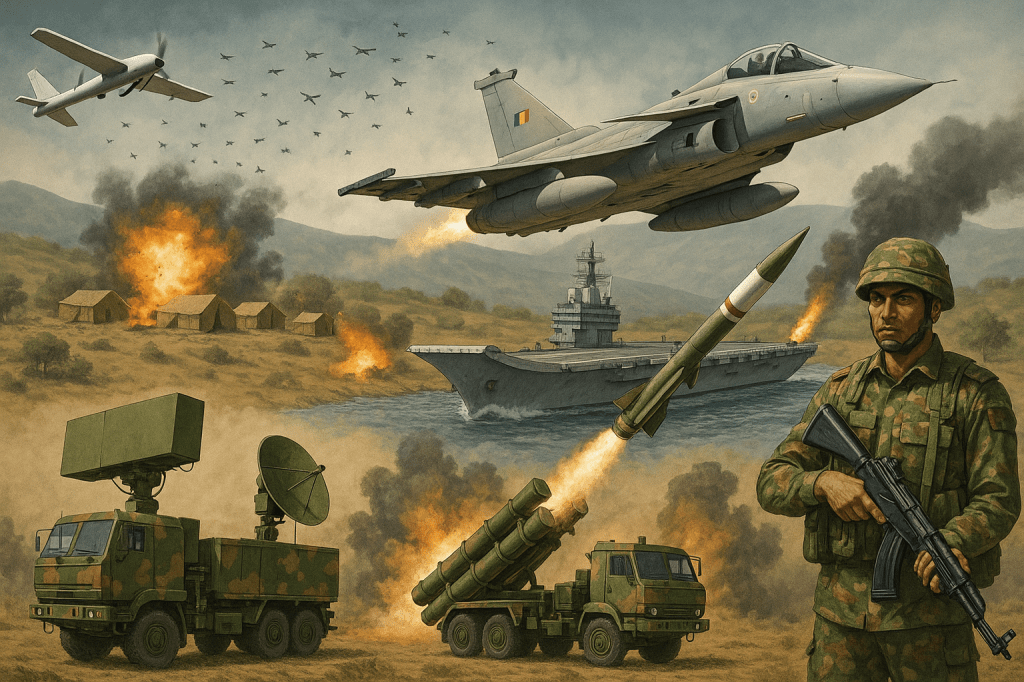
On May 7, 2025, India launched Operation Sindoor, a coordinated tri-services strike targeting nine terrorist camps in Pakistan and Pakistan-occupied Kashmir (PoK), in response to the brutal Pahalgam terror attack of April 22. Beyond the immediate tactical success, the operation offered a revealing look into India’s indigenous defense capabilities—technologies, weapons systems, air defence mechanisms, and surveillance platforms developed under the banner of Atmanirbhar Bharat.
Indigenous Systems Used in Operation Sindoor
1. SkyStriker Kamikaze Drones
Manufactured in Bengaluru via a joint venture between Alpha Design and Israel’s Elbit Systems, these loitering munitions delivered high-precision strikes on terrorist camps. With real-time video capability and two-way communication, they enabled targeted neutralization of 80–100 terrorists, demonstrating India’s growing competence in unmanned aerial warfare.
2. DRDO’s Low-Cost Miniature Swarm Drone System (LMS)
Indigenous, cost-effective, and precise—DRDO’s LMS drones were instrumental in hitting targets while minimizing collateral damage. Their deployment marked a significant milestone in India’s autonomous weapons development program.
3. INS Vikrant: Indigenous Aircraft Carrier
Though its direct role in the operation was limited to support, INS Vikrant’s strategic positioning off the western coast served as a deterrent. Constructed by Cochin Shipyard with 76% indigenous content, it is a symbol of India’s shipbuilding prowess.
4. Advanced Electronic Warfare (EW) Systems
DRDO’s indigenous EW capabilities, likely based on systems such as Samyukta and Shakti, were pivotal in suppressing enemy radar and communication networks, enabling Indian aircraft to penetrate deep without detection.
Aftermath and Indigenous Responses (May 8–9, 2025)
1. Integrated Counter-UAS Grid
When Pakistan retaliated with drone and missile attacks on Indian military bases, India’s indigenous anti-drone systems rose to the occasion. This integrated grid, consisting of radar, jammers, and kinetic kill solutions, neutralized a coordinated 35-minute drone assault in Jammu and Kashmir.
2. Akash Surface-to-Air Missile System
Developed by DRDO and Bharat Electronics Limited, the Akash system was deployed in multiple zones including Rajasthan and Jammu. Officials reported a near-100% interception success rate, affirming its value in India’s multi-layered air defence framework.
3. SEAD/DEAD Operations with EW Support
While Rafale jets and SCALP missiles (both imported) were involved in Suppression/Destruction of Enemy Air Defences (SEAD/DEAD) over Lahore, indigenous EW systems were essential in jamming enemy radar, reportedly exposing flaws in Pakistan’s Chinese-supplied HQ-9 and HQ-16 systems.
4. BSF Surveillance Operations
The Border Security Force utilized Netra V-series mini-UAVs and thermal imaging systems—both indigenous—for border monitoring and successfully thwarted infiltration attempts in Samba. INSAS rifles and other indigenously manufactured small arms were also deployed.
Effectiveness on the Battlefield
The indigenous systems displayed notable effectiveness:
- Precision: SkyStriker and DRDO loitering drones ensured surgical strikes with minimal civilian damage.
- Defensive Strength: The Akash system and anti-drone grid protected key military bases during enemy retaliations.
- Tactical EW Superiority: Indian EW systems enabled deep penetration by jamming Pakistani defences.
- Border Vigilance: Indigenous surveillance drones empowered the BSF to maintain round-the-clock border security.
While imported platforms like Rafale, S-400, and SCALP missiles were crucial, the core indigenous systems proved reliable, cost-effective, and capable under fire.
Global Competitiveness of Indian Indigenous Systems
India’s defence export value has surged to $2.5 billion in FY 2023–24, with a CAGR of over 45%. However, how do these systems stack up globally?
Export-Ready Indigenous Systems
- Akash Missile System
Proven in combat, cost-effective, and weather-resistant—Akash is gaining interest in Southeast Asia and Africa. Its simplicity and affordability make it appealing compared to Western alternatives.
- BrahMos Cruise Missile
A joint Indo-Russian marvel with Mach 3 speed and pinpoint accuracy, BrahMos has been sold to the Philippines and is being negotiated with Indonesia and Thailand. It is arguably India’s most competitive export.
- Pinaka Rocket Launcher
Deployed in multiple combat zones and exported to Armenia, Pinaka offers high-rate firepower at a fraction of the cost of U.S. or Russian equivalents.
- Tejas Light Combat Aircraft
Despite setbacks in Malaysia due to performance concerns, Tejas remains a low-cost 4.5 generation fighter option for countries unable to afford F-16s or Eurofighters. India is working to resolve issues around its engine and radar to improve export viability.
Challenges to Global Competitiveness
- Partial Indigenization: Many Indian platforms still rely on imported subsystems (e.g., jet engines, radar).
- Limited Production Capacity: Indian defence PSUs are often slow and bureaucratic in international bidding.
- Perception Issues: Western buyers often perceive Indian systems as less reliable than U.S. or European counterparts.
Future Outlook
India aims to increase defence exports to $5 billion by 2025. With 75% of its 2024–25 defence procurement budget reserved for indigenous products, and investments in defence corridors (Uttar Pradesh and Tamil Nadu), India is laying the foundation for a strong, self-reliant ecosystem.
Programs like iDEX (Innovations for Defence Excellence) and increased funding for Technology Development Fund (TDF) projects are catalysing private-sector innovation, further sharpening India’s edge in cost-effective, scalable defence solutions.
Conclusion
Operation Sindoor and its aftermath presented a clear demonstration of India’s maturing indigenous defence capabilities. From loitering drones and SAM systems to aircraft carriers and electronic warfare, India has shown it can design and deploy systems that meet modern battlefield demands. While global competitiveness is improving, challenges around scale, perception, and technological depth remain. With sustained reforms and strategic investments, India is well-positioned to become a global defence manufacturing and export hub in the decade ahead.
 Unmukt