In the age of digital disinformation, wars are no longer fought just on the battlefield — they’re fought on WhatsApp, Twitter, and newsrooms. Operation Sindoor, India’s swift and precise military response to a Pakistan-backed terror attack, became not only a story of strategic success but also a case study in how facts are often buried beneath layers of political spin, foreign commentary, and media speculation.
What Triggered Operation Sindoor?
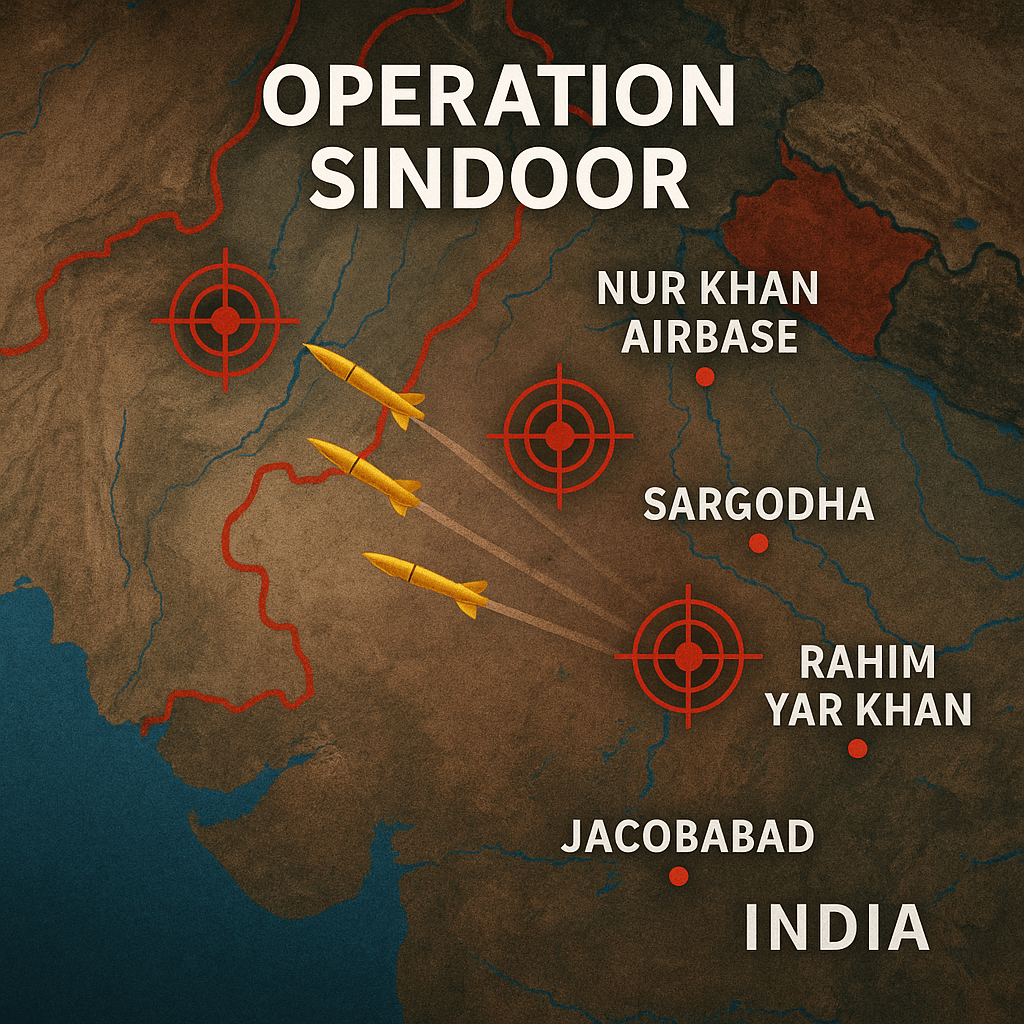
On April 22, 2025, a brutal terror attack in Pahalgam, Jammu & Kashmir, claimed the lives of 26 civilians, including pilgrims. Intelligence traced the plot to Pakistan-based terrorist groups, prompting India to launch Operation Sindoor — a 23-minute air and missile operation that began at 4:03 AM on May 7, 2025.
Targets of the Operation Included:
Nur Khan Airbase (Rawalpindi)
Mushaf Base (Sargodha)
Rahim Yar Khan airbase
Shahbaz Airbase (Jacobabad)
Radar sites in Pasrur and Lahore
Satellite images later confirmed damage to runways, bunkers, and radar systems. The strikes were precise, time-bound, and aimed at disabling Pakistan’s offensive capabilities while avoiding civilian casualties.
Ceasefire: No Mediation, Just a Phone Call
Contrary to various media reports and speculative comments, especially from former U.S. President Donald Trump, the ceasefire was not the result of international mediation.
On May 10, 2025, Pakistan’s Director General of Military Operations (DGMO) made a direct hotline call to his Indian counterpart, requesting a halt to hostilities. India’s DGMO and the Ministry of External Affairs (MEA) confirmed that the ceasefire was arranged bilaterally.
MEA Statement:
“There was no international mediation. The ceasefire was arranged solely via military channels.” — Vikram Misri, Foreign Secretary, Government of India
Then why didn’t Prime Minister Modi publicly respond to Trump’s claim? Because diplomacy is about clarity, not volume. When the Ministry of Defence and MEA have issued a formal position, repeating it from the Prime Minister’s podium only adds fuel to unfounded rumors.
Rafale Jet Shot Down? Absolutely False
Following Operation Sindoor, Pakistani media and some fringe outlets claimed that a Rafale jet was shot down during the operation.
The Reality:
India’s Defence Secretary R. K. Singh confirmed that no Indian aircraft, including Rafale, was lost in combat.
Dassault Aviation, the Rafale manufacturer, also denied any loss.
India’s Press Information Bureau (PIB) flagged the Pakistani claim as “completely false.”
The truth? One Rafale returned early due to a minor sensor malfunction. It was back in the skies within three days. There was no shoot-down, no crash, and no damage. Just a lie wrapped in clickbait.
The “3 Jets Down” at Shangri-La? Misinterpretation
At the Shangri-La Dialogue in Singapore, India’s Chief of Defence Staff, General Anil Chauhan, mentioned that three aircraft were grounded for checks during the operation.
This was twisted by some commentators into claims that “three Indian jets were downed.” In reality, these aircraft were not hit by enemy fire — they were temporarily grounded as a safety measure and were operational again within 48 hours.
What the CDS Actually Said:
“We studied a tactical mistake that temporarily grounded three jets. But within 48 hours, they were back in action.”
There is a big difference between a strategic review and a battlefield loss. The former makes you stronger. The latter didn’t happen.
Who Saved Indian Skies? Not Just S-400s
Another myth that made the rounds was that India’s Russian-made S-400 missile defence system saved the country from Pakistan’s drone and missile strikes.
While the S-400 was deployed to cover high-altitude sectors, the real heroes were India’s indigenous air defence systems:
Akash SAMs
MR-SAMs (jointly with Israel)
L/70 Anti-Aircraft Guns
Akashteer Command & Control Network
These systems intercepted over 90% of incoming drones and missiles, particularly low-cost swarms launched by Pakistan. The indigenous network played the lead role, not the imported ones.
Strategic Outcome: India Won the Fight and the Message
Category
Outcome
Military Response
India disabled 4 airbases, 2 radar sites, and multiple launch pads.
Diplomacy
No mediation accepted. Ceasefire on India’s terms via DGMO hotline.
Disinformation
Rafale claims, Trump mediation, and aircraft losses debunked.
Defence Systems
Indigenous systems proved highly effective — a win for Atmanirbhar Bharat.
Operation Sindoor showcased India’s technological edge, military precision, and diplomatic maturity. But it also revealed how easily misinformation can dilute real victories.
In today’s world, where narratives move faster than missiles, citizens must learn to verify before they amplify.
So next time someone says, “Trump stopped the war” or “Pakistan shot down a Rafale,” ask them for evidence — and show them this article.
Human rights are meant to protect the dignity, freedom, and well-being of every individual, regardless of nationality, race, or belief. These principles are supposed to be universal and applicable to all people. However, a disturbing trend has emerged over the years—one where terrorists are granted the very protections intended for innocent victims, often in stark contrast to the silence or neglect of the victims of terrorism themselves. This hypocrisy of human rights advocacy is especially evident in the tragic story of Daniel Pearl, the Wall Street Journal journalist who became a victim of one of the most horrific terrorist acts of the early 21st century.
Daniel Pearl’s Tragic Murder
In 2002, Daniel Pearl, an investigative journalist based in Pakistan, was abducted by a group of Islamist extremists while he was working on a story about the growing threats of radical terrorism in the region. His investigation had led him to Al-Qaeda links and the global jihadist network, and his work focused on uncovering the connections between Islamic extremists and various state and non-state actors.
On January 23, 2002, while researching, Daniel was kidnapped in Karachi by a group led by Ahmed Omar Saeed Sheikh, a British-Pakistani terrorist who was later convicted for his role in the crime. Shortly thereafter, Pearl’s captors made it clear that his life was at risk, and on February 21, 2002, they released a gruesome video showing his brutal beheading. This heinous act shocked the world and exposed the true face of radical Islamic terrorism.
Daniel Pearl was not just a journalist; he was a man dedicated to revealing the truth about the growing terror networks operating under the guise of religious extremism. His murder was a tragic loss not only to his family but also to the world of journalism and the pursuit of truth. But what happened in the aftermath of his murder speaks volumes about the hypocrisy in the treatment of terrorists and terror victims.
The Failure to Hold Terrorists Accountable
In the years following Pearl’s murder, his killers—especially the mastermind, Ahmed Omar Saeed Sheikh—became a symbol of the international community’s inability to take decisive action against those who commit acts of terrorism. Despite being sentenced to death by a Pakistani court, Sheikh’s trial was mired in controversy, and in 2020, a Pakistani court shockingly acquitted him of charges related to Pearl’s death, citing a lack of evidence and pointing to the possibility of political motivations behind the case.
While Daniel Pearl’s family and the global community sought justice, the Pakistani government, a key ally in the War on Terror, showed a disturbing reluctance to fully investigate and prosecute those involved in Pearl’s murder. The question remains: why did the world remain largely silent in the face of such a blatant act of terror? And more importantly, why did human rights organizations often choose to focus their energies on protecting terrorists, rather than demanding justice for victims like Daniel Pearl?
Human Rights Hypocrisy: Terrorists and Victims in the Same Light
The tragic story of Daniel Pearl serves as a glaring example of the hypocrisy inherent in certain aspects of the human rights movement. In many instances, terrorists—individuals who destroy lives, spread fear, and violate the most basic rights of others—are often given legal protections and media attention, while their victims are left behind in the shadows.
This hypocrisy is particularly evident when we look at the way certain human rights organizations rallied around individuals linked to terrorist acts. Take the example of Aafia Siddiqui, often referred to as the “Lady al-Qaeda.” Siddiqui was convicted in 2010 for attempting to murder U.S. soldiers in Afghanistan and for her connections to terrorist groups like Al-Qaeda. Yet, despite her involvement in terror, human rights groups began campaigning for her release, focusing on her alleged mistreatment in U.S. custody, rather than her role in terrorism.
At the same time, the victims of the terrorism Siddiqui and others like her supported were often left out of the discussion. For example, the 9/11 attacks left nearly 3,000 people dead, yet those who died are often overshadowed by campaigns that prioritize the rights of terrorists over those of the victims.
The case of Daniel Pearl fits perfectly into this pattern. While the terrorists responsible for his murder have, in some cases, received legal protections, the victim’s rights—the rights of a journalist who was simply doing his job to report on the truth—were ignored by both the Pakistani authorities and many in the international community. Human rights organizations that often rally behind accused terrorists conveniently overlook the impact of their violence on innocent people.
The Double Standard: Victims of Terror vs. Terrorists
The human rights double standard becomes even more troubling when examining the global response to the terrorist threat. On one hand, human rights groups demand that those accused of terrorism be afforded due process, even when there is clear evidence of their involvement in heinous acts. On the other hand, these same organizations often remain silent or downplay the rights of victims, such as Daniel Pearl and others who have been affected by terrorism.
Take, for example, the Paris terrorist attacks in 2015, where dozens of innocent civilians were slaughtered by Islamic extremists. While there was outrage over the attacks and support for the victims’ families, there was also considerable attention on the rights of the attackers. Human rights groups, once again, were quick to argue that the accused terrorists must be afforded their legal rights, including protection from torture and inhumane treatment, but the voices of the victims and their families were often drowned out in the debate.
Conclusion: The World Must Choose Justice Over Hypocrisy
The death of Daniel Pearl should serve as a stark reminder of the hypocrisy inherent in the selective application of human rights principles. While the terrorists responsible for his death—and those like them—are often shielded by human rights activists, the victims of their violence are often ignored or forgotten. The world must recognize that human rights should be about justice for everyone, not just those who commit atrocities. Terrorists should not be shielded by legal protections while their victims continue to suffer in silence.
Daniel Pearl’s death was not just a tragedy for his family but for the world. It was a reminder of the need to hold terrorists accountable and protect the rights of the innocent. Until the international community truly upholds human rights for all—victims and perpetrators alike—the hypocrisy of human rights will continue to tarnish the ideals that should be protecting us all.
This story serves as a call to action for justice, truth, and a true commitment to universal human rights. Only then can we begin to create a world where victims of terror are protected and terrorists are held to account for their actions.
On May 7, 2025, the Indian Armed Forces launched Operation Sindoor in response to the April 22 terror attack in Pahalgam, Jammu & Kashmir, which claimed 26 lives, mostly Hindu tourists. This military operation marked a decisive and symbolic turning point in India’s counter-terrorism strategy, targeting multiple terror infrastructure hubs across Pakistan and Pakistan-occupied Kashmir (PoK). As events continue to unfold, Operation Sindoor has not only altered regional dynamics but also ignited new debates on diplomacy, strategy, and national identity.
1. Casualties and Cross-Border Escalation
Operation Sindoor involved 24 precision airstrikes on nine terror-linked sites, reportedly neutralizing over 70 militants affiliated with groups like Jaish-e-Mohammed (JeM), Lashkar-e-Taiba (LeT), and Hizbul Mujahideen. India claims over 60 additional injuries, including close aides of JeM chief Maulana Masood Azhar. Pakistan, however, reports 26–31 deaths—many allegedly civilians—and 46 injuries, citing damage to civilian structures in Muzaffarabad, Kotli, and Bahawalpur.
In retaliation, Pakistan conducted cross-border shelling along the Line of Control (LoC), resulting in 12 civilian and one soldier death on the Indian side, with 51 more injured. Pakistan claimed 10 civilian deaths and 38 injuries from Indian shelling. While both sides provide conflicting casualty numbers, the human cost remains undeniable.
2. Regional Disruptions and Security Response
The operation triggered sweeping regional disruptions. Pakistan shut its airspace for 48 hours, grounding international flights and disrupting regional connectivity. In India, 27 airports including Srinagar, Leh, Jammu, and Amritsar were closed until May 10, causing over 300 flight cancellations.
India also conducted “Operation Abhyaas,” a nationwide civil defense drill across 244 districts—the first of its scale since the 1971 war. Additional security measures included nightly blackouts in border regions like Gurdaspur, Punjab, and the closure of public ceremonies at Indo-Pak retreat points. Police leaves were canceled in Punjab, Rajasthan sealed its borders, and schools in frontier districts were shut for up to 72 hours.
3. Political and Diplomatic Reactions
Domestically, the operation garnered near-unanimous political support. Prime Minister Narendra Modi chaired high-level strategic meetings, while opposition leaders such as Mallikarjun Kharge and Jairam Ramesh supported the action, emphasizing national unity.
International reactions were mixed. The United Nations and China called for “maximum restraint,” whereas the U.S. and UK acknowledged India’s right to self-defense but urged de-escalation. Russia expressed concern over potential regional instability, and Sweden advised against travel to affected Pakistani regions. India’s Ministry of External Affairs briefed members of the UN Security Council, reaffirming its anti-terror position.
4. Strategic and Symbolic Dimensions
Operation Sindoor marked a doctrinal shift in India’s counter-terrorism approach, blending conventional military precision with psychological messaging. Key targets included:
Muzaffarabad & Kotli: Known JeM and LeT training hubs
Gulpur & Barnala: Linked to attacks in Poonch and IED production
Muridke & Bahawalpur: High-profile bases, including those that trained 26/11 attacker Ajmal Kasab
India deployed state-of-the-art technology, including SCALP cruise missiles, HAMMER bombs, and indigenous SkyStriker suicide drones. This reflects a significant leap in India’s military capabilities and its intent to project deterrence beyond the LoC.
The name “Sindoor” carries deep cultural symbolism. Referring to the vermilion worn by married Hindu women, it was chosen to honour the widows of the Pahalgam victims. However, critics argue that the symbolism reinforces gender stereotypes, placing women in the frame of passive victims rather than empowered agents.
5. Societal and Economic Consequences
The shockwaves of Operation Sindoor extended to the civilian sphere. Panic gripped Pakistani cities like Lahore, as videos circulated of civilians fleeing explosions. In India, civilians in border towns faced movement restrictions, school closures, and economic uncertainties.
The government prepared to invoke the Essential Services Maintenance Act to ensure stable supplies and prevent profiteering. PM Modi also postponed a diplomatic tour to Europe, reflecting the operation’s seriousness. Public sentiment in India, particularly in Jammu & Kashmir, was buoyant. In Srinagar’s Lal Chowk, locals gathered in solidarity, while families of the Pahalgam victims expressed gratitude.
6. Ongoing Developments and Risks Ahead
As of May 8, 2025, tensions remain high. India conducted large-scale air force drills near the western border, involving Rafale and Jaguar aircraft. Pakistan intensified shelling across multiple LoC sectors, while the BSF neutralized a suspected infiltrator in Punjab.
India’s Ministry of Defence claimed to have foiled a Pakistani cyber-attack targeting air defense radars. Meanwhile, misinformation campaigns have emerged, with Pakistan falsely claiming Indian aircraft losses. Home Minister Amit Shah directed strict monitoring of media and social platforms to counter propaganda.
India has signaled that it seeks no further escalation but remains prepared to respond decisively to any additional aggression.
7. Conclusion
Operation Sindoor has underscored a new phase in South Asian geopolitics—one where assertiveness, symbolism, and technology intersect. While India portrays the operation as a necessary response to terror, Pakistan’s retaliatory posture and civilian impact raise serious questions about the path forward.
The international community watches closely, urging both nuclear-armed neighbors to exercise restraint. As of now, the border remains volatile, the region tense, and the future uncertain. The next steps—diplomatic, military, and humanitarian—will determine whether Operation Sindoor becomes a precedent for proactive counter-terrorism or a flashpoint in South Asia’s fragile stability.
On May 7, 2025, India launched Operation Sindoor, a major military strike against terrorists in Pakistan and Pakistan-occupied Kashmir (PoK), in response to a deadly terror attack in Pahalgam, Jammu and Kashmir, on April 22, 2025. That attack killed 26 people—25 Indians and one Nepali, mostly tourists. Imagine losing your family on a vacation—that’s the pain these families felt. India hit back hard, and now the leader of a major terror group has spoken out. Here’s the full story, updated with the latest news, for regular people like us.
What Happened in Operation Sindoor?
Operation Sindoor targeted nine terrorist hideouts in Pakistan and PoK, focusing on groups like Jaish-e-Mohammed (JeM) in Bahawalpur and Lashkar-e-Taiba (LeT) in Muridke, plus other spots like Kotli, Ahmadpur Sharqia, Muzaffarabad, and Faisalabad. These groups have been behind many attacks on India, including the Pahalgam massacre.
For the first time since the 1971 India-Pakistan war, the Indian Army, Air Force, and Navy worked together. India used a clever strategy called air defense saturation, which is like sending so many distractions that the enemy’s radar gets confused and can’t spot the real attack. They sent drones, loitering munitions (like smart flying robots), SCALP missiles, BrahMos, Spice 2000 bombs, Gaurav bombs, and HAMMER bombs (used by Rafale jets). The Army hit 70% of the targets, and the Air Force handled 30%. No Indian jets were lost, showing how well-planned this was.
India says the strikes killed at least 17 terrorists and injured 60, but unofficial reports claim up to 120 people might have died. Pakistan says civilians, including a child, were killed. No one outside has checked these numbers, so the real human cost isn’t clear yet.
A Terror Chief Speaks: Maulana Masood Azhar’s Statement
A big update came on May 7, 2025, around midday. Maulana Masood Azhar, the leader of Jaish-e-Mohammed, issued a statement admitting that 10 of his family members, including his elder sister, her husband, a nephew, and his wife, were killed in the Indian missile strikes on his headquarters in Bahawalpur. Azhar also said four close associates died, bringing the total to 14 deaths he acknowledged. He vowed revenge, calling the strikes an attack on his group’s mission. This is the first time Azhar has publicly confirmed such losses, and it shows the strikes hit hard at the heart of JeM—his own family.
But let’s think about this critically. Azhar’s statement, shared through posts on X, confirms the strikes were effective, but it also raises questions. Why is Azhar, a known terrorist under Pakistan’s protection, able to issue statements so freely? And does his vow of revenge mean more attacks are coming? This could make things even more tense between India and Pakistan.
Why Call It “Sindoor”?
The name “Sindoor” has a deep meaning. In Indian culture, sindoor is the red powder married Hindu women wear to show their husbands are alive. The Pahalgam attack targeted Hindu men, including newlyweds, leaving their wives heartbroken. One story that touched many was of Himanshi Narwal, who lost her husband, Navy officer Lt. Vinay Narwal, just six days after their wedding. Sindoor also stands for a warrior’s courage—soldiers often wear it before battle. The name was a message of justice for the victims and a show of bravery.
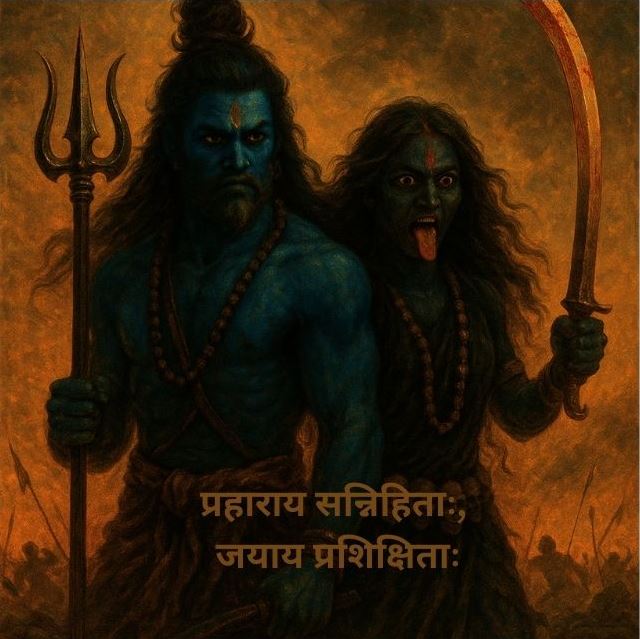
At around 1 AM on May 7, 2025, the Indian Army posted on X to hint at the coming strikes. They shared a Sanskrit sloka, a short poem with a big meaning:
प्रहाराय सन्निहिताः, जयाय प्रशिक्षिताः
This means “Ready to Strike, Trained to Win.” It’s like saying, “We’re prepared to fight, and we’ll win.” The Army wanted the world to know they were serious about stopping terrorism.
What Did the World Say?
United States: U.S. President Donald Trump called the India-Pakistan situation a “shame” and hoped it would “end very quickly,” pointing out their long history of conflict.
United Nations: UN leader Antonio Guterres was worried and asked both countries to stay calm, saying the world can’t afford a big fight between them.
Other Countries: India told the U.S., UK, Russia, Saudi Arabia, and UAE about the strikes, saying they only targeted terrorists, not Pakistan’s military. But most of these countries haven’t said much, which might mean they’re not fully supporting India’s actions.
Proof of Pakistan’s Role: A Hospital Visit
Two people named Jen and Arminal visited a hospital in Pakistan after the strikes and found something shocking. They saw terrorists injured in the attack being treated under the protection of Pakistan’s Army. This suggests the terrorists work closely with the Army, which could explain why these attacks keep happening. It’s like finding out a bully is being helped by a teacher—now you know why the trouble doesn’t stop. Azhar’s statement adds to this picture, showing how deeply JeM is tied to Pakistan’s system.
Steps India Took Before the Strikes
Before Operation Sindoor, India had already taken big steps against Pakistan after the Pahalgam attack. They stopped sharing river water under the Indus Waters Treaty and cut off trade with Pakistan. It’s like telling a troublesome neighbor, “We’re done.” These actions showed India’s anger, and the strikes were the next step.
Pakistan’s Trick to Hide the Damage
Pakistan is trying to cover up the damage from India’s strikes. They’re using bulldozers in three or four areas to clear away the destroyed terrorist sites, hoping Western media won’t notice the real impact. It’s like cleaning up a messy room before your parents see it—you don’t want them to know what happened. This makes it harder for the world to see the truth about Pakistan’s role in supporting terrorism.
Fake News in India: The Hindu’s False Story
Not everyone in India is helping during this time. A big newspaper, The Hindu, spread false news by showing old pictures of a grounded Indian jet and claiming three Indian jets had crashed in Jammu and Kashmir areas like Aknoor, Ramban, and Pampora. They said government officials told them this, but it wasn’t true—no jets crashed during Operation Sindoor. This kind of fake news can scare people and help India’s enemies. Some call this the “0.5 front”—Indians who work against their own country, almost like hidden enemies. If they’re harming India by spreading lies, why aren’t they called terrorists too?
The Big Questions: Casualties, Risks, and Politics
There are many unanswered questions. India says they only hit terrorists, but Pakistan claims civilians, including a child, died. No one has independently checked who really died, so we don’t know the full truth. Some unofficial reports say 120 people might have died—much more than India’s numbers. Azhar’s statement confirms 14 deaths in his circle, but what about others? It’s like two kids fighting and each blaming the other—we need someone neutral to find out what happened, but there’s no one doing that.
There’s also a risk of a bigger fight. Pakistan fired back by shelling Indian areas, killing three civilians, and their Prime Minister Shehbaz Sharif called the strikes an “act of war.” Azhar’s vow of revenge adds fuel to the fire. Even though India said they didn’t want to make things worse, Pakistan’s reaction and Azhar’s words show how quickly this could get out of hand.
Some people wonder if the timing of the operation was political. The Pahalgam attack made Indians very angry, and Prime Minister Narendra Modi and Defence Minister Rajnath Singh were closely involved. Doing something big like this can make the government look strong, especially when people are upset. It’s like a student doing extra work before a test to impress the teacher—sometimes it’s more about looking good than solving the problem.
Will Opposition Leaders Ask for More Proof?
Opposition leaders like Arvind Kejriwal, Rahul Gandhi, and Mamata Banerjee might ask for more proof about the operation. The Indian Army recorded everything using drones, so there’s video evidence. But Kejriwal might say, “Show us the videos to prove no civilians were harmed.” Rahul Gandhi, who praised the operation at first, might ask, “How do we know this won’t lead to a bigger war, especially with Azhar’s threats?” Mamata Banerjee might focus on border safety, saying, “What are you doing to protect our people if Pakistan or JeM attacks back?” They’ll likely push for more details to make sure the government is telling the truth, even if they support fighting terrorism.
What Might Satya Pal Malik Say?
Satya Pal Malik, a former governor of Jammu and Kashmir, has criticized the government before. He might say the Pahalgam attack was planned by Modi’s team to justify this operation and gain public support—like a conspiracy to make the government look good. Malik has made claims like this before, saying the 2019 Pulwama attack happened because of the government’s mistakes. He might ask, “Did Modi’s team plan the Pahalgam attack to start this fight?” Most evidence points to Pakistan-backed terrorists being behind the attack, but Malik’s words could still make people wonder.
What Does This Mean for You?
Operation Sindoor shows India is serious about stopping terrorism, especially with Azhar’s admission proving the strikes hit their target. But it also shows how complicated things are with Pakistan. Here’s what it means for regular people:
Stay Safe: If you live near the border, be careful. Schools and airports in places like Srinagar and Jammu were closed for safety after the strikes.
Bigger Picture: A small fight can turn into a big one, especially with Azhar’s vow of revenge. Let’s hope both countries calm down.
Ask Questions: We should support the Army but also ask for the truth, especially when lives are lost. And we should be careful about fake news—like what The Hindu spread—that can make things worse.
The Army’s message, “Justice is served. Jai Hind,” made many Indians proud, and locals in Jammu and Kashmir were chanting “Indian Army Zindabad” and “Bharat Mata ki Jai.” But as citizens, we should keep asking questions to make sure our leaders are doing the right thing—for today and for a peaceful tomorrow.


 Unmukt