
Unmukt

Tag: ukraine

  • Putin, Trump, and Modi: The Global Stage Is a Theater, But India Refuses to Play by the Script

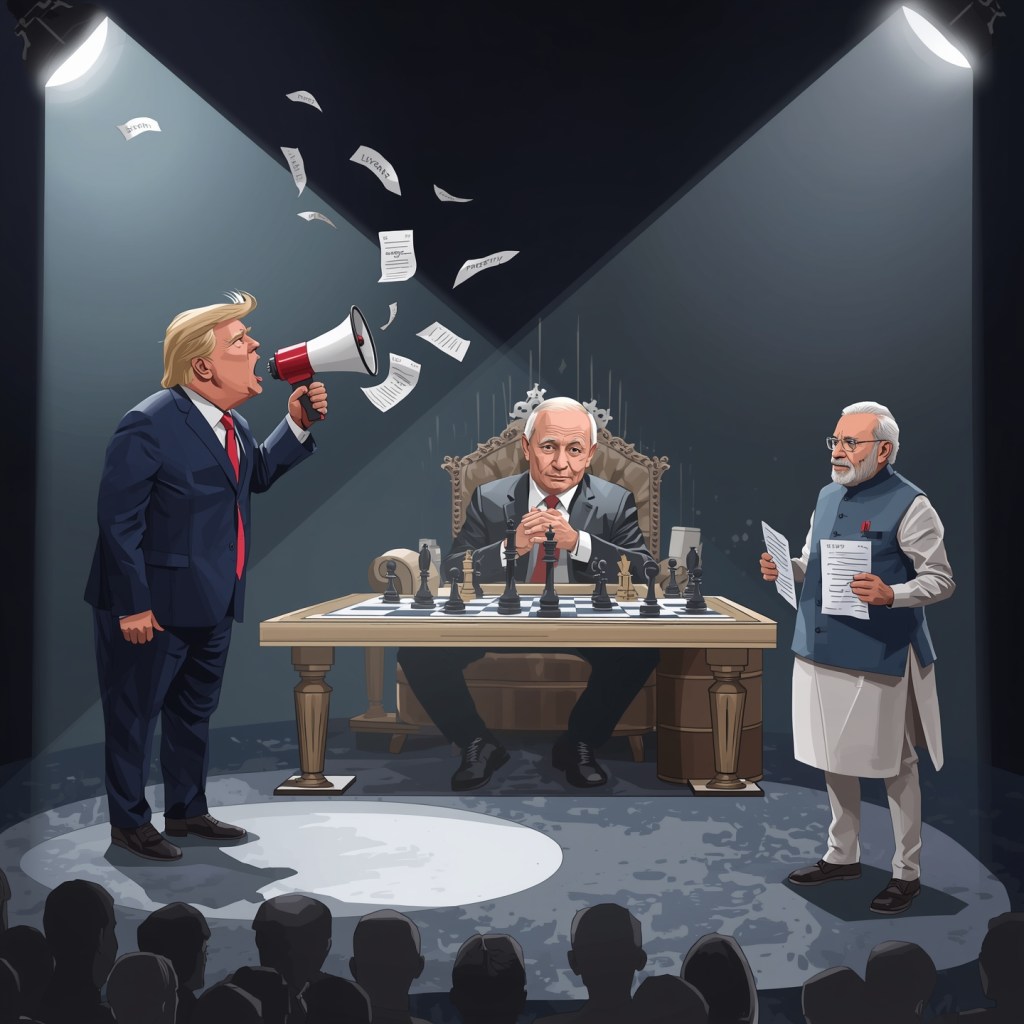
    When Vladimir Putin extended a hand to Donald Trump, inviting him to Moscow, the headlines screamed of shockwaves in global diplomacy. Yet beneath the spectacle lies a simpler truth: nothing fundamental has changed. Putin remains anchored to his original objectives in Ukraine, Trump is playing a public relations game ahead of U.S. elections, and India has quietly shifted from being a pawn in this geopolitical theater to becoming an independent actor with its own playbook.

    Putin’s Subtle Messaging

    Putin’s remarks carried a calculated blend of conciliation and firmness. He acknowledged Ukraine’s independence — a line nobody expected him to utter — but swiftly reaffirmed his non-negotiables: Russia will not concede land, and Kyiv will never join NATO. For all the noise, his red lines remain intact.

    The real surprise was his open invitation to Trump. By doing so, Putin forced Trump into an awkward corner — either reject the gesture and look weak, or accept it and appear cozy with the Kremlin. In either case, Putin gains narrative control.

    Trump’s Media Alchemy

    For Trump, however, the optics are the victory. He will spin this as proof of his influence: “I sanctioned India, I brought Putin to the table, I can stop the war.” In the Trumpian playbook, perception always outweighs policy.

    Expect him to trumpet upcoming summits with Narendra Modi and Xi Jinping as further evidence that global leaders come knocking on his door. This is less about negotiation and more about stagecraft: the image of Trump as the indispensable power broker.

    India: From Target to Challenger

    But here lies the unexpected twist: India refused to follow the script. Washington’s tariff escalation — from 25% to an eye-watering 2500% on certain goods — was meant to corner New Delhi. Instead, India doubled down on diversification.

    Within weeks, it identified 50 new trading partners, allocated ₹2000 crore for global trade fairs, and leaned heavily into Africa and the Global South. At the Red Fort, Prime Minister Modi’s message was unmistakable: “Dependence is not independence.”

    This wasn’t defiance for its own sake — it was a declaration of strategic sovereignty. The era when Washington could dictate India’s economic choices is over.

    What Comes Next

    Trump will likely pivot toward Pakistan, applying pressure there and then presenting himself as India’s friend. It is a familiar pattern: create a problem, offer a partial solution, claim credit. But this time, Modi’s government appears less susceptible to the theatrics.

    The game, then, is temporal. Trump’s maneuvers may resonate in the American media cycle, but globally their shelf life is short. At best, his narrative can survive until the U.S. mid-term elections. Beyond that, the limits of spin will collide with the stubborn realities of geopolitics.

    The Bigger Picture

    What unfolded was not diplomacy, but theater. Putin reiterated old positions. Trump sought to inflate his image. Yet India — often underestimated — quietly demonstrated that it is no longer a reactive power. It is crafting its own narrative, its own networks, and its own alliances.

    The true story is not that Putin invited Trump to Moscow. The true story is that the global stage has new rules — and India has refused to be anyone’s supporting actor.
  • Trump’s Game of Leverage: Media Victories, Strategic Losses – and How India & Russia Respond

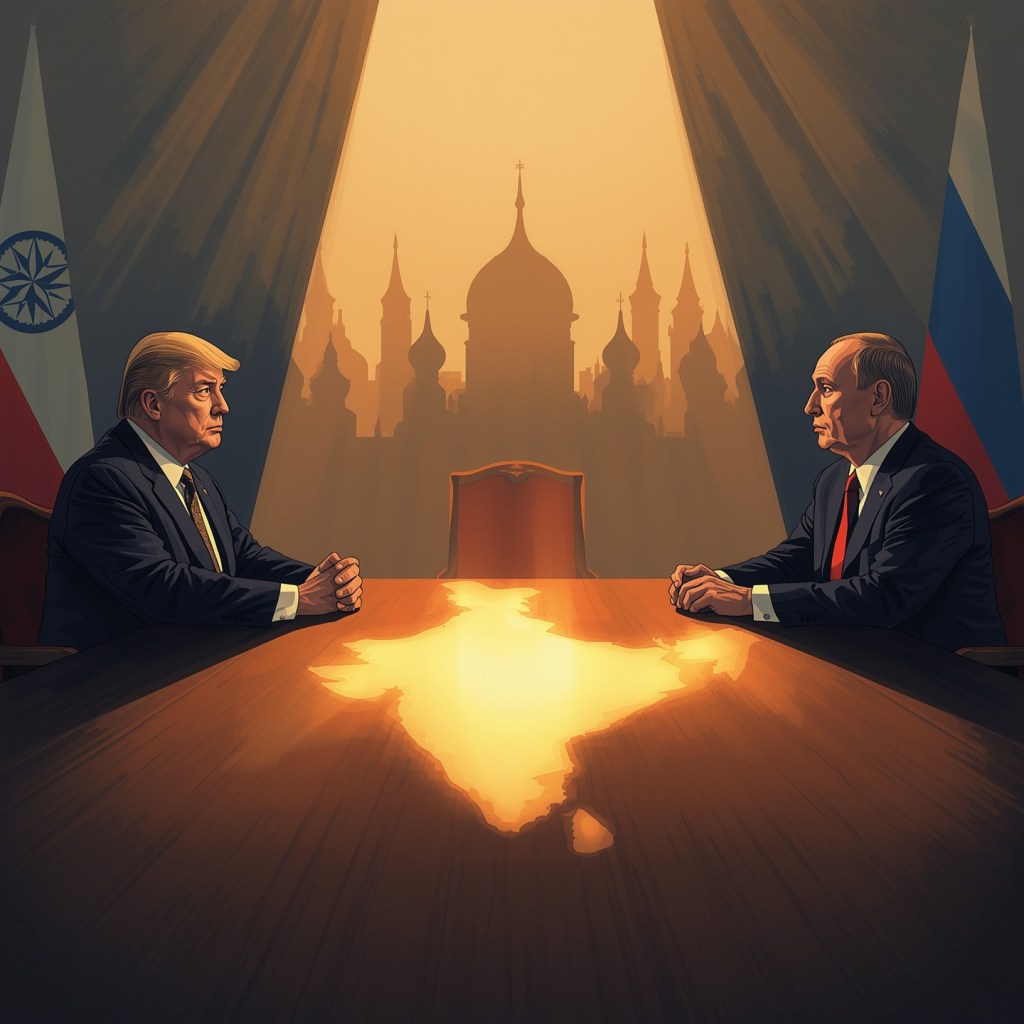
    In the theater of global politics, Donald Trump’s method is disarmingly simple: create leverage, amplify it for media consumption, and then abandon it once the spotlight shifts. It is a style that may win headlines, but it rarely produces sustainable results.

    The Leverage-Dump Cycle

    Trump’s foreign policy, if it can be called that, revolves around momentary victories that fuel his domestic narrative. He brands himself as the master negotiator, but his “art of the deal” is often little more than tactical theater.

    • First, he identifies a pressure point – be it sanctions, tariffs, or rhetorical threats.
    • Then, he proclaims that his leverage is forcing change.
    • Finally, once the immediate headlines are secured, he abandons the issue or flips sides, leaving allies and adversaries confused and often alienated.

    The problem is that leverage only works if it is backed by consistent strategy. Trump’s version is self-referential: he creates leverage in his own mind, celebrates it, and then discards it. In the short run, it excites his political base and dominates media cycles. In the long run, it erodes trust, weakens alliances, and strengthens adversaries.

    India: Not a Pawn in Trump’s Game

    Trump’s latest attempt to pull India into his narrative is a classic example. By claiming that he had “sanctioned” India to pressure Russia, he sought to project himself as a global power broker. The reality? India’s oil trade with Russia has doubled, not diminished.

    New Delhi is not a pliable pawn in Trump’s improvisational chessboard. India’s foreign policy under Prime Minister Narendra Modi is defined by strategic autonomy. Whether it is purchasing Russian oil, strengthening ties with the United States, or engaging Europe and Africa, India pursues a multi-vector approach. It will not sacrifice its national interest to fuel an American politician’s election narrative.

    This reality has eluded Trump. For him, India is often reduced to a talking point – a convenient prop in his domestic political theater. For India, however, Trump is one of many players in a world where multipolarity is the new normal.

    Russia: The Patient Player

    If Trump’s game is short-term theater, Vladimir Putin’s is long-term chess. While Trump performs for the cameras, Putin builds narratives grounded in history and sustained by military and economic realities.

    In his meetings, Putin often subjects interlocutors to history lessons stretching back decades. Trump, famously allergic to detail, cannot sit through such sessions without distraction. The asymmetry is obvious: one plays to CNN and Fox News soundbites, the other plays to centuries of Russian statecraft.

    During recent encounters, Putin allowed Trump his moments of triumph. He even threw him a “lollipop” by suggesting that had Trump been president, the Ukraine war might not have happened. It cost Putin nothing to say it, but it gave Trump a headline. Meanwhile, Russia’s fundamental objectives remain unchanged: Ukraine will not join NATO, and Moscow will not cede the territories it controls.

    The Media Mirage

    Trump’s approach resonates with his political base – the MAGA faithful who see him as a champion against elites. For them, the illusion is enough. But outside America, the cracks are visible. The American media, both left and right, has lambasted his foreign policy blunders. Analysts have called his maneuvers “the greatest foreign policy mistake” and “the undoing of decades of bipartisan effort.”

    The world is not fooled. India sees through the noise, continuing to expand trade with Russia. Putin indulges Trump’s theatrics, but on his own terms. Europe remains skeptical. Even America’s traditional allies worry that another Trump presidency would mean volatility rather than strategy.

    The Bottom Line

    Donald Trump is not playing a grand game of geopolitics. He is playing a grand game of media – one where perception outweighs policy, and short-term drama eclipses long-term stability.

    India and Russia, in their own ways, have adapted. India ignores the noise and quietly pursues its national interest. Russia humors Trump, using him when convenient, but remains anchored in its strategic objectives.

    The world must understand: Trump’s greatest victories are not on the battlefield of diplomacy but in the arena of headlines. For allies and adversaries alike, the challenge is the same – to distinguish between the spectacle of leverage and the reality of strategy.

  • India at the Crossroads of Global Power: Lessons from the Trump–Putin Dialogue

    The recent meeting between former U.S. President Donald Trump and Russian President Vladimir Putin drew the world’s attention, not because it resolved the Ukraine conflict, but because of the larger signals it sent to the global community — including India.

    A Meeting Without a Breakthrough

    Despite the hype, the Trump–Putin encounter ended without any ceasefire or binding agreement. Both leaders described the discussion as “positive,” acknowledging that fundamental concerns were placed on the table. Putin reiterated Russia’s long-standing demands: recognition of Crimea, autonomy for Russian-speaking regions of Ukraine, and a guarantee that NATO will not expand into Ukraine. Trump, on his part, promised to consult NATO allies and Ukraine’s leadership before moving forward.

    While Western commentators stopped short of calling it Trump’s defeat, many conceded that Putin emerged relatively stronger. Trump’s earlier claim that he could end the war “in one day” now appears hollow after months of stalemate.

    India’s Name in the Room

    Interestingly, even though India was not directly present at the talks, it became a focal point. Trump had earlier imposed a 25% penalty tariff on Indian goods, arguing that this economic pressure would push Moscow to the negotiation table. Yet, the measure has done little to alter Russia’s stance.

    For India, however, the linkage is important. If the penalty tariff is lifted, Indian exporters believe they can absorb the standard trade duties and remain competitive in the U.S. market. American importers of Indian goods have expressed similar confidence. Thus, India’s economic resilience is indirectly shaping the diplomatic calculus.

    A Validation of India’s Position

    Prime Minister Narendra Modi has consistently emphasized that dialogue is the only sustainable path to peace. The Trump–Putin interaction, though inconclusive, demonstrates that even hardened adversaries ultimately return to the negotiating table. This underscores the credibility of India’s long-standing call for diplomacy over confrontation.

    Moreover, India’s role is not limited to economics. Zelensky has already reached out to Modi, expressing concerns that Ukraine’s fate might be decided without Kyiv’s participation — echoing fears of being sidelined, much like smaller nations during the Yalta Conference of 1945. With an invitation to meet Modi during the upcoming UN General Assembly session, India is seen as a possible bridge between conflicting powers.

    A Shifting Strategic Landscape

    Even as trade disputes simmer, defense ties between India and the U.S. are deepening. The ongoing joint military exercises in Alaska highlight India’s pragmatic balancing of relationships with both Washington and Moscow. At the same time, Trump’s tariff policy is unpopular at home, with falling approval ratings and internal dissent within his administration.

    This juxtaposition of economic pressure, military cooperation, and diplomatic maneuvering illustrates the complexity of today’s multipolar order — and India’s increasingly central place within it.

    Conclusion: India’s Moment of Responsibility

    The Trump–Putin talks may not have yielded a ceasefire, but they remind the world that the global order cannot bypass India. Whether through economic resilience, diplomatic credibility, or strategic partnerships, India today occupies a pivotal role in shaping outcomes that extend far beyond South Asia.

    As the UN General Assembly approaches, the question is no longer whether India will be part of the conversation — it is how India chooses to shape it.