Introduction
On May 7, 2025, India launched Operation Sindoor in response to the brutal Pahalgam terror attack. This precision military strike not only eliminated terrorist infrastructure deep inside Pakistan and PoK but also laid bare the glaring vulnerabilities in Pakistan’s Chinese-built air defense systems. At the same time, India’s indigenous and hybrid air defense architecture achieved a historic 100% interception rate, marking a new era of strategic self-reliance.
The Operation Unfolds
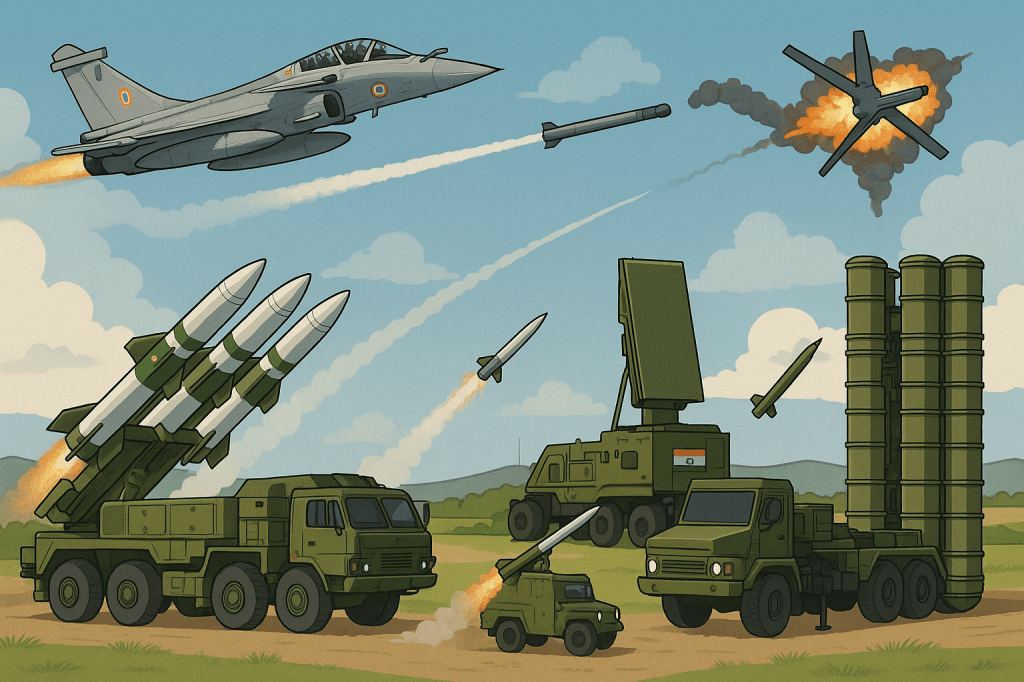
Indian Rafale jets, equipped with SCALP missiles and Hammer bombs, struck nine terrorist targets 500 km inside enemy territory with total stealth. Accompanying SkyStriker drones and Harop loitering munitions, co-developed with Israel, carried out deep strikes, overwhelming Pakistan’s Comprehensive Layered Integrated Air Defence (CLIAD) network—powered by HQ-9BE, FD-2000, and LY-80 (HQ-16) systems from China.
Pakistan’s Air Defense Collapse
Despite years of investment in Chinese systems, Pakistan’s defenses failed to detect or intercept a single Indian projectile. The ineffectiveness of the HQ-9BE and LY-80 was stark, especially as Pakistan attempted a retaliatory barrage of over 56 drones and missiles. Not one succeeded in penetrating Indian defenses.
India’s Air Defense Masterclass
The Indian response, featuring DRDO-developed Akash, QRSAM, VSHORADS, and the Akashteer command system, supported by Russian S-400s, neutralized all incoming threats. The seamless coordination between layers demonstrated the power of Indian engineering and doctrine. Notably:
- Akash and QRSAM countered drones and subsonic missiles.
- VSHORADS took down low-flying kamikaze drones.
- Akashteer provided 360-degree integration and real-time command.
- S-400 covered long-range missile threats with 400 km interception capability.
Global Reactions and Strategic Significance
Defense analysts and foreign governments, including the U.S. and Japan, hailed the operation. Pakistan’s claims of shooting down Indian aircraft were widely discredited. “Brand India” emerged as a credible counter to Chinese defense exports, signaling a shift in geopolitical trust.
Conclusion
Operation Sindoor wasn’t just a tactical success—it was a strategic masterstroke. India’s indigenous systems not only defended its territory flawlessly but also exposed the hollowness of China’s military exports, altering the defense narrative across Asia and Africa.


 Unmukt
Leave a reply to Unmukt_GP Cancel reply