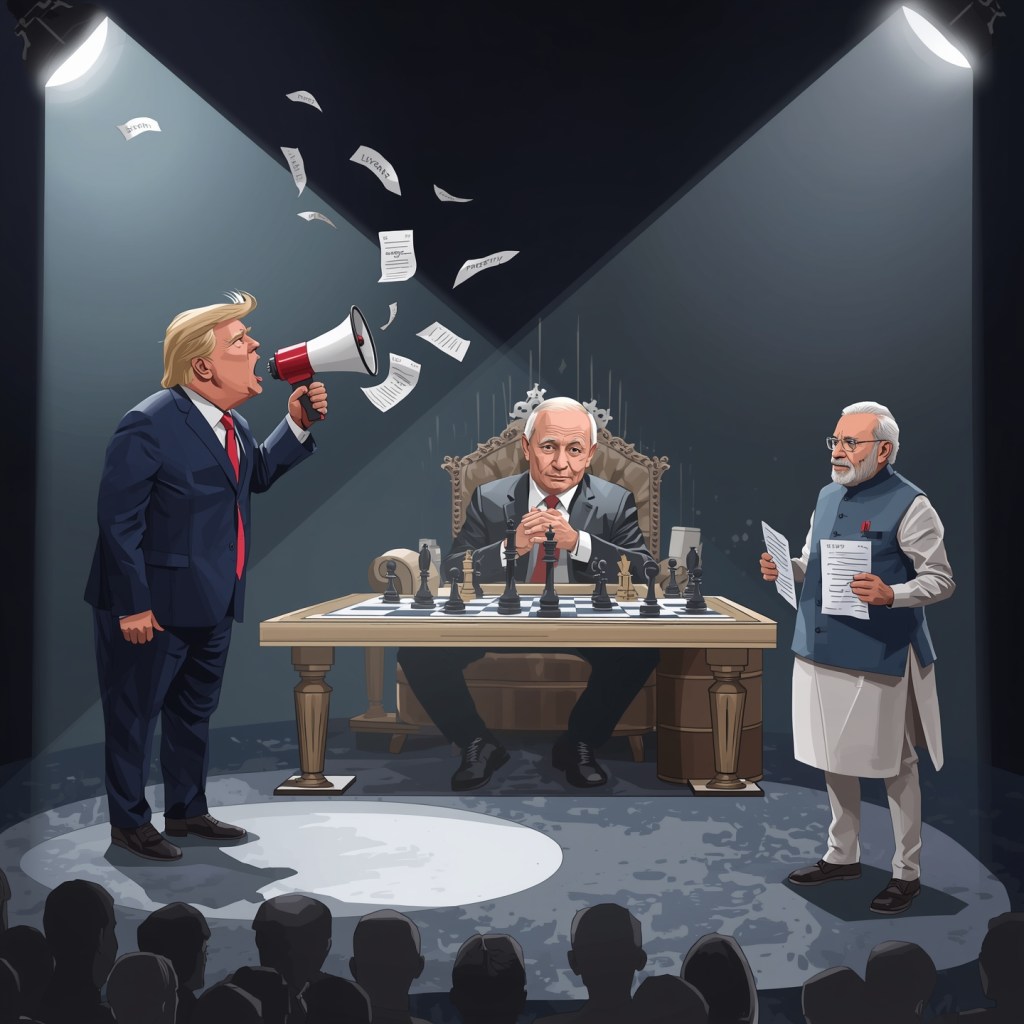
In the theater of global politics, Donald Trump’s method is disarmingly simple: create leverage, amplify it for media consumption, and then abandon it once the spotlight shifts. It is a style that may win headlines, but it rarely produces sustainable results.
The Leverage-Dump Cycle
Trump’s foreign policy, if it can be called that, revolves around momentary victories that fuel his domestic narrative. He brands himself as the master negotiator, but his “art of the deal” is often little more than tactical theater.
- First, he identifies a pressure point – be it sanctions, tariffs, or rhetorical threats.
- Then, he proclaims that his leverage is forcing change.
- Finally, once the immediate headlines are secured, he abandons the issue or flips sides, leaving allies and adversaries confused and often alienated.
The problem is that leverage only works if it is backed by consistent strategy. Trump’s version is self-referential: he creates leverage in his own mind, celebrates it, and then discards it. In the short run, it excites his political base and dominates media cycles. In the long run, it erodes trust, weakens alliances, and strengthens adversaries.
India: Not a Pawn in Trump’s Game
Trump’s latest attempt to pull India into his narrative is a classic example. By claiming that he had “sanctioned” India to pressure Russia, he sought to project himself as a global power broker. The reality? India’s oil trade with Russia has doubled, not diminished.
New Delhi is not a pliable pawn in Trump’s improvisational chessboard. India’s foreign policy under Prime Minister Narendra Modi is defined by strategic autonomy. Whether it is purchasing Russian oil, strengthening ties with the United States, or engaging Europe and Africa, India pursues a multi-vector approach. It will not sacrifice its national interest to fuel an American politician’s election narrative.
This reality has eluded Trump. For him, India is often reduced to a talking point – a convenient prop in his domestic political theater. For India, however, Trump is one of many players in a world where multipolarity is the new normal.
Russia: The Patient Player
If Trump’s game is short-term theater, Vladimir Putin’s is long-term chess. While Trump performs for the cameras, Putin builds narratives grounded in history and sustained by military and economic realities.
In his meetings, Putin often subjects interlocutors to history lessons stretching back decades. Trump, famously allergic to detail, cannot sit through such sessions without distraction. The asymmetry is obvious: one plays to CNN and Fox News soundbites, the other plays to centuries of Russian statecraft.
During recent encounters, Putin allowed Trump his moments of triumph. He even threw him a “lollipop” by suggesting that had Trump been president, the Ukraine war might not have happened. It cost Putin nothing to say it, but it gave Trump a headline. Meanwhile, Russia’s fundamental objectives remain unchanged: Ukraine will not join NATO, and Moscow will not cede the territories it controls.
The Media Mirage
Trump’s approach resonates with his political base – the MAGA faithful who see him as a champion against elites. For them, the illusion is enough. But outside America, the cracks are visible. The American media, both left and right, has lambasted his foreign policy blunders. Analysts have called his maneuvers “the greatest foreign policy mistake” and “the undoing of decades of bipartisan effort.”
The world is not fooled. India sees through the noise, continuing to expand trade with Russia. Putin indulges Trump’s theatrics, but on his own terms. Europe remains skeptical. Even America’s traditional allies worry that another Trump presidency would mean volatility rather than strategy.
The Bottom Line
Donald Trump is not playing a grand game of geopolitics. He is playing a grand game of media – one where perception outweighs policy, and short-term drama eclipses long-term stability.
India and Russia, in their own ways, have adapted. India ignores the noise and quietly pursues its national interest. Russia humors Trump, using him when convenient, but remains anchored in its strategic objectives.
The world must understand: Trump’s greatest victories are not on the battlefield of diplomacy but in the arena of headlines. For allies and adversaries alike, the challenge is the same – to distinguish between the spectacle of leverage and the reality of strategy.


 Unmukt
Leave a reply to satyam rastogi Cancel reply